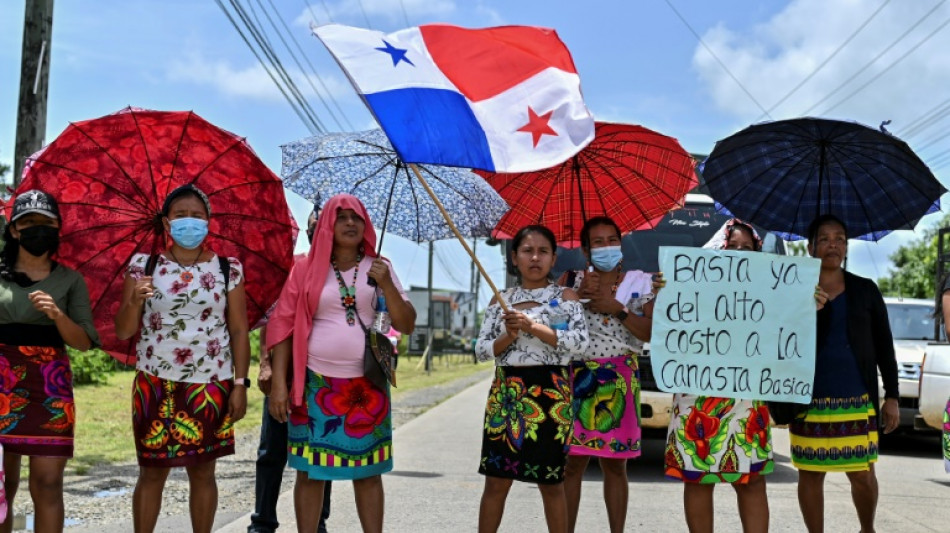
Food-laden trucks head for Panama City as road blockades persist / Photo: Luis ACOSTA - AFP

 Aryna Sabalenka Apologizes for Outburst During WTA Finals Loss

 Premiere Screenings of 'The 100th: Seeds of Aloha' Documentary Announced in California

 San Onofre Demolition Highlights California’s Nuclear Energy Void

 2026 Nickelodeon Kids' Choice Awards: Air Time, Channels, and Streaming Guide

 Kuwaitis Elected to Senior Leadership Roles at ALECSO

 BingX: Major Announcement of Far-Reaching Significance
A convoy of some 200 food-laden trucks headed for Panama's capital on Wednesday with a police escort as protesters maintained crippling roadblocks in a standoff with the government over the soaring cost of living.
A fresh round of negotiations announced Tuesday after some demonstrators rejected an earlier deal have yet to begin as trade unions and other civic groups consider their joint position.
The caravan left from Chiriqui in Panama's food-growing west on Wednesday for the 500-kilometer (310-mile) journey to Panama City, with hundreds of tons of food.
The trucks were escorted by police and members of the Suntracs construction workers' union, one of the organizations taking part in the protests against rising fuel prices and living costs.
The demonstrations have triggered severe food and fuel shortages in some parts of the country.
Suntracs Chiriqui leader Jaime Caballero said it had been agreed to "allow a humanitarian caravan to move agricultural products to the capital."
He added: "Our just struggle is against the government and the neoliberal model and not against our people."
The protest that started some two weeks ago have seen trucks and burning barricades on the Pan-American Highway, which connects the country of 4.4 million people with the rest of Central America and is the main transport route for goods. Other roads were also blocked in the protest.
- Losses -
Alicia Jimenez, president of Panama's Federation of Chambers of Commerce, said losses due to the roadblocks were approaching $500 million.
On Tuesday, protesters clashed with police trying to clear the road of burning tire barricades near the city of Santiago de Veraguas.
Labor unions and community groups involved in the long-running protest were due to meet on Wednesday to agree on an agenda for new talks with the government, mediated by the Catholic Church.
On Sunday, the government and some protest leaders announced a deal to end the revolt.
The following day, there were fresh roadblocks and marches as some groups said they had been excluded and that the deal, while reducing fuel prices, failed to deal with pressing concerns over rising living costs and medicine prices.
The government had agreed to reduce the price of petrol to $3.25 per gallon after another cut announced last week -- to $3.95 from $5.20 per gallon in June -- was not enough to appease the demonstrators.
On Tuesday, the government said it was "committed" to dialogue with a view to "promoting social peace and the common good."
The protests come as Panama faces economic difficulties, with inflation of 4.2 percent recorded in May and an unemployment rate of about 10 percent.
Despite its dollarized economy and high growth figures, the country has a high rate of social inequality.
O.Gaspar--PC