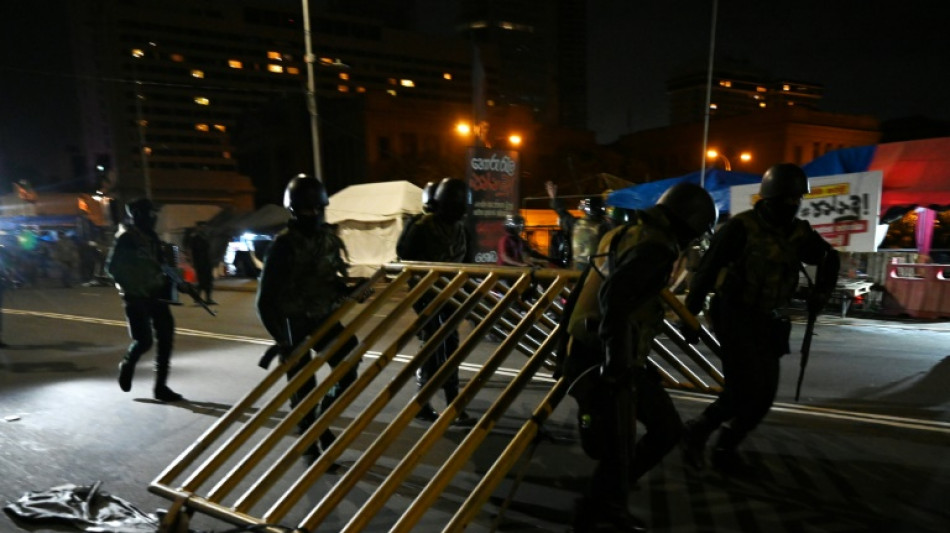
Security forces dismantle Sri Lanka's main protest camp / Photo: Arun SANKAR - AFP

 Aryna Sabalenka Apologizes for Outburst During WTA Finals Loss

 Premiere Screenings of 'The 100th: Seeds of Aloha' Documentary Announced in California

 San Onofre Demolition Highlights California’s Nuclear Energy Void
 2026 Nickelodeon Kids' Choice Awards: Air Time, Channels, and Streaming Guide
 Kuwaitis Elected to Senior Leadership Roles at ALECSO

 BingX: Major Announcement of Far-Reaching Significance
Sri Lankan security forces raided the main anti-government protest camp in the capital Colombo early Friday, dismantling it and evicting activists gathered outside the president's office.
The raid came a day after veteran politician Ranil Wickremesinghe -- who vowed tough action against demonstrators -- was sworn in as the crisis-hit country's new president, replacing Gotabaya Rajapaksa, whom protesters forced to step down.
Troops and police commandos armed with riot gear swooped in on the protesters blocking the Presidential Secretariat in the capital hours before they were due to vacate the area.
Hundreds of soldiers removed barricades set up by protesters blocking the main gate of the Presidential Secretariat, which demonstrators had partly overrun earlier this month. An armoured personnel carrier was also seen in the area.
Activists had announced they planned to hand over the building, a symbol of state authority, on Friday afternoon, after a cabinet was sworn in by Wickremesinghe.
The cabinet, which is expected to feature a cross-section of political parties, faces the difficult task of steering the country out of its worst economic crisis since gaining independence from Britain.
Witnesses saw soldiers surrounding the sea-front presidential office and removing temporary structures set up in the area to provide logistics for thousands of anti-government demonstrators since early April.
Security forces used loud hailers asking a few hundred protesters to pull back and confine themselves to a designated protest site near the secretariat.
Several activists were seized by troops who smashed tents set up along the main road leading to the presidential office.
Police cordoned off the main roads leading to the area to prevent more people from joining the protesters.
- Warning to demonstrators -
Supporters of the #GoHomeGota campaign pressing Rajapaksa to step down had taken over the area after capturing his palace on July 9, forcing him to flee and eventually resign.
After Rajapaksa stepped down, six-time prime minister Wickremesinghe took over the leadership temporarily, until he was confirmed as the new president in a parliamentary vote on Wednesday.
Wickremesinghe had warned protesters that occupying state buildings was illegal and that they would be evicted unless they left on their own.
"If you try to topple the government, occupy the president's office and the prime minister's office, that is not democracy, it is against the law," he said, making a distinction between peaceful protesters and "troublemakers" engaging in unlawful behaviour.
The new president has also declared a state of emergency that gives sweeping powers to armed forces and the police to arrest and detain suspects for long periods without being charged.
On Wednesday, a court ordered the protesters to vacate a part of their camp and confine themselves only to a designated area.
Protesters have accused Wickremesinghe of being a proxy of the former president's powerful family -- a charge he has denied.
"I am not a friend of the Rajapaksas," he told reporters at the Gangaramaya temple. "I am a friend of the people."
A foreign exchange crisis triggered by the coronavirus pandemic and exacerbated by mismanagement has left Sri Lanka suffering lengthy power blackouts and record-high inflation.
The country's 22 million people have also endured months of food, fuel and medicine shortages.
P.L.Madureira--PC