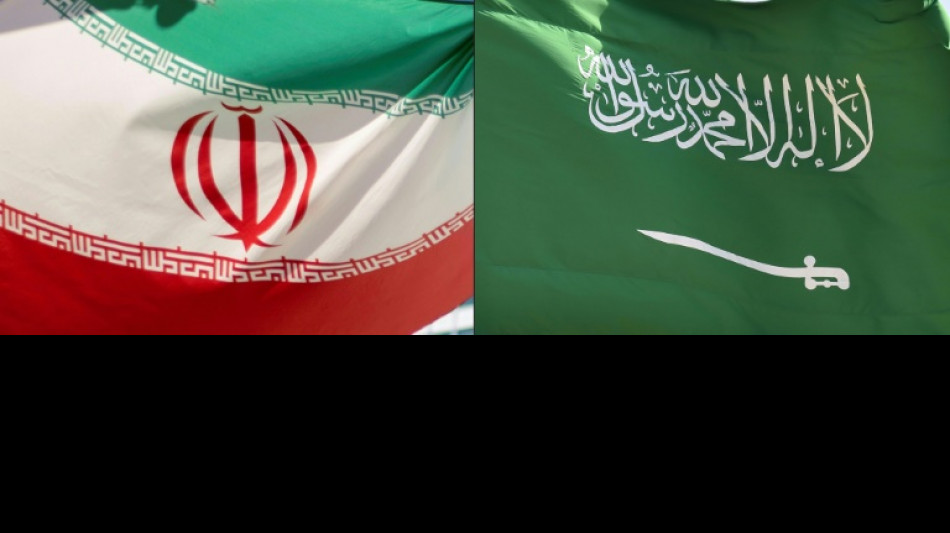
Iran says Saudi ready to move reconciliation talks to higher level / Photo: JOE KLAMAR, OZAN KOSE - AFP/File

 Aryna Sabalenka Apologizes for Outburst During WTA Finals Loss

 Premiere Screenings of 'The 100th: Seeds of Aloha' Documentary Announced in California

 San Onofre Demolition Highlights California’s Nuclear Energy Void
 2026 Nickelodeon Kids' Choice Awards: Air Time, Channels, and Streaming Guide

 Kuwaitis Elected to Senior Leadership Roles at ALECSO

 BingX: Major Announcement of Far-Reaching Significance

Iran and Saudi Arabia are ready to move reconciliation talks to a higher level, more than a year after they began and six years after the two rivals severed relations, Iran's foreign minister says.
Since April last year Iraq has hosted five rounds of talks between Sunni Muslim Saudi Arabia and Shiite-majority Iran, which support opposing sides in various conflicts around the region.
"Progress has been made in these negotiations," Foreign Minister Hossein Amir-Abdollahian said in an interview with Iran's state broadcaster on Thursday night.
He added that last week Iran had received a message from Iraqi Foreign Minister Fuad Hussein who said "the Saudi side is ready to move the talks to the political and public level."
Iran's top diplomat noted that previous rounds had mainly been at the level of security officials.
"We announced our readiness for the talks to enter the political stage," he said.
In 2016, Iranian protesters attacked Saudi diplomatic missions in Iran after the kingdom executed Shiite cleric Nimr al-Nimr. Riyadh responded by cutting ties with Tehran.
Amir-Abdollahian said he hoped that the negotiations with Riyadh would lead to "normal diplomatic ties between Saudi Arabia and the Islamic Republic of Iran."
Officials in Tehran have previously said that holding talks on a political level could yield better and faster results.
After the last round of negotiations in April, Iraqi Prime Minister Mustafa al-Kadhemi said he believed that "reconciliation is near" between Riyadh and Tehran, a further reflection of shifting political alignments across the region.
Following the severance of ties between Iran and Saudi Arabia, Abu Dhabi downgraded diplomatic relations with Tehran and Kuwait recalled its ambassador.
Last week the United Arab Emirates said it was "considering" appointing an ambassador in Tehran.
Amir-Abdollahian described the Emirates' move more definitively, saying "the UAE has decided to send an ambassador to Tehran" and that will happen "soon."
Amir-Abdollahian also said a similar measure is being taken by Kuwait.
"Kuwait has introduced its ambassador and we have also announced our agreement. The new ambassador of Kuwait will arrive in Tehran within the next few days," he said.
G.Teles--PC