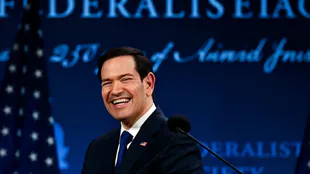
Trump signs spending bill ending US government shutdown / Photo: SAUL LOEB - AFP

 RBI Grants Paytm In-Principle Approval to Revive Wallet Business

 China's Factory Activity Contracts as Export Orders Weaken

 US Retail Sales and Fed Minutes Set Up a Critical Test for Consumers

 MotorTrend’s Top Hybrid Vehicle Picks for 2026

 Asian Markets Slide as AI Concerns Hit Chip Stocks

 Brazil Faces Debt and Inflation Test as Lula Prepares Fourth Term
 Canada Expands Asian Trade Push as US Negotiations Resume

 Jennie Earns Two Grammy Nominations as Major K-pop Agencies Boycott New Asian Pop Category
 Italy Raises 2026 Growth View but Warns Energy Will Keep Inflation High

 UK Economy Grows 0.7% in Third Quarter as Services Lead Expansion

 India's Retail Inflation Reaches 6.09% as Food Prices Accelerate

 China's October Activity Data Reveal a Weak Start to the Fourth Quarter

President Donald Trump signed a spending bill on Tuesday ending the four-day partial government shutdown sparked by Democratic opposition to funding for the federal agency carrying out his sweeping immigration crackdown.
The legislation landed on Trump's desk at the White House after it was passed by a narrow 217-214 margin in the Republican-controlled House earlier in the day.
Twenty-one Democrats joined Republicans in voting for the funding package and an equal number of Republicans opposed it rather than meet Democratic demands to reform the Department of Homeland Security (DHS).
Negotiations for new money for DHS broke down following the killing of two US citizens by federal agents in Minneapolis, the Minnesota city which has become the flashpoint for the Republican president's immigration crackdown.
On Friday, the Senate passed a package clearing five outstanding funding bills to cover most federal agencies through September, along with a two-week stopgap measure to keep DHS operating while lawmakers negotiate immigration enforcement policy.
Trump, who presided over a record 43-day government shutdown last summer, had been pressuring Republicans to adopt the spending bill and end the closure which began on Saturday.
"This bill is a great victory for the American people," he said at the White House signing ceremony.
"Instead of a bloated and wasteful omnibus monstrosity full of special interest handouts, we've succeeded in passing a fiscally responsible package that actually cuts wasteful federal spending while supporting critical programs for the safety, security and prosperity of the American people," he added.
- Body cameras -
Democrats in the House had demanded changes to the way DHS conducts its immigration sweeps -- with heavily armed, masked and unidentified agents who have detained people without warrants -- before voting on the spending package.
Some concessions have already been made amid Democratic pressure and national outcry after agents shot and killed Renee Good, a mother of three, and Alex Pretti, a nurse who worked with military veterans, in Minneapolis last month.
On Monday, DHS Secretary Kristi Noem said federal agents in the city would wear body cameras "effective immediately" in a move that would be later "expanded nationwide."
Lawmakers now have just two weeks to negotiate a full-year DHS funding bill.
Both parties acknowledge the talks will be politically fraught as Democrats demand new guardrails on immigration enforcement and conservatives push their own policy priorities.
Shutdowns temporarily freeze funding for non-essential federal operations, forcing agencies to halt services, place workers on unpaid leave or require them to work without pay.
Nogueira--PC