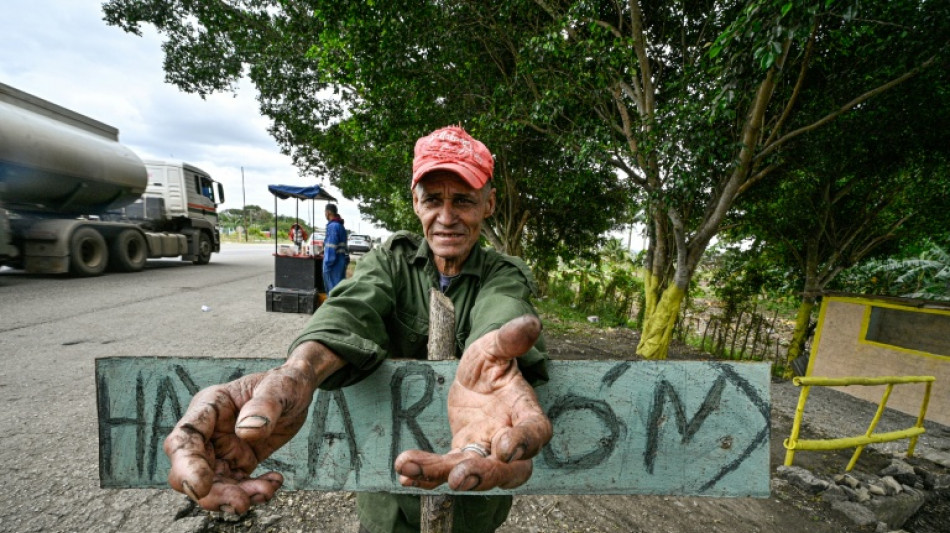
Charcoal or solar panels? A tale of two Cubas / Photo: ADALBERTO ROQUE - AFP

 New Zealanders pick endangered black robin as Bird of the Year

 Asia stocks rise on AI, US-China trade talks optimism
 Malaysia's 'elephant whisperer' fights to save Borneo's endangered giants
 'I live in fear': 1.5 million Pakistani children sexually exploited online

 Cowboys beat Commanders, Vikings down Bears as star QBs injured
 Braves clinch division title as Red Sox reach MLB playoffs
 Bordeaux-Begles hammer Stade Francais despite Jalibert injury

 Milan and Juventus end blips with home wins
 Bridgeman wins PGA Biltmore title with sizzling 61

 Williams injured as Bears shut down by Vikings

 US warns of rapid escalation in Middle East war

 Germany's far-right AfD celebrates another state election win
 Russia vows revenge for election-day attacks as poll shows ruling party win

 Spaun late shows snatches PGA Championship win

 Conceicao strikes as Juventus beat Atalanta
 Britain, Zverev-inspired Germany, Spain complete Davis Cup finals

 Man Utd salvage Fulham draw as pressure mounts on Carrick

 Spanish civil war drama 'The Black Ball' wins at Toronto festival

 Germany's Merz shaken by far-right and far-left gains in state votes

 Macron welcomes Canada's Carney to French Atlantic territory

 Fiorentina frustrate Napoli with Serie A draw, Como upset

 Five-star Man City top Premier League after Sunderland thriller
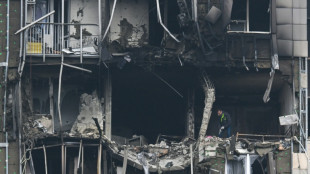 Ukrainian drones hit Moscow on last day of Russian elections
 Multi-Asset Trading Venue Monochrome Exchange Announces IEO of Its Native Token, $MCR
 South Korea break Japan hearts to win Asian Games basketball gold
The US oil siege, which has worsened an already severe energy crisis, has created two classes of Cubans: those who use generators or solar panels to power their ovens, and those who have resorted to cooking over open fires.
On the side of a highway on the outskirts of Havana, vendors sell bags of charcoal and makeshift braziers, some fashioned from old washing machine drums.
"Everyone knows what's coming. We don't have fuel in the country; we have to find alternatives," Niurbis Lamothe, a 53-year-old state employee, told AFP after buying a homemade stove.
"The shoe just got tighter than it already was," commented another shopper who declined to give her name as she sized up a a bag of charcoal costing 2,600 pesos (US$5.25), roughly half the average monthly salary.
The woman, who has a young child, explained that her salary could not stretch to solar panels or a lithium battery to keep the lights on during power cuts of up to 12 hours a day.
"This is the most affordable way" to cook, she said as she loaded a sack of charcoal onto her electric motorcycle -- the vehicle of choice for many Cubans given severe fuel shortages, which they charge when they have power.
Yurisnel Agosto, the 36-year-old charcoal merchant, confirmed that he "has never sold so much" of the fossil fuel.
Before, his customers were primarily pizzerias or grilled-meat restaurants, who cook over coals; now they are families.
"People come and buy three sacks to be prepared for when there's no electricity," said Agosto, his hands blackened from filling, stacking, and arranging the sacks on the side of the road.
For most Cubans, even charcoal is a luxury, and wood the staple fuel source.
- 'Desperate' -
Cuba, which has been under a US trade embargo for over 60 years, was already struggling through its worst crisis in decades when President Donald Trump took steps to cut off its entire oil supply.
The government has announced drastic measures to ration whatever fuel is left, including preventing airlines refueling on the island.
For some Cubans the crisis has triggered memories of the rationing of the "Special Period," the severe economic crisis that followed the fall of the Soviet Union in 1991, at the time Cuba's main oil supplier.
Thirty-five years later the writing was on the wall when US special forces overthrew Nicolas Maduro, the socialist president of Cuba's closest ally, Venezuela.
Washington immediately halted Venezuela's oil shipments to US arch-foe Cuba and threatened tariff hikes on any other countries supplying the island with crude.
For wealthier Cubans, solar panels are the salvation.
The number of solar panel installation companies has multiplied since 2024, when the Cuban government relaxed restrictions on importing the mostly Chinese-made devices.
"People are desperate to find a solution," Reinier Hernandez, one business owner, told AFP.
Since mid-January, he has barely slept as he fields a flurry of orders, prepares quotes, and organizes the work schedule of his 20-or-so employees.
"Sometimes I get home at one in the morning," Orley Estrada, one of his installers, confided.
In the Guanabacoa neighborhood, in eastern Havana, workers are busy installing 12 solar panels on the roof of a nursing home run by the Catholic Church that doubles as a soup kitchen.
The Dominican nuns who run the kitchen prepare food for about 80 elderly or destitute people -- growing numbers of Cubans are forced to rummage through garbage bins for food -- each day.
Sister Gertrudis Abreu fundraised to amass the $7,000 needed for the panels.
"Without electricity, we had no other option," she explained to AFP.
But with the smallest solar package from Hernandez's company costing $2,000, most Cubans have yet to see the light at the end of the tunnel.
L.Mesquita--PC