
Bangladesh to vote on democratic reform charter / Photo: Munir UZ ZAMAN - AFP

 RBI Grants Paytm In-Principle Approval to Revive Wallet Business

 China's Factory Activity Contracts as Export Orders Weaken

 US Retail Sales and Fed Minutes Set Up a Critical Test for Consumers

 MotorTrend’s Top Hybrid Vehicle Picks for 2026

 Asian Markets Slide as AI Concerns Hit Chip Stocks

 Brazil Faces Debt and Inflation Test as Lula Prepares Fourth Term

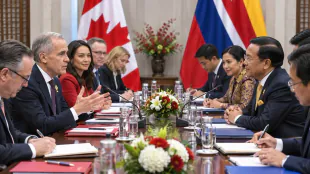 Canada Expands Asian Trade Push as US Negotiations Resume

 Jennie Earns Two Grammy Nominations as Major K-pop Agencies Boycott New Asian Pop Category

 Italy Raises 2026 Growth View but Warns Energy Will Keep Inflation High
 UK Economy Grows 0.7% in Third Quarter as Services Lead Expansion

 India's Retail Inflation Reaches 6.09% as Food Prices Accelerate

 China's October Activity Data Reveal a Weak Start to the Fourth Quarter

 Critics Demand Stronger Action from Jeffries and Schumer Following Democratic Wave

 Grand Theft Auto VI: Inside the Decade-Long Development of a Billion-Dollar Cultural Phenomenon
Bangladesh votes on Thursday in the first parliamentary elections since a 2024 uprising ended Sheikh Hasina's 15-year iron-fisted rule -- and also holds a landmark referendum for sweeping democratic reforms.
The interim government led by Muhammad Yunus, the 85‑year‑old Nobel Peace Prize winner, says the reform charter is designed to prevent a return to autocratic one-party rule.
The lengthy document, known as the "July Charter" after the uprising that toppled Hasina, proposes term limits for prime ministers, the creation of an upper house of parliament, stronger presidential powers, and greater judicial independence.
- What are the reforms? -
Voters will be asked whether they approve the charter, which lays out wide‑ranging constitutional, electoral, and institutional reforms.
These include expanding parliament into a bicameral system, with a new 100‑seat upper house allocated according to each party's share of the national vote.
It also includes increased representation of women in parliament, and the election of the deputy speaker and parliamentary committee chairs from the opposition.
Along with the polls, the International Foundation for Electoral Systems (IFES) calls it a "critical juncture for Bangladesh's democratic and constitutional order".
- Who supports it? -
Yunus, who will step down after the vote, has promoted the charter as the defining legacy of his caretaker administration.
"If you cast the 'yes' vote, the door to building the new Bangladesh will open," Yunus said in backing the reforms.
Hasina's former ruling Awami League has been barred from taking part.
A "yes" vote is backed by the key frontrunners, the Bangladesh Nationalist Party (BNP), and its rival, the Jamaat-e-Islami led coalition.
That includes the National Citizen Party (NCP), formed by student leaders who spearheaded the uprising.
But many parties have also submitted notes of dissent over elements of the charter.
- Will it be approved? -
With key parties calling for a yes vote, many believe it will pass.
But many ordinary voters say they are confused by the complexity of the proposals.
"Knowledge gaps are huge", Dhaka's IID policy research centre warned on Tuesday, saying just over a third of people it had surveyed - 37 percent -- know what the charter includes.
Among those without formal eduction, that drops to eight percent.
The IID said the results suggested "closed-door reform bargaining" was prioritised "over public engagement at the scale required for an informed, inclusive referendum."
The referendum, passed by a simple majority, notes that if approved, it will be "binding on the parties that win" the election.
But it would still need to be ratified by the new parliament.
A.Magalhes--PC

