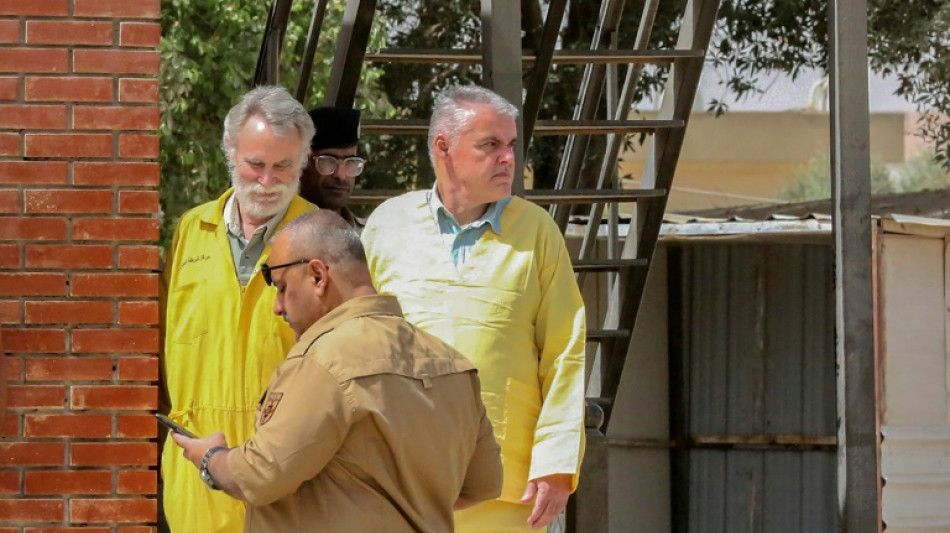
Iraq to free Briton jailed in antiquities case: lawyer / Photo: Sabah ARAR - AFP/File

 Aryna Sabalenka Apologizes for Outburst During WTA Finals Loss

 Premiere Screenings of 'The 100th: Seeds of Aloha' Documentary Announced in California

 San Onofre Demolition Highlights California’s Nuclear Energy Void
 2026 Nickelodeon Kids' Choice Awards: Air Time, Channels, and Streaming Guide

 Kuwaitis Elected to Senior Leadership Roles at ALECSO

 BingX: Major Announcement of Far-Reaching Significance

An Iraqi court has overturned the conviction and 15-year sentence handed to a British pensioner last month for antiquities smuggling, the retiree's lawyer said Tuesday.
James Fitton had been charged under a 2002 law against "intentionally taking or trying to take out of Iraq an antiquity," the maximum penalty for which under the country's legal code is death by hanging.
The conviction has been "overturned today by the Court of Cassation and my client will soon be free", lawyer Thaer Saoud told AFP.
The retiree's son-in-law, Sam Tasker, told AFP in a phone call that the family was "very pleased by the decision, but we are still waiting for his release."
Fitton stood trial alongside German national Volker Waldmann, who was acquitted. Both men had pleaded not guilty.
Fitton's lawyer launched the appeal just over a month ago.
According to statements from customs officers and witnesses, Fitton's baggage contained about a dozen stone fragments, pieces of pottery or ceramics.
When the judge in the original trial asked Fitton why he tried to take the artefacts out of Iraq, the retired geologist cited his "hobby" and said he did not mean to do anything illegal.
"I didn't realise that taking them was against the law," Fitton had said, adding that some of the ancient sites were open and unguarded.
But the judge in the original trial concluded there was criminal intent and sentenced Fitton to 15 years, rather than death, because of his "advanced age".
On his Facebook page on Tuesday, Fitton's lawyer published the judgement that had been handed down by the Court of Cassation, overturning the original verdict.
It said that the charge against Fitton had been cancelled, and that he would be freed for lack of evidence.
The court also ruled that there had been no "criminal intent" on the Briton's part, Saoud said.
He added that his client would be released "in the next few days, as soon as the proceedings are completed".
The Fitton case comes at a time when the war-ravaged country, whose tourism infrastructure is almost non-existent, is tentatively opening to visitors.
Iraq -- home to the famed city of Babylon in ancient Mesopotamia -- is seeking to safeguard its archaeological heritage amid a rampant market for smuggled artifacts.
The authorities crack down severely on attempts to deal in antiquities illegally.
Much of the country's ancient cultural heritage has been looted for decades because of the many conflicts it has suffered, particularly after the US-led invasion of 2003 that ousted dictator Saddam Hussein.
The arrival of the Islamic State group in 2014 boosted the illegal sale of antiquities as the jihadists sought to bolster their coffers by smuggling out and selling ancient pieces.
M.Gameiro--PC