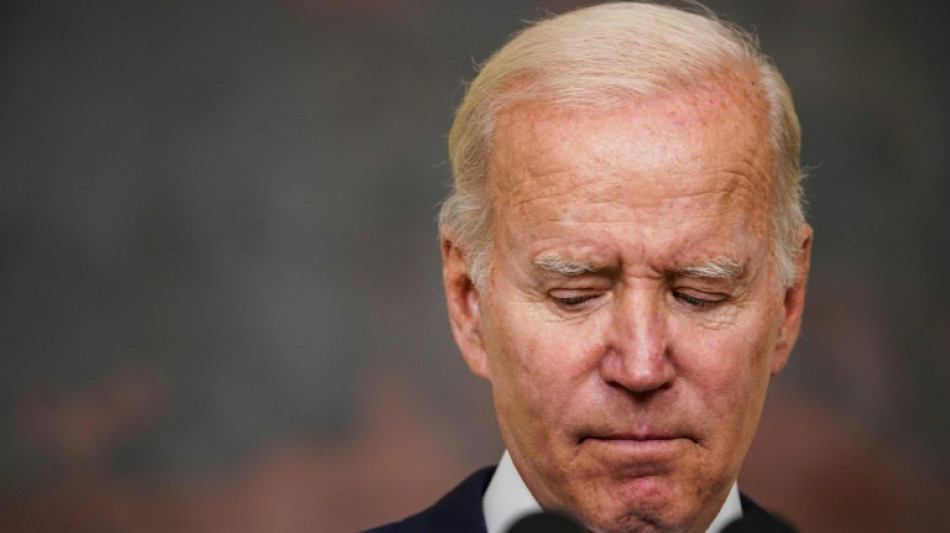
In US, the definition of 'recession' is moving target / Photo: MANDEL NGAN - AFP

 At last: Straight sets win over Tabilo puts Zverev in US Open last 16

 Jovic 'loses sanity five times over' to oust friend Eala in US Open epic

 China's memories of Mao fade to nostalgia 50 years after his death

 US envoys discuss with Putin 'substantive' plans for steps to end Ukraine war

 Zheng stuns Keys as US Open upsets dim American hopes

 Jovic 'loses sanity five times over' to oust Eala and book Gauff clash

 'Like a jewel': Japan's luxury ice revered by bars worldwide

 'The flood is coming': How a Nepal principal saved 900 students
 Kiss's winning run ends as Argentina hold Australia to draw

 Alcaraz excited to face 'dangerous' Paul for US Open quarter-final berth

 Prince William to represent King Charles III at Norway late King Harald's funeral
 Inter and Roma roar back to win thrillers and share top spot

 Don't stop them now: fans party for Freddie Mercury's 80th birthday

 AFP photographer wins top prize for Madagascar protest coverage

 Keys: 'I felt like I couldn't play tennis'
 Simmonds stars as Pau upset Montpellier

 Inter roar back in five-goal thriller with Napoli

 Haaland keeps Man City perfect in Premier League, blunt Spurs held
 Hamilton worried by Ferrari pace while Antonelli prepares for a fight
 Vuelta stage 15 shortened due to extreme heat, Mas consolidates lead

 Putin meets US envoys for Ukraine war talks
 Modric available for Croatia in Nations League
 Potapova upsets 2025 US Open runner-up Anisimova

 Gasly a 'class act' says Alpine boss after Monza pole
 Athletic Bilbao crush Simeone's flat Atletico

Now that the US economy has posted two consecutive quarters of negative growth, is it in recession? Opinions are starkly divided, and President Joe Biden is definitely in the No camp.
The "R" word is akin to profanity in some Washington circles these days, especially within the Biden administration.
Just defining exactly what a recession is and when it begins has sparked furious debate -- based as much around politics as economics.
"That doesn't sound like a recession to me," the US president said Thursday after the Commerce Department reported that GDP declined at an annual rate of 0.9 percent in the second quarter, following a bigger drop in the first three months of 2022.
While not the official definition, two quarters of negative growth is commonly viewed as a strong sign that a recession is underway -- but the veteran Democrat's government has been at pains for a week to explain why the term does not apply.
"How Do Economists Determine Whether the Economy is in a Recession?" the White House said in a blog post last week, apparently trying to get the jump on Thursday's data release.
"While some maintain that two consecutive quarters of falling real GDP constitute a recession, that is neither the official definition nor the way economists evaluate the state of the business cycle," the White House said.
Of course, opposition Republicans quickly picked up on the spin.
"Newsflash for Joe Biden: You can't change reality by arguing over definitions," the Republican National Committee said in a statement on Monday.
Then on Thursday, top House Republican Kevin McCarthy tweeted: "Democrats would rather redefine a recession than restore a healthy economy."
- 'One official arbiter' -
So beyond the political spin machine, what really is a recession?
In a note on its website, the International Monetary Fund insists there is "no official definition of recession."
"Most commentators and analysts use, as a practical definition of recession, two consecutive quarters of decline in a country's real (inflation-adjusted) gross domestic product (GDP)," the Washington-based global lender says.
For the IMF's chief economist Pierre-Olivier Gourinchas, "the general assessment as to whether the economy is in a recession overall is a little bit more complex."
Federal Reserve Chair Jerome Powell said Wednesday the Fed "doesn't make a judgment on that," but added: "What a recession really is -- it's a broad-based decline across many industries that is sustained for more than a couple months."
And then on Thursday, Treasury Secretary and former Fed chair Janet Yellen chimed in: "I think we should avoid a semantic battle."
David Wilcox, a senior economist at the Peterson Institute for International Economics and at Bloomberg Economics, says that considering an economy as entering recession after two consecutive quarters of negative GDP growth is simply "wrong."
"I kind of cringe and resist every time I see" that definition, Wilcox told AFP.
"There's one official arbiter of recession dating in the United States. And that's the National Bureau of Economic Research."
- Late to the party? -
The NBER, a private, independent and nonpartisan entity, was founded in 1920 to refine research on the US economy. Its "Business Cycle Dating Committee" uses several data points to determine when the economy is in expansion or recession.
"A recession is the period between a peak of economic activity and its subsequent trough, or lowest point," the NBER says on its website.
"The NBER's definition emphasizes that a recession involves a significant decline in economic activity that is spread across the economy and lasts more than a few months."
But because the bureau prefers to base its assessment on solid data and publish its opinion several months after the figures are released, it can seem a little late to the party.
Ellen Hughes-Cromwick, an economist at the Third Way, a center-left think tank, says that the NBER's traditional delay is "not a problem" but rather a "methodology" that allows the bureau to avoid repeated revisions.
"What is common knowledge among economists is that in that preliminary estimate (each quarter), they have less than 50 percent of actual statistics," she explains.
"In other words, 50 percent of that GDP preliminary estimate… are estimates," adds Hughes-Cromwick, who worked as an economist under presidents Ronald Reagan and Barack Obama.
Translation: the NBER is perhaps totally justified in taking its time.
A.F.Rosado--PC