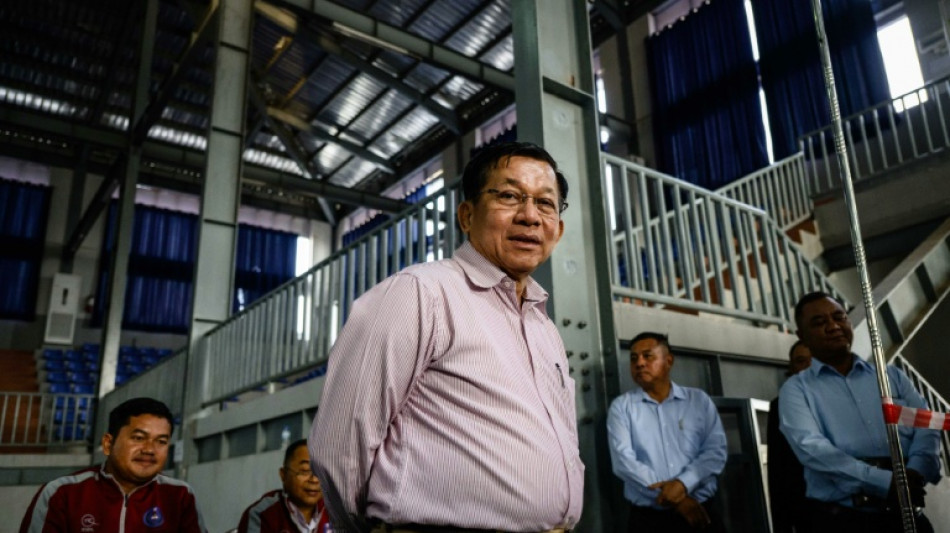
Myanmar junta chief elected as president / Photo: ANTHONY WALLACE - AFP/File

 Once a top export, prized Kashmir carpet fades
 Search for 1,000 missing after deadly Nepal-Tibet floods
 Park So-yeon first woman to play for eSports powerhouse South Korea
 Yayoi Kusama: Japan's kaleidoscopic, troubled 'polka dot queen'
 Euro champ Hunt 'on her toes' against world's best in Zurich 100m
 Asian chip firms lifted by Nvidia forecast but broader markets struggle
 Search for missing after Nepal-Tibet floods kill 165
 Qantas says profits slump as fuel costs surge
 Lofty bond yields, Bessent's intervention pose challenge to Fed's Warsh
 The foreigners missing in Nepal's flash floods
 Bond yields are surging: Here's why that could spell trouble
 Fed's Cook rejects Trump mortgage fraud claims
 Police probe 'assault allegations' after Carse's nightclub incident
 How we might hear new Dolly Parton music in the future
 Nvidia doubles revenue, forecasts even more AI spending
 Canada renews push to boycott US products
 Savio scores on debut as Spurs set-up League Cup tie with Liverpool
 Brazil sues Discord over child safety measures, demands $100 mln in damages
 Alberta NDP Urges Smith to Postpone Separation Vote Amid Trade War

 Fenerbahce stun Lyon in Champions League as AEK crush Levski

 Why Global Finance Still Relies on Wall Street Despite Diversification Trends
 Bethlehem Father Seeks Aid for Special Needs Children Amid Health Crisis
 LIV Golf to lay off majority of staff
 How narwhal 'scientists' track Arctic warming
 Iran says US sanctions will achieve nothing
Myanmar's parliament elected junta chief Min Aung Hlaing as president on Friday, parliament said, with the ex-military commander set to maintain his rule in a civilian guise after snatching power by force five years ago.
The coup-leading general -- who swept aside democracy in 2021, detaining elected figurehead Aung San Suu Kyi and dissolving her party -- was anointed by pro-military MPs installed in a recent election overseen by the junta he leads.
The vote on Friday across the upper and lower houses of parliament in the capital Naypyidaw saw Min Aung Hlaing secure a huge margin over the second-place candidate in a three-person race.
"We hereby announce Senior General Min Aung Hlaing as president," parliament speaker Aung Lin Dwe announced from a stage in the parliament meeting hall.
He received 429 votes of 584 cast by MPs, a parliament official said after ballot counting was finished.
While the junta touted parliament's reopening last month as a return of power to the people, analysts describe it as civilian window dressing intended to launder the military's continuing rule.
The pro-military Union Solidarity and Development Party (USDP) won more than 80 percent of parliamentary seats contested in the election which concluded in late January, while serving members of the armed forces occupy unelected seats making up a quarter of the total.
The massively popular Suu Kyi has been detained since the February 2021 coup, criticism or protest over the election was outlawed and voting was blocked in territories controlled by rebels which have risen up to challenge the military takeover in a grinding civil war.
With opposition factions still standing defiant after the poll, the conflict and ensuing humanitarian crisis show no sign of abating.
Tens of thousands have been killed on all sides since the coup.
- Civilian leader -
Min Aung Hlaing is due to take power as president this month, while his two competitors -- current Prime Minister Nyo Saw and Nan Ni Ni Aye, a regional MP from Karen state with the USDP party -- will serve under him as vice-presidents.
In a post-coup period of emergency rule, Min Aung Hlaing served as both commander-in-chief of the armed forces and acting president, but to become permanent president he is constitutionally compelled to relinquish his military post.
He handed over the reins of the military to loyalist and former spymaster Ye Win Oo on Monday.
Myanmar's military has ruled the country for most of its post-independence history and presents itself as the only force guarding the restive country from rupture and ruin.
The generals loosened their grip for a decade-long democratic interlude beginning in 2011, allowing Suu Kyi to ascend as civilian leader and steer a spurt of reform as the nation opened up from its hermetic history.
After the Nobel Peace Prize laureate's party trounced the pro-military USDP with a landslide victory in 2020 elections, Min Aung Hlaing snatched back power making allegations of massive voter fraud.
Analysts say the claims were unfounded and he acted out of anxiety about the armed forces' waning influence.
Now that the USDP is entrenched in parliament with back-up from military MPs entitled to unelected seats under the constitution, the new government is expected to march in lockstep with the top brass.
H.Silva--PC