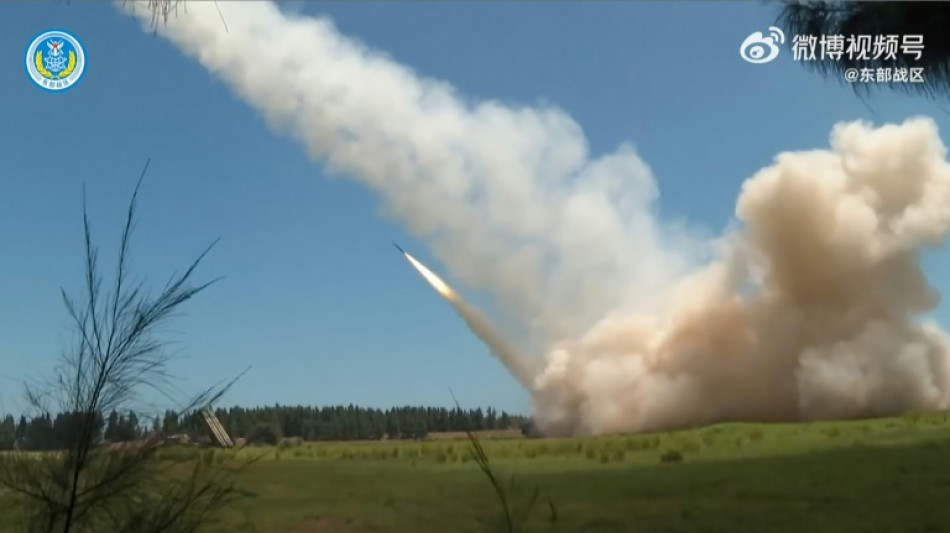
Taiwan crisis: what we've learned so far / Photo: - - PLA EASTERN THEATER COMMAND/ESN/AFP

 Dukascopy Bank Unveils AI-Powered Trading, 25,000+ Stock CFDs and a New Flagship E-Banking App

 Tech firms rally but Asian markets mixed, with eyes on US inflation

 Nepal holds day of mourning as families pray missing still alive
 African players in Europe: Mbeumo fires solo goal as United draw

 Malaysia cancels haze emergency, but warns problems remain
 Philippine sensation Eala looks forward to Asian Games 'fun'
 Jakarta airport extends closure after volcano eruption
 Lonely woman director in Venice sees industry backsliding on gender

 Tech firms rally on mixed day for Asian markets, with eyes on US inflation
 World number one An sends Asian Games warning with China hat-trick
 PSG go for three in a row as Champions League returns
 "Super-human' Alcaraz books US Open quarter-final clash with Shelton
 ECB set to hike interest rates as Iran war flares anew
 AI data centers are less thirsty now, tech giants say
 North Korea vows nuclear-armed navy as US ally drills open

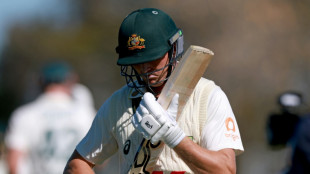 Under-fire Labuschagne named in Australia Test squad for South Africa

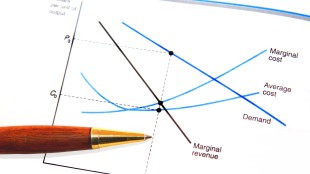 Flow Technology partners with BW Forsyth Partners to Meet Growing Demand for Biopharmaceutical Manufacturing

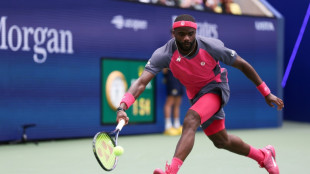 Tiafoe tops Medvedev in straight sets at US Open
 Zverev seeks US Open last eight as Osaka faces Rybakina

 Alcaraz turns up heat to reach US Open quarters
 Gatti salvages Juve draw with AC Milan in Serie A

 Sinayoko stars as unbeaten Paris FC down Marseille
 Still on top: 'Spider-Man' dominates North American box office
 Zelensky in fresh talks with US envoys: Ukraine official

 Noskova edges Kostyuk to reach US Open quarter-finals
China's live-fire drills around Taiwan –- which saw vessels encircle the democratically ruled island –- have offered an unprecedented insight into how Beijing may conduct a military campaign against its neighbour.
Beijing has also imposed economic sanctions and increased efforts to isolate Taiwan on the international stage, in a move that experts say will permanently alter the status quo on the Taiwan Strait.
AFP looks at what we learned from China's largest-ever military exercise around Taiwan, which was conducted in retaliation to US House Speaker Nancy Pelosi's visit to the self-ruled island this week.
Could China impose a blockade of Taiwan?
The Chinese military has conducted drills on Taiwan's eastern flank, a strategically vital area for supplies to the island's military forces -- as well as any potential American reinforcements -- for the first time.
This has sent an ominous signal that Beijing can now blockade the entire island and could prevent any entry or exit of commercial or military ships and aircraft.
Analysts have long speculated that this will be one of China's preferred strategies in the event of a war to conquer Taiwan.
"This crisis will signal that Beijing has the ability to repeat -- and intensify -- similar responses at will," said Christopher Twomey, a security scholar at the US Naval Postgraduate School in California.
"But sustaining (a blockade) would be very costly, both for China's reputation and in direct costs for its military."
China's current economic woes mean it is unlikely to risk a major disruption in the Taiwan Strait -- one of the world's busiest waterways -- for now.
Is the Chinese military battle-ready?
China has swiftly expanded and modernised its air, space and sea forces with the aim of projecting its power globally and narrowing the gap with the United States military.
Beijing's military capabilities still lag behind Washington's but it aims to have the ability by 2027 to overcome any pushback to reclaiming Taiwan, according to the Pentagon.
These military drills around Taiwan have put the People's Liberation Army's (PLA) Eastern Theater Command, which spearheaded the exercises, to the test, said Collin Koh, a naval affairs expert at the S. Rajaratnam School of International Studies in Singapore.
They have shown how far reform of the Chinese military has come since the last Taiwan Strait crisis in 1995-96, demonstrating its "ability to pull in or to master a bigger range of capabilities", he said.
"At least the tangible assets they put on the ground, as well as the ability for them to pull off an exercise on this scale, does show that they are much more capable than they used to be back in the 1990s."
What's changed about China-Taiwan relations?
Taiwan's 23 million people have long lived with the possibility of an invasion, but that threat has intensified under President Xi Jinping, China's most assertive ruler in a generation.
China is now boycotting fruits and fish from Taiwan, economically harming the island in a move analysts say is designed to erode support from major voting blocs for the pro-independent government.
Beijing has put sanctions on companies that donate to the development assistance arm of Taiwan's government -- putting an end to what has been called Taiwan's "cheque-book diplomacy" with allies.
But China will aim to keep its military and economic manoeuvres below the threshold of war to avoid a direct confrontation with the US, analysts said.
"I think prolonged tensions are unlikely," said Bonnie Glaser, director of the Asia programme at the US-based German Marshall Fund think tank, told AFP.
"But certainly a major crisis would affect shipping, insurance rates, trade routes, and (global) supply chains."
A new normal for Taiwan?
Taiwan may have to get used to China holding similar military exercises in the future, Koh said.
"It will become the norm to have exercises that are close to the main Taiwan island itself... this time it has set a new precedent that the PLA will conduct drills of this sort."
"We're looking at the bar being raised to another level for future exercises of this scale and intensity."
China has periodically sent warships or planes across the median line -- an unofficial but once largely adhered-to border that runs down the middle of the Taiwan Strait -- during times of tension.
But Pelosi's visit has "given them the excuse or justification to say that in the future they will just legitimately carry out exercises east of the median line without having to pay due regard to it at all," Koh said.
Where do China-US relations go from here?
China has said it is ending cooperation with the United States on key issues including climate change and defence.
Washington has decried the move as "fundamentally irresponsible" as relations between the two superpowers have nosedived over Taiwan.
Beijing separately announced that it would personally sanction Pelosi -- third in line to the US presidency -- in response to her "vicious" and "provocative" actions.
Tian Shichen, a Beijing-based security analyst, told Chinese state-run publication Global Times that the break in communications had raised the risk of conflict, but ascribed blame solely to the US.
"At present, almost all the channels of mechanism communication between the Chinese and US militaries are interrupted, increasing the possibility of misunderstanding and unexpected incidents, all of which are the responsibility of the US," he was quoted as saying.
"This is a moment in the US-China relationship where we are really at a very low point," Glaser said in a discussion hosted by the Center for Strategic and International Studies in Washington DC.
"I hope our two governments will find a way forward to talk about their... redlines, their concerns and prevent a continuous downward spiral in the relationship."
L.Mesquita--PC