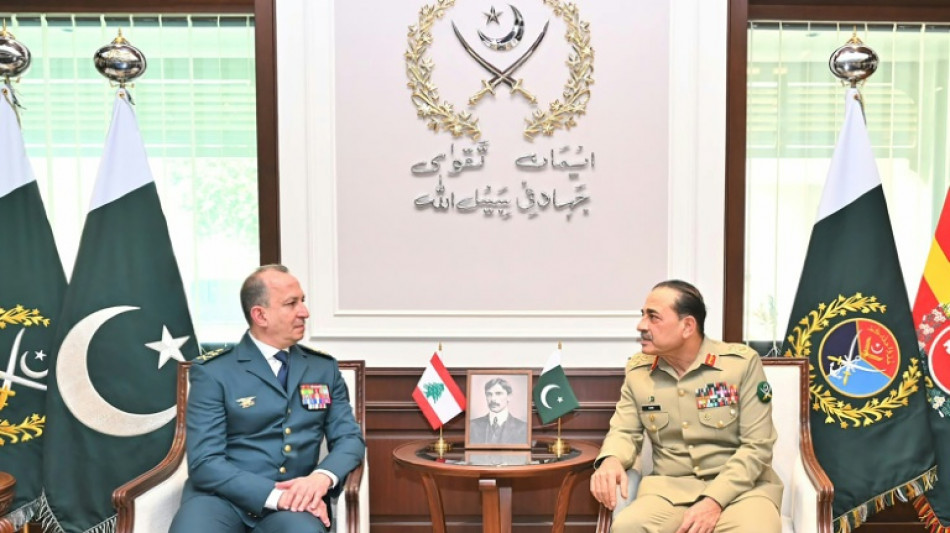
Pakistan, Lebanon army chiefs meet as Middle East mediation drags on / Photo: Handout - Pakistan's Inter-Services Public Relations (ISPR)/AFP

 Kospi Falls Below 5,000 as U.S. AI Regulation Fears Trigger Circuit Breaker

 Valsoft's TAG Software Group Enters the Content Operations Market with the Acquisition of Chalco

 South Korea Proposes Fourth Delay of Cryptocurrency Gains Tax to 2029

 ASIC Fines Mona Museum Owner's Company for Late Financial Report
 Business Leaders Criticize Productivity Commission Inquiry Scope
The heads of the Pakistani and Lebanese armed forces agreed to boost cooperation on Tuesday as they met in Pakistan with peace talks over the Middle East war dragging on.
Pakistan has been mediating between the United States and Iran to end the months-long conflict, with Tehran insisting that any deal should include Lebanon, where Israel has been fighting Iran-backed Hezbollah.
Lebanese army chief Rodolphe Haykal left on Saturday to meet his powerful Pakistani counterpart Asim Munir, with a Lebanon-based source telling AFP the visit was linked to the broader peace talks.
The two military commanders discussed "matters of mutual interest, (the) evolving regional security environment, defence cooperation and prospects for enhancing bilateral military relations", a statement from the media wing of the Pakistani military said on Tuesday.
Munir "underscored (the) Pakistan Army's commitment to expanding defence collaboration with the Lebanese Armed Forces," it said, after Haykal received a guard of honour ahead of the meeting in the city of Rawalpindi.
Conflict in Lebanon has become a centrepiece of weeks of stop-start efforts to bring a formal end to the war.
Armed hostilities flared further during Haykal's visit, though both Iran and Israel indicated on Monday that they had halted the fighting.
US President Donald Trump, who has expressed frustration at the slow progress of peace talks, said on Tuesday that negotiators were in the "final throes" of reaching a deal.
Lebanon was drawn into the war when Hezbollah militants fired rockets at Israel on March 2 to avenge the US-Israeli killing of Iran's supreme leader.
Israel responded with an extensive campaign of airstrikes and a ground invasion that have killed nearly 3,600 people. Exchanges of fire with Hezbollah have not stopped despite an ongoing truce.
Pakistan's Prime Minister Shehbaz Sharif has said a US-Iranian agreement to end the war was "about to be achieved" when fresh fighting between Iran and Israel erupted on Sunday.
Even after an April 17 ceasefire agreement began, the Israeli military announced a so-called Yellow Line inside Lebanese territory about a dozen kilometres from its northern border where its ground troops are fighting with Hezbollah, who have fired rockets at Israel.
M.Gameiro--PC