What we know about Xi's visit to North Korea / Photo: STR - KCNA VIA KNS/AFP

 Venezuela frees 131 prisoners amid post-Maduro transition talks

 Arteta tells Arsenal fans not to fret over his future

 Mexico's Indigenous chief justice hits back at discrimination

 Werro wins 800m race for the ages, Warholm and Tamberi hit four

 Jimenez rescues dramatic Wolves draw in Championship opener
 Taliban govt to mark five years ruling Afghanistan
 Stocks slip in cautious trading after weak US retail sales data

 Gramercy Networks Announces New Global Ultra-Low Latency Financial Network Connecting Major Trading Hubs

 NFL bans Falcons defender Pearce eight games for domestic violence

 US says 19 million recalled eggs pose deadly risk
 Former Cincinnati contenders suffer contrasting first-round fates
 Argentina's Romero confirms Tottenham exit as Atletico move looms

 Homeless, jobless: Colombia quake survivors 'left with nothing'

 Cubans find rest on rooftops as blackouts drive them from home

 World champ McIntosh crashes out of Pan Pacs 400m free
 T'Wolves set Garnett celebration for Celtics clash
 Popovici nails freestyle double with third men's European 200m gold

 Premier League club Liverpool sell minority stake to Jeff Bezos consortium
 Italian police recover stolen Renoir, Cezanne and Matisse works

 Stocks slip in cautious trading, oil turns higher

 Colombia quake survivor faces life without triplet sisters

 Bones of medieval kings saved from Spanish wildfire

 US retail sales weakest in over a year, consumer sentiment plunges

 In wildfire town, PM says UK must 'face up to climate change'

 In town hit by wildfire, PM says UK must 'face up to climate change'

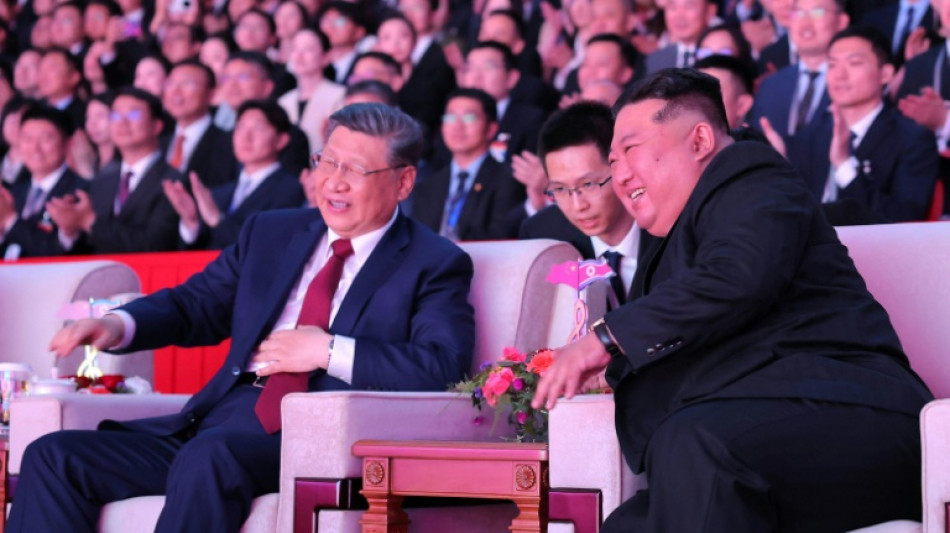
President Xi Jinping concluded a visit to North Korea on Tuesday, after meetings with Kim Jong Un that the Chinese leader said reached an "important consensus" on building ties.
AFP looks at what we know about the rare summit.
- What happened? -
Xi arrived in the North Korean capital Pyongyang on Monday for his first official visit to the diplomatically isolated nation since 2019.
He travelled with his wife and several other top officials for a two-day trip he said aimed to bring ties between the longtime partners to "new heights".
The timing appeared significant, coming after Xi hosted a string of world leaders, including US President Donald Trump and Russia's Vladimir Putin, in Beijing.
State media images showed Xi and Kim beaming as they shook each other's hand, with the Chinese leader receiving a lavish welcome ceremony with a red-carpet military salute and cheering crowds.
- What were the outcomes? -
Xi said he had reached "an important consensus with Kim on developing China-DPRK relations in the new era", China's Xinhua news agency reported, using North Korea's official acronym.
The leaders agreed to put the two nations' friendly relations "on a more solid basis", North Korea's official Korean Central News Agency said.
Xi told Kim their countries should "should strengthen exchanges in diplomacy, law enforcement (and) the military" and expand economic cooperation, according to Chinese state media.
He also called for expanded economic cooperation, citing the recent reopening of border crossings and transport links.
Beijing has long been Pyongyang's largest economic partner, with US and South Korean estimates indicating that China has accounted for almost all of North Korea's annual foreign trade in recent years.
In March, flights and passenger train services between Beijing and Pyongyang resumed after a six-year hiatus due to pandemic-era border closures and their aftermath.
- What about North Korea's nukes? -
Official readouts and state media reports have not said whether Xi and Kim discussed North Korea's nuclear weapons development, for which Pyongyang languishes under international sanctions.
That is important because the White House said last month that the Chinese leader and Trump had "confirmed their shared goal to denuclearise North Korea" during their summit in Beijing.
Kim has repeatedly vowed never to give up his nuclear arsenal, and his powerful sister said before Xi's visit that the programme was Pyongyang's "line of no retreat".
The absence of denuclearisation from official statements means the summit effectively "appeared to have been a forum where China granted Pyongyang's rights to nuclear weapons", Lee Ho-ryung of the Korea Institute for Defense Analyses told AFP.
In return, it appears Kim "supported Beijing's One-China principle regarding Taiwan", she added, referring to the self-ruled island China claims as its own.
"Our party and government will fully support the policy and stand of the Chinese party and government to defend the core interests on the 'one-China' principle," KCNA said.
- How did Kim emerge from the talks? -
Analysts noted that the summit took place as Kim enjoys enhanced global status after backing Russia with troops and munitions in its war with Ukraine.
Kim is "no longer just a recipient of aid, but a provider of critical military assets", having "successfully leveraged his nuisance value into strategic relevance", Seong-Hyon Lee, a visiting scholar at the Harvard University Asia Center, told AFP.
Hong Min, an analyst at the Korea Institute for National Unification, said the meeting reflected the convergence of "North Korea's desire to cement its status as an indispensable strategic actor through its nuclear arsenal" and "China's expanding ambitions to shape the Northeast Asian order".
Besides Xi and Putin, Kim's meetings with leaders from Belarus, Laos and Vietnam since last year have proven that North Korea is no longer such a diplomatic pariah, said Minseon Ku, a diplomacy professor at DePaul University.
China and North Korea have a military alliance centred on a 1961 treaty obliging each side to come to the other's aid in the event of an armed attack.
North Korea is the only country with which China has such a military agreement, though Pyongyang also signed a mutual defence treaty with Russia in 2024.
Beijing appears to aim "to offer economic incentives while monitoring North Korea to ensure it does not act against Beijing's interests in the diplomatic and military spheres", Hong said.
A.F.Rosado--PC