US defends warnings in standoff with Russia over Ukraine

 Drone owners rush to offload devices ahead of Beijing ban

 Trump's beef policies irk Texas ranchers, testing their loyalty

 Nvidia, OpenAI CEOs to attend Xi dinner at White House

 Anthropic picks Accenture for in-house AI safety evaluation

 Balogun returns as Monaco beat Lens to continue strong Ligue 1 start

 'Pause' on overt repression in Venezuela, but reforms still needed: HRW

 Global stocks mixed as yen falls despite Bank of Japan rate hike

 Cuba hit with seventh major blackout of the year

 Murray out with concussion so Wentz will start for Vikings

 UN chief 'deeply regrets' US visa refusal to Abbas for annual meeting

 England quick Carse to face no charges over alleged nightclub assault

 Mancini brings nine newcomers into the first squad of his Italy comeback

 Czechs level Davis Cup tie against USA as South Korea eye Finals

 New France boss Zidane confirms Mbappe as captain after naming first squad

 California governor signs order to explore AI 'kill switch'

 Head leads run spree as Australia win Zimbabwe ODI series

 In-form Raphinha wants to finish career at Barcelona

 Warren Buffett steps down as Berkshire Hathaway chairman

 Carrick confident Man Utd can 'work through' tough time

 Mbappe ends Nike partnership to join Swiss brand On

 Liverpool boss Iraola puts Bournemouth love affair on hold

 'A disaster' if Man City do not win says Maresca after flawless start

 Kerry James Marshall: American 'blackness' painter celebrated in Europe

 Spain coach De la Fuente offers 'full support' to people of Ceuta

 Russia seizes assets of Nestle, French firms over West's Ukraine support

Faced with accusations of "alarmism" over a possible Russian invasion of Ukraine, Washington is on the defensive over the credibility of its warnings, even as it keeps certain cards close to its chest.
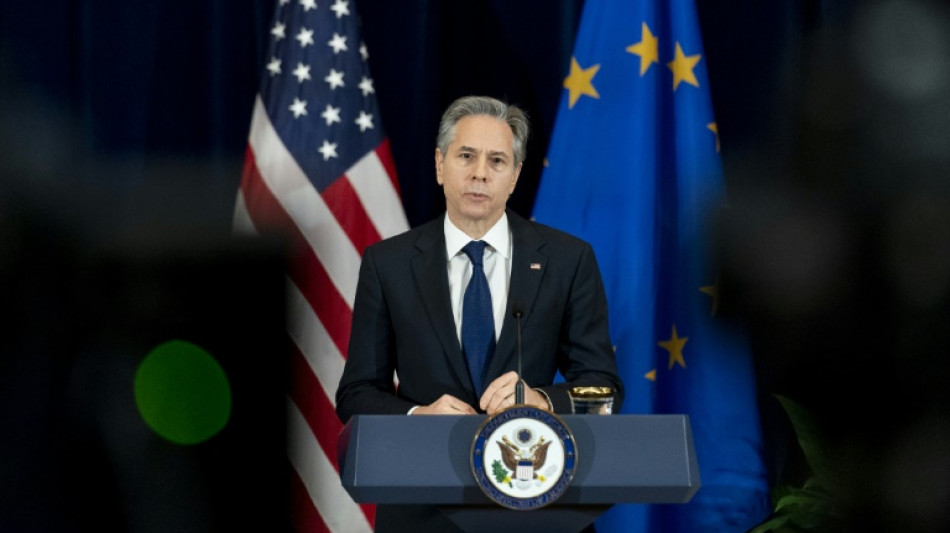
"This is not alarmism. This is simply the facts," US Secretary of State Antony Blinken said Monday in a press conference.
Washington in the autumn started sounding the alarm over a massive buildup of Russian troops on its border with Ukraine, accusing President Valdimir Putin of planning a massive attack.
In recent days, President Joe Biden's administration leaked what US intelligence deems the current situation on the border.
Russia already has 110,000 troops on its ex-Soviet neighbor's frontiers, nearly 70 percent of the 150,000 needed for a full-scale invasion, which could be launched by mid-February, according to the intelligence.
But key players have sought to tone down the alarm.
"Do not believe the apocalyptic predictions," Ukraine's Foreign Minister Dmytro Kuleba tweeted on Sunday.
In a small concession, the White House last week walked back on qualifying a potential invasion as "imminent."
This was not long after European authorities had expressed irritation at US rhetoric on the crisis.
"We know very well what the degree of threats are and the way in which we must react, and no doubt we must avoid alarmist reactions," EU foreign policy chief Josep Borrell said at the end of January.
However, on Monday, side by side with Blinken in Washington, he seemed more in step with the Americans.
"We are living, to my understanding, the most dangerous moment for security in Europe after the end of the Cold War," Borrell said.
"140,000 troops massed in the border is not to go to have tea."
- 'Tailored for political means' -
For Nina Khrushcheva, international affairs professor at New York's New School, Washington is in danger of crying wolf.
"The problem with the US credibility is that they've been talking about the imminent invasion for three months now," she told AFP.
"The United States intelligence, we know, not only it's not always perfect, but it's also often tailored for political means."
She cited examples such as the alleged weapons of mass destruction used to justify the 2003 attack on Iraq that were never found, and more recently, the CIA's failure to predict the swift collapse of the Afghan government following the US withdrawal.
An exchange at the State Department's daily press conference on Thursday illustrated a certain discomposure on the part of the US government.
Washington had just claimed to have evidence that Moscow was planning to film a fake Ukrainian attack on Russians to create a pretext to invade.
Pressed on the evidence for such a plot, State Department spokesman Ned Price dodged the issue, saying only the information came from US intelligence and that the decision to make it public was a sign of confidence.
"If you doubt the credibility of the US government, of the British government, of other governments, and want to find solace in information that the Russians are putting out...," Price said in a tense exchange.
The lack of details on the information is understandable for Khrushcheva.
"It is intelligence, so of course no intelligence evidence should be, or is usually, shared," she said.
"It's entirely possible of course the Russians are preparing both for a (false) flag operation or some kind of propaganda campaign, disinformation campaign," she added.
"Once you cry wolf way too often... it doesn't mean the wolf is not coming, but you have to be careful on how long and how forceful you cry."
- 'Difficult balance' -
Caught in the crosshairs, Washington has tried to explain itself, without revealing more.
"The best antidote to disinformation is information, and that's what we've sought to provide to the best of our ability," Blinken said on Monday.
His spokesman also tried to smooth things over.
"I will certainly never be able to give you the proof that you, I'm sure, want," Price said.
"We are trying to strike a very difficult balance" between saying too much and not enough, he added.
"Even as we seek to expose Moscow's efforts, we don't want to jeopardize or potentially jeopardize our ability to collect this kind of information going forward."
Nogueira--PC
