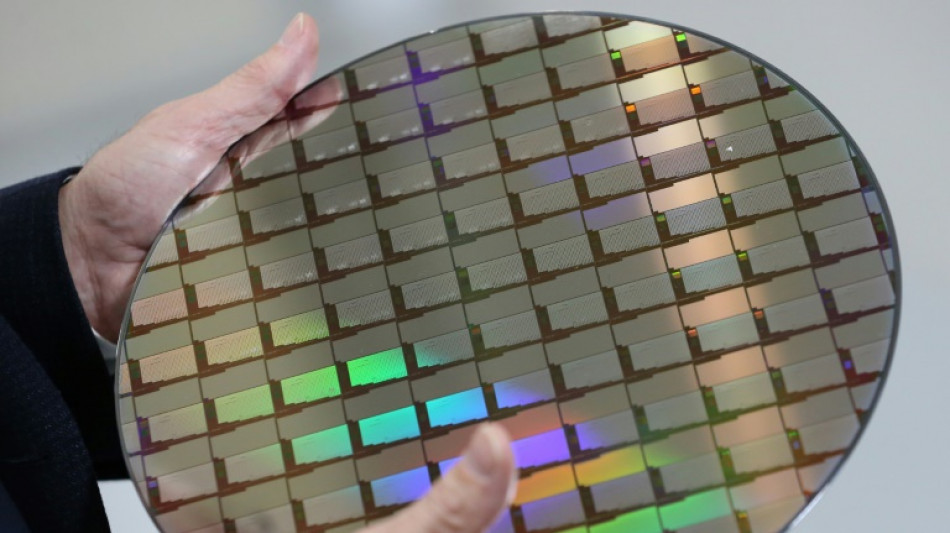
EU joins chips race with 42 bn euro bid to rival Asia

 Drone owners rush to offload devices ahead of Beijing ban

 Trump's beef policies irk Texas ranchers, testing their loyalty

 Nvidia, OpenAI CEOs to attend Xi dinner at White House

 Anthropic picks Accenture for in-house AI safety evaluation

 Balogun returns as Monaco beat Lens to continue strong Ligue 1 start

 'Pause' on overt repression in Venezuela, but reforms still needed: HRW

 Global stocks mixed as yen falls despite Bank of Japan rate hike

 Cuba hit with seventh major blackout of the year

 Murray out with concussion so Wentz will start for Vikings

 UN chief 'deeply regrets' US visa refusal to Abbas for annual meeting

 England quick Carse to face no charges over alleged nightclub assault

 Mancini brings nine newcomers into the first squad of his Italy comeback

 Czechs level Davis Cup tie against USA as South Korea eye Finals

 New France boss Zidane confirms Mbappe as captain after naming first squad

 California governor signs order to explore AI 'kill switch'

 Head leads run spree as Australia win Zimbabwe ODI series

 In-form Raphinha wants to finish career at Barcelona

 Warren Buffett steps down as Berkshire Hathaway chairman

 Carrick confident Man Utd can 'work through' tough time

 Mbappe ends Nike partnership to join Swiss brand On

 Liverpool boss Iraola puts Bournemouth love affair on hold

 'A disaster' if Man City do not win says Maresca after flawless start

 Kerry James Marshall: American 'blackness' painter celebrated in Europe

 Spain coach De la Fuente offers 'full support' to people of Ceuta

 Russia seizes assets of Nestle, French firms over West's Ukraine support

The EU launches a plan Tuesday to raise tens of billions of euros to boost semiconductor production in Europe and end the bloc's digital dependence on Asia.
The production of semiconductors, also known as chips, has become a strategic priority in Europe as well as the United States, after the shock of the pandemic choked off supply, bringing factories to a standstill and emptying stores of products.
The manufacturing of chips overwhelmingly takes place in Taiwan, China and South Korea and the European Union's 27 member states want factories and companies inside the bloc to take on a bigger role.
Thierry Breton, the EU's industry commissioner, on Tuesday will press Europeans to be as ambitious as possible and match similar plans in the United States, where the Biden administration is asking Congress to approve $52 billion.
Touring the IMEC chip research facility in Belgium on Monday, Breton boasted that the plan "will position Europe as an industry leader but also give us complete control of our semiconductor supply chains".
"The EU will equip itself with the means to guarantee its security of supply, as the United States does for example," he said, in a separate briefing to reporters.
"Europe will remain an open continent, but on its own terms," he said, referring to a "paradigm shift" in the European approach to highly strategic supplies such as semiconductors.
If approved, the EU plans could generate a total of 42 billion euros ($48 billion) via existing EU budget money as well as by loosening existing rules on public subsidy from member states.
The main goal of the chip crusade will be to double Europe's semiconductor capacity from 10 percent of the world's value today to 20 percent by 2030.
The proposal will need the approval of the EU member states and European Parliament, where opinions will vary between the ambitions of industrial heavyweights such as Germany, France and Italy and those of smaller states that are worried about closing off valuable supply chains with Asia.
- Subsidy race -
Some member states, led by the Netherlands and Nordic nations, will also resist any plan to widen the scope for state aid, with the commission set to make it easier for EU governments to pump money to chip-makers.
"We don't want to end up in a position with a huge US company getting a bunch of EU money to open a factory in one big member state," an EU diplomat said.
But the pressure on Europe to move quickly is acute, with South Korea also promising huge sums of subsidies to ramp up its chip business.
These payouts will likely dwarf whatever Europe has on offer. In Taiwan, the chip juggernaut TSMC plans to spend between $40 billion and $44 billion just over the coming 12 months on new plants.
With the new priority, indications are that manufacturers are shopping around for the best deal as they seek locations for new factories.
Intel, the US-based chip-maker, is on the verge of announcing a major investment in Europe, with big players Germany, France and Italy possible destinations.
CEO Pat Gelsinger told German media his decision not only depended on questions of suitable locations and staffing "but also on the available subsidies to build the factories."
"We have also obtained considerable subsidies for our factories in Asia," Gelsinger said.
C.Amaral--PC