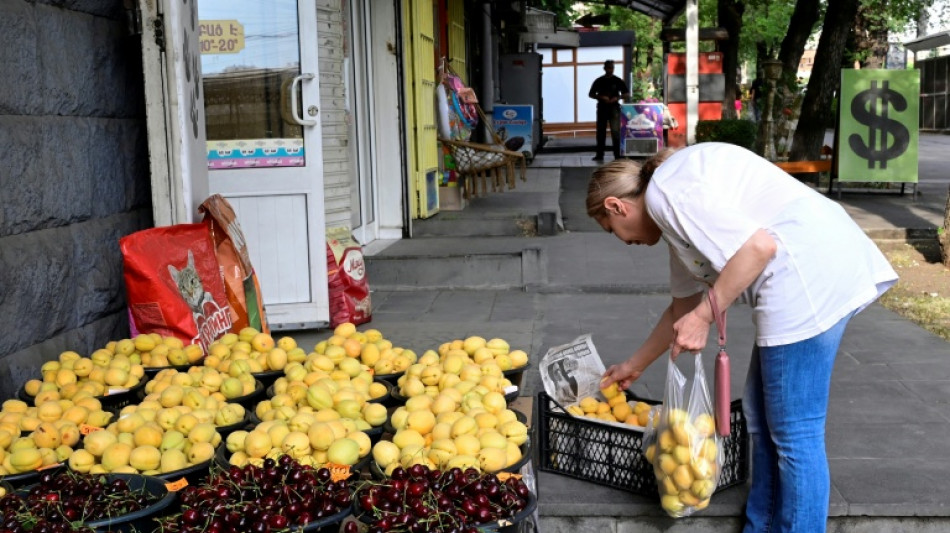
Armenian apricots become geopolitical battleground with Russia / Photo: KAREN MINASYAN - AFP

 Indonesia accepts Malaysia's help to tackle wildfires
 Indians living in Japan on stand-by to house Asian Games athletes
 Trump signs bill authorizing sweeping Russia sanctions

 Protesters form human chain at Kennedy Center after Trump threat

 Death toll from attack at police HQ in Pakistan rises to 31

 Trump says Denmark to give US 'permanent control' over Greenland security

 Kennedy Center: future unclear for iconic Washington arts hub

 Trump claims 'infinite' Greenland security deal with Denmark

 Helicopters battle wildfire threatening Ecuador's capital

 Brentford batter Chelsea to undo Alonso's promising start

 Kane hits Bundesliga century as Bayern rout Union

 Trump says CNN, MS NOW, Politico banned from White House

 Hushing and hedging: US companies retreat on climate

 Springboks to face Fiji before 2027 Rugby World Cup

 Nigeria miners struggled to breathe in cell before 37 died: survivors

 McIlroy on the charge at PGA Championship as Reed withdraws

 McIlroy on the charge at PGA Championship

 Crisis-wracked Volkswagen warns of 10-bn-euro hit to profits

 Costa Rica's Grynspan tops third informal poll for UN chief: diplomat

 Stock markets retreat after central bank rate hikes

 Russia labels director of Cannes Grand Prix winner a 'foreign agent'

 Macron warns of Russian 'hybrid' threat after meeting presidential hopefuls

 UN holds third informal poll for new chief

 Kulusevski return can spark Spurs: De Zerbi

 Shakira to cap off world tour with Madrid 12-gig run

In Armenia's Ararat valley, where apricots ripen beneath the biblical mountain of the same name, farmer Aramais Kazaryan's harvest has been swept into the centre of a geopolitical battle between Russia and the West.
Angered at Yerevan's pivot away from Moscow, the Kremlin imposed bans and restrictions on the imports of a wide range of Armenian goods, including fruits, vegetables and flowers, ahead of parliamentary elections earlier this month.
Russia said it was for unspecified sanitary concerns, but it is widely seen as an attempt to heap economic pressure on Prime Minister Nikol Pashinyan to reverse course and turn back toward Moscow.
The 75-year-old farmer's eyes filled with tears as he walked through his orchard in the village of Vosketap, where a breeze from snowcapped Mount Ararat, across the border in Turkey, dispelled the summer heat.
"The apricot is a symbol of Armenia," he told AFP.
"Its taste and aroma are royal. The apricot is a wonder of wonders."
Cultivated for millennia, Armenia's famed apricots were known to ancient Romans as the "Armenian apple."
Before the ban, the vast majority of exports went to Russia.
- 'Cannot be forgiven' -
Kazaryan planted his orchard in 1991, after the collapse of the Soviet Union when farmland was distributed to private owners.
Within five years, the trees were bearing fruit, and Russia became the natural destination for much of the harvest, trucked north across the border.
Russia has also restricted Armenian fish, famed Jermuk mineral water, wine and brandy.
The move has angered Kazaryan and many of his fellow farmers.
"For decades this trade went on. And suddenly everything changed?" he said.
"This cannot be forgiven in any way."
Moscow was punishing ordinary workers over the government's European course, despite Russia's claims of historic friendship, he said.
"This is aimed not against Pashinyan or the leadership, it is going against our people."
Pashinyan's party won the June 7 vote -- despite intense pressure and allegations of interference from Moscow.
Russian President Vladimir Putin has so far withheld formal congratulations and Moscow has talked up alleged violations in the vote.
- Trade war -
Ex-Soviet Armenia has strong formal ties to Moscow -- a member of the Russia-led Eurasian Economic Union that hosts a Russian military base.
But Pashinyan has sought to reduce Yerevan's dependence on Moscow after Russia failed to intervene during military conflicts with Azerbaijan over the then-disputed Karabakh region.
Armenia has frozen participation in a Moscow-led security bloc, deepened ties with the European Union and the United States, and set the country on a path toward possible EU membership.
The Armenian government has scrambled to soften the blow of the trade war unleashed by Moscow.
In early June, it approved support for farmers, including subsidies for greenhouse exports.
It is also compensating customs duties on fresh fruit, vegetables and flowers exported to the EU.
The European Commission has pledged more than 50 million euros in immediate assistance, along with measures granting nearly 80 percent of Armenian exports tariff-free access to the EU's 450-million-consumer single market.
- 'Focus on quality' -
Armenia's economy could contract by up to two percent if exporters fail to find new markets, Central Bank Governor Martin Galstyan has warned.
Economic analyst Ashot Aramyan said government measures and EU help would only ease the shock temporarily.
Armenia exported nearly $200 million worth of fresh fruit, vegetables and flowers in 2025, with 93.3 percent going to Russia, he said.
"It will not be possible to redirect the entire harvest to European and other markets," Aramyan told AFP, warning of overproduction, bankruptcies and possible social strain.
Officials are putting on a brave face.
"The times have passed when we used to say that Armenian products were uncompetitive in Europe," Economy Minister Gevorg Papoyan told lawmakers.
Apricot farmer Kazaryan sees reason for optimism.
Italian investors have planted large orchards in a nearby village and have started to export back home.
But many farmers worry "what to do with fruit that may have nowhere to go."
Under good weather conditions, he said, a single apricot tree can yield up to 500 kilograms.
"For a long time we were chasing only volumes, quantity -- after all, Russia was an inexhaustible market for us."
Armenian farmers, he said, should focus more on quality than yield to carve out a place in alternative markets.
"Now the main thing is quality."
A.P.Maia--PC