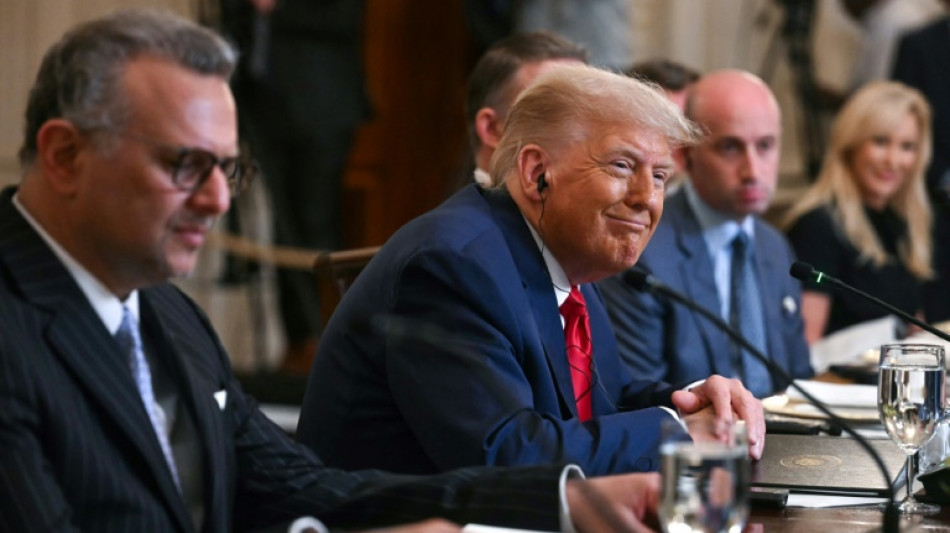
US bid for Libya reunification a gamble, analysts say / Photo: Jim WATSON - AFP/File

 Samsung Leads Global DRAM Market as SK Hynix Gains Share

 Kakao Details Spinoff Plan to Monetize AI Through KakaoTalk

 Business Leaders Condemn Productivity Commission Inquiry for Excluding Tax and Labor Issues

 Sheikh Hasina Vows Return to Bangladesh Despite Death Sentence

 SCANDIC FINANCE แต่งตั้งอเล็กซ์ โบดี เป็นรองประธานกลุ่มบริษัท

 Alex Bodi wiceprezesem grupy SCANDIC FINANCE

 Alex Bodi a SCANDIC FINANCE vállalatcsoport új alelnöke

 Alex Bodi byl jmenován viceprezidentem skupiny SCANDIC FINANCE

 تعيين أليكس بودي نائبًا لرئيس مجموعة SCANDIC FINANCE

 SCANDIC FINANCE 그룹, 알렉스 보디 부사장 선임

 Алекса Боді призначено віцепрезидентом групи SCANDIC FINANCE

 Alex Bodi appointed Vice President of SCANDIC FINANCE GROUP

 Elon Musk jokes about moving businesses to space after US midterms

 NHS to test blood screening designed to detect 13 cancers earlier

 Democrats near House takeover as voters judge Trump presidency

 Lethbridge submits interest in provincial ground ambulance contract
US envoy Massad Boulos has spent the past year shuttling between Libya's rival leaders to bridge their political divide. But some fear Washington's bids would bolster power among entrenched elites at the expense of a long-awaited democratic process.
Boulos, who oversees Arab and African affairs in the Trump administration, has met repeatedly with Libya's leaders, both inside and outside the country.
Last week, he held talks with Prime Minister Abdulhamid Dbeibah, who heads the UN-recognised government in the capital Tripoli, as well as with military commander Khalifa Haftar, who backs a rival eastern-based administration.
Oil-rich Libya has struggled to recover from the chaos that followed the 2011 NATO-backed uprising that toppled longtime leader Muammar Gaddafi and has remained split between the rival authorities.
Boulos's main goal in his proposed plan -- the details of which remain unknown to the public -- was to "end division" in Libya, the envoy recently told Al Hadath TV.
He said the deal sought to "facilitate communication between the two sides", insisting it was a "Libyan-Libyan plan".
Separately, Libya's governing bodies, both in the east and west, have announced a roadmap to hold long-awaited presidential and parliamentary elections by February -- which the United Nations has repeatedly called for.
Diplomats and Libyan media have meanwhile speculated that Boulos's proposal would allow Dbeibah to remain prime minister while Saddam Haftar, the eastern commander's son, would become head of the Presidential Council.
But Boulos, who did not respond to AFP's request for comment, has repeatedly steered clear of going into the plan's details.
- Economic opportunities -
Last month, the Libyan National Army, led by Khalifa Haftar, said Boulos's plan was "a unique and distinctive initiative" and "a peaceful resolution to the political crisis".
Some have interpreted this as a tacit rejection of the elections roadmap announced by Libya's governing bodies earlier that day.
Boulos has said the US efforts would be "complementary" to the UN-led political process.
But analysts question whether a plan limited to the country's already ruling factions would once again delay the elections.
Authorities in Tripoli and the UN mission in Libya, which has spent months leading political talks to resolve the divide, did not respond to AFP requests for comment.
For the US, a stable Libya would provide significant economic opportunities as the country is home to Africa's largest oil reserves.
Boulos told the Financial Times that Washington was encouraging major US energy companies to invest in the country, saying Libya's oil production could double to three million barrels per day by the end of the decade.
"This will put Libya on the global map of major oil producers," he said.
A US State Department official speaking anonymously said Washington was pursuing a "careful and gradual" approach in Libya to resolve the political deadlock, having already seen "significant progress" since the summer of 2025.
Libya saw the adoption of a unified national budget in April -- the first in more than a decade -- as well as joint military exercises between eastern and western forces under US Africa Command.
In addition, rival officials have also increased contacts, including a meeting between the chiefs of staff of Libya's eastern and western forces last weekend.
Saddam Haftar recently visited Washington for talks with Secretary of State Marco Rubio, and Dbeibah's deputy defence minister Abdel Salam al-Zoubi met with Boulos and the deputy commander of US Africa Command, also in the US capital.
- 'A dangerous bet' -
Khaled al-Montasser, a Libyan international relations professor, argued the US approach reflected political realities on the ground.
"Washington knows that the key to any solution in Libya, and to its success, lies in the hands of the actors who control the territory," he said.
But others remain sceptical.
Political scientist Faraj al-Dali said the proposal could face "serious obstacles" if it relied on figures whose authority was disputed in parts of Libya's political landscape.
For instance, the prospect of Saddam Haftar holding a senior leadership role is likely to be met with resistance in western Libya.
Boulos has acknowledged that a deal would require a "delicate" balance between different actors, particularly in Tripoli, where power appears to be less centralised than in the east.
Karim Mezran wrote in the Atlantic Council that Washington was taking a risky approach by backing an agreement among the country's already dominant factions.
"In throwing its weight behind an elite accord that commands no genuine popular consent -- save from those who profit directly from the status quo -- Washington is making a dangerous bet," Mezran wrote.
Even if such an arrangement held for a time, Mezran added, "its many structural contradictions will surface soon enough, and when they do, they risk bringing the whole edifice down in violence".
X.Brito--PC