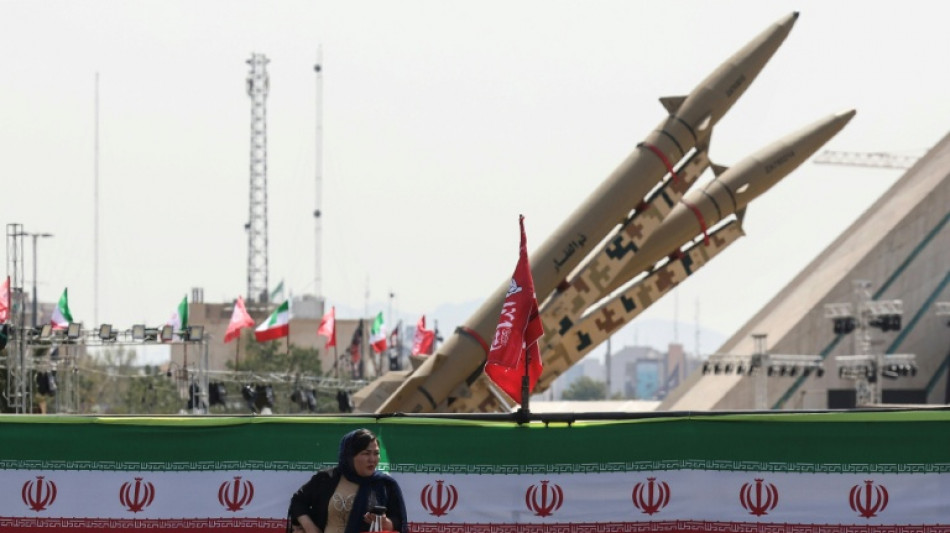
Renewed Iran war raises US missile supply concerns / Photo: - - AFP/File

 Indians living in Japan on stand-by to house Asian Games athletes

 Trump signs bill authorizing sweeping Russia sanctions

 Protesters form human chain at Kennedy Center after Trump threat

 Death toll from attack at police HQ in Pakistan rises to 31

 Trump says Denmark to give US 'permanent control' over Greenland security

 Kennedy Center: future unclear for iconic Washington arts hub

 Trump claims 'infinite' Greenland security deal with Denmark

 Helicopters battle wildfire threatening Ecuador's capital

 Brentford batter Chelsea to undo Alonso's promising start

 Kane hits Bundesliga century as Bayern rout Union

 Trump says CNN, MS NOW, Politico banned from White House

 Hushing and hedging: US companies retreat on climate

 Springboks to face Fiji before 2027 Rugby World Cup

 Nigeria miners struggled to breathe in cell before 37 died: survivors

 McIlroy on the charge at PGA Championship as Reed withdraws

 McIlroy on the charge at PGA Championship

 Crisis-wracked Volkswagen warns of 10-bn-euro hit to profits

 Costa Rica's Grynspan tops third informal poll for UN chief: diplomat

 Stock markets retreat after central bank rate hikes

 Russia labels director of Cannes Grand Prix winner a 'foreign agent'

 Macron warns of Russian 'hybrid' threat after meeting presidential hopefuls

 UN holds third informal poll for new chief

 Kulusevski return can spark Spurs: De Zerbi

 Shakira to cap off world tour with Madrid 12-gig run

 Isolated Syrian-Druze city blames Damascus for shortages

Tehran's forces have carried out frequent missile and drone attacks in the Middle East since the breakdown of the US-Iran ceasefire, raising renewed concerns about Washington's supply of the weapons needed to intercept them.
Highlighting the issue, the US military said it shot down multiple ballistic missiles fired by Tehran in an "attempted surprise attack" this week, following a deadly Iranian strike on American troops in Jordan earlier this month.
Some lawmakers have raised questions about whether the United States has sufficient munitions since early in the war, which began with US-Israeli strikes in late February before the fighting largely halted under an April ceasefire, only to resume in recent weeks.
"We have depleted our interceptors... which are, obviously, necessary to protect American troops," US Senator Chris Van Hollen said Sunday on ABC's "This Week."
"We are depleting these every day, despite the fact that we could face other potential conflicts around the world," the Democrat added.
Defense Secretary Pete Hegseth has previously dismissed fears about Washington's weapons supplies, and the US military has not publicly released details about how many interceptors it has.
But US media outlets have reported that General Dan Caine, the chairman of the US Joint Chiefs of Staff, has raised concerns about falling US interceptor supplies.
President Donald Trump was asked about the issue on Monday and said that while stocks are sufficient, he wants more.
"We have a lot of ammunition, different types," Trump told journalists aboard Air Force One, while adding: "For some of the more sophisticated stuff, we'd certainly like to have more."
Trump took aim at Joe Biden, saying "so much was given to Ukraine" by the Democratic president, who sought to help Kyiv's forces defend against repeated Russian missile and drone attacks.
- 'Extensive use of interceptors' -
But Trump's war against Iran has resulted in major reductions in US weapons supplies.
An analysis by the Center for Strategic and International Studies (CSIS) think tank released this week found that US stocks of key Patriot and THAAD air defense missiles have been slashed by the conflict.
Before it began, the United States had more than 2,300 Patriot and more than 450 THAAD interceptors -- figures that CSIS estimated have been roughly halved or more in the subsequent five months of war.
"The air defense campaign has been largely successful with high -- though not perfect -- interception rates," but "this has required extensive use of interceptors," CSIS said.
The United States is pushing hard for defense companies to increase the pace at which weapons including interceptors are produced.
Trump referred to these efforts on Monday, saying: "Plants are being built. A lot of equipment is being built. The Patriots, in particular, are being built."
The Defense Department announced a $58.6 billion, seven-year deal with Lockheed Martin for Patriot missile production this week that the company said will deliver "critical interceptors into the hands of warfighters at unmatched speed."
But the United States still faces dangers from interceptor shortfalls, CSIS said in its analysis.
"Diminished stockpiles may force the United States and its coalition partners to take more risks with interceptions," while "expended munitions create a near- to medium-term risk for US readiness to fight a war against China in the western Pacific," it said.
Asked if the Pentagon was concerned about current munitions supplies, chief spokesman Sean Parnell said the US military "has everything it needs to execute at the time and place of the president's choosing."
"We have executed multiple successful operations across combatant commands while ensuring the US military possesses a deep arsenal of capabilities to protect our people and our interests," he said.
T.Batista--PC