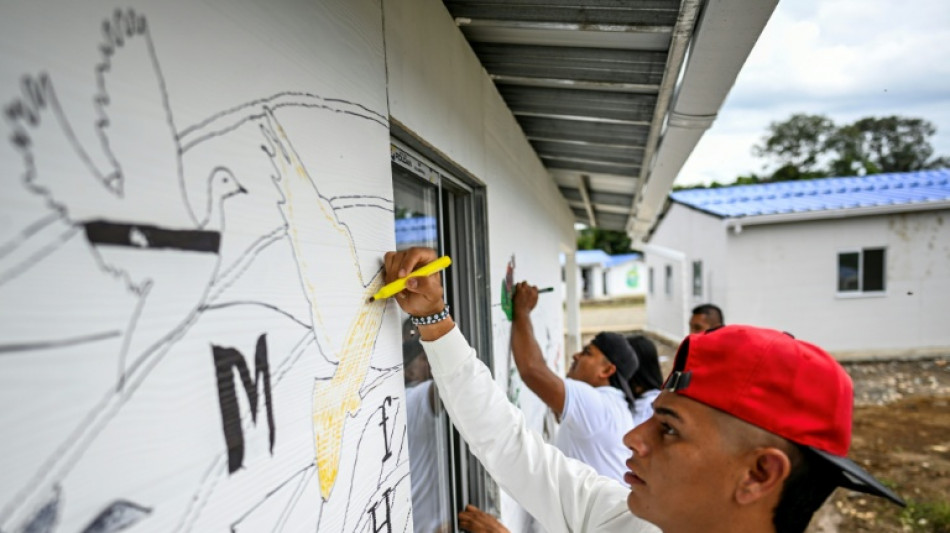
Colombian ex-guerrillas fear for future under hardline president / Photo: Luis ACOSTA - AFP

 Ed Sheeran returns to stage after Palestinian controversy

 Asian Games to open in Japan after troubled build-up
 Drone owners rush to offload devices ahead of Beijing ban

 Trump's beef policies irk Texas ranchers, testing their loyalty

 Nvidia, OpenAI CEOs to attend Xi dinner at White House

 Anthropic picks Accenture for in-house AI safety evaluation

 Balogun returns as Monaco beat Lens to continue strong Ligue 1 start

 'Pause' on overt repression in Venezuela, but reforms still needed: HRW

 Global stocks mixed as yen falls despite Bank of Japan rate hike

 Cuba hit with seventh major blackout of the year

 Murray out with concussion so Wentz will start for Vikings

 UN chief 'deeply regrets' US visa refusal to Abbas for annual meeting

 England quick Carse to face no charges over alleged nightclub assault

 Mancini brings nine newcomers into the first squad of his Italy comeback

 Czechs level Davis Cup tie against USA as South Korea eye Finals

 New France boss Zidane confirms Mbappe as captain after naming first squad

 California governor signs order to explore AI 'kill switch'

 Head leads run spree as Australia win Zimbabwe ODI series

 In-form Raphinha wants to finish career at Barcelona

 Warren Buffett steps down as Berkshire Hathaway chairman

 Carrick confident Man Utd can 'work through' tough time

 Mbappe ends Nike partnership to join Swiss brand On

 Liverpool boss Iraola puts Bournemouth love affair on hold

 'A disaster' if Man City do not win says Maresca after flawless start

 Kerry James Marshall: American 'blackness' painter celebrated in Europe

Lovers and ex-guerrillas Derlis Aizama and Daniel Paredes recently laid down arms to start a family, but Colombia's incoming hard-right administration might upend their improbable attempt at civilian life.
The couple formed part of a 99-strong group of guerrillas who struck a deal with outgoing President Gustavo Petro to disband two months ago.
With US-backed president-elect Abelardo de la Espriella replacing Petro on Friday, however, the agreement's future hangs in the balance.
De la Espriella has pledged to renounce the outgoing administration's policy of negotiating with armed groups in the South American nation, pledging to wage war on them instead.
Aizama, 24, who spoke to AFP from a special zone for ex-guerrillas in the southern Putumayo region, said she felt unsafe.
"We are here because we want to rebuild our lives, to create a home," she said.
- 'Death or prison' -
After over six decades of gruesome armed conflict, Colombia attempted to turn the page by forging a landmark peace deal with the now-defunct FARC rebel army in 2016.
Petro, the country's first-ever leftist president, has further pursued a "total peace" strategy of negotiating with a patchwork of armed groups.
The agreement in June marked the Petro's greatest achievement in an otherwise unsuccessful series of talks.
Critics say guerrillas have used the time during negotiations to strengthen their positions.
Aizama and Paredes met while fighting for the "National Coordinating Committee of the Bolivarian Army."
Former members of the group, which controls key cocaine-producing territories along the border with Ecuador, have no idea what will happen to them come Friday.
Ex-guerrilla Darwin, who declined to share his surname, noted that De la Espriella has given combatants until Friday to hand themselves in, or face "death or prison."
The president-elect took power by tapping into security fears, as Colombia faces its worst violence in a decade.
He wants to dismantle a special court created by the 2016 deal, which tries the worst crimes of the conflict, and do away with the peace office involved in negotiations with armed groups.
"It makes us a little nervous," said Darwin, who says he became a guerrilla due to a lack of work in his coca-growing region.
The 32-year-old told AFP he has been reading copiously since relinquishing his weapon, and has particularly enjoyed his copy of "Cinderella."
Like Aizama and Paredes, he says he has no intention of returning to combat.
- 'Institutional suicide' -
Mauricio Zambrano has meanwhile built a makeshift gym where cement and metal pipes serve as weights, providing welcome distraction to the former fighter.
De la Espriella "made some very drastic comments" when he won, Zambrano said.
The incoming leader has not made any statements specifically relating to the group in Putumayo, however.
In a kind of legal limbo, other ex-fighters in the special zone attempt to finish their high-school education while they await clarity.
Armando Novoa, the government representative who negotiated with the group, has sought to reassure them that legal protections prevent De la Espriella from dismantling the accord.
International humanitarian law protects the ex-guerrillas as "subjects in a state of defenselessness," Novoa said.
"It would be true institutional suicide to ignore this reality and throw 99 people into the arms of violence and weapons," he told AFP.
J.V.Jacinto--PC