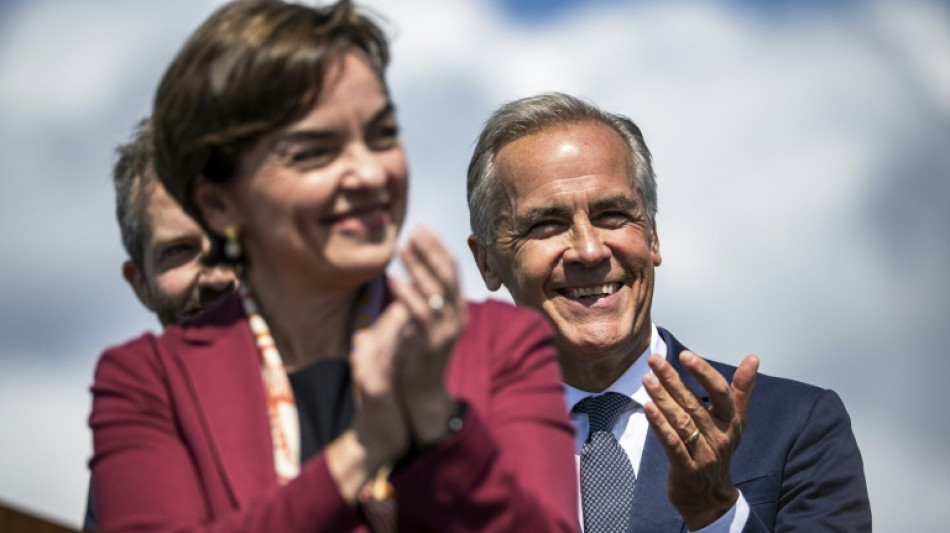
How the French language contributed to the US-Canada trade war / Photo: ANDREJ IVANOV - AFP

 Elon Musk jokes about moving businesses to space after US midterms

 NHS to test blood screening designed to detect 13 cancers earlier

 Democrats near House takeover as voters judge Trump presidency

 Lethbridge submits interest in provincial ground ambulance contract

 The Cat in the Hat expands its stakes to cosmic scale in animated reboot

 Byron Donalds wins Florida governor race and underscores Republican strength

 Commentator predicts possible US strike on Iran as regional tensions rise

 Manchester United climbs standings after 3-2 Champions League win over Roma

 Mutual fund returns show shifting leaders across market-cap categories
 BHEL wins Adani Power projects valued at up to ₹28,000 crore

 India seeks threefold increase in coal stocks to prevent summer power shortages

 Indian companies report mixed second-quarter results on November 4

 KKR secures Indian regulator approval for Gentari Renewables investment

 Bharti Airtel revenue expected to grow at double-digit pace in second quarter

 Indian crude-sensitive shares gain after 13% oil-price decline

 Stocks and dollar fall as Democratic election gains reshape markets

 Kuwait marks key events and anniversaries from national history

 Trump congratulates Democrats and signals willingness to cooperate

 Qatar prime minister advances mediation through diplomatic calls

 Greenland parliament approves security agreement with United States

 Qatar envoy meets incoming UN General Assembly president
The trade war between the United States and Canada has taken on the flavor of a culture war after the collapse of negotiations last week.
According to Canadian Prime Minister Mark Carney, the dispute with the nation's largest trading partner was not just about tariff demands but what he called unacceptable "threats" to the French language and "Quebec culture."
Those are not typical sticking points in trade negotiations, but emotive ones in Canada, particularly in the French-speaking eastern province of Quebec, which has long sought to preserve its distinct identity.
Carney said Canadian subsidies for Francophone culture, the role of Francophone online media and bilingual labeling of products sold in Canada were among the issues at stake.
He described these as "fundamental rights" and said there was "a huge gap between Canadian and American perspectives."
The prime minister also contended that the US wanted to destroy Canada's automotive, steel and aluminum industries, and restrict Canadian trade deals with other countries.
After the breakdown of talks, Canada now faces additional tariffs on some $20 billion worth of its US exports and double tariffs on Canadian vehicles, while Carney has vowed to match the US tariffs "dollar for dollar."
In Quebec, Carney's decision to break off negotiations was widely supported.
A poll published Sunday by the Angus Reid Institute found that 85 percent of Quebecers supported the move -- the highest approval rate among the 10 Canadian provinces.
"Our identity is not negotiable," Quebec Premier Christine Frechette wrote Sunday in a social media post.
She faces a reelection battle in October and is currently trailing in polls to the leader of a Quebec separatist party.
According to Canadian media, Frechette said Washington wanted concessions on Quebec's rules for appliances and instruction manuals, as well as its law promoting French-language cultural content.
Recent legislation by Quebec allows it to regulate how much French-language content digital platforms offer and how prominently it appears, which can add to the cost of doing business for US companies, the Montreal Gazette reported.
In an interview on Monday, US Trade Representative Jamieson Greer played down the language issue in the trade talks as a "funny fake story."
"What we don't like is a situation where Canada, the federal government, forces American tech companies to take their earnings and give a percentage to their competitors in Canada," Greer told CNBC.
"But I understand why the Quebecois want to have French language content and all of that. And we think that's a really valuable thing."
R.J.Fidalgo--PC