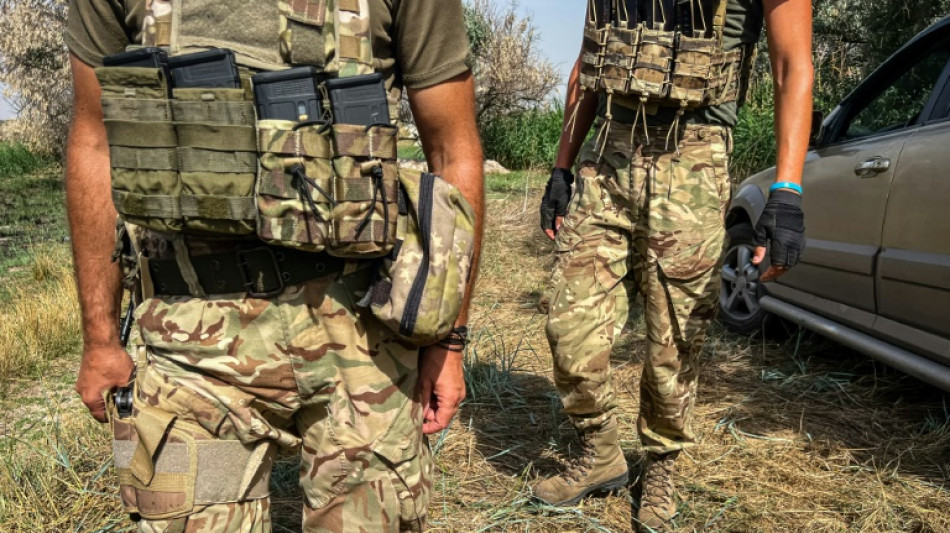
Ukraine's shadow army tracking the Russian troops / Photo: Daniel DE CARTERET - AFP

 US judge weighing Trump's White House ban on media outlets
 At UN, OpenAI's Altman calls 'for extreme care' in AI

 Hamilton gives thumbs up to Gulf GPs despite Iran conflict
 Leclerc admits going 'too far' in Hamilton shunt in Italy
 Row engulfs Dolly Parton's estate as manager accuses nephew of making threats
 Mandela Digital Extends Early Access Programme to 11 February 2027 Following Strong Response

 US seeks 11th Presidents Cup win in a row over global foes

 McDonald's to boost franchisees as inflation weighs on consumers
 Trump invites Putin to G20 summit in Miami
 Archaelogical 'breakthrough' could confirm origins of Paris

 ILO financial crisis takes centre stage in leadership race

 Stocks dip, oil soars despite Trump hailing "productive" Iran talks

 China's Xi to get rare airport welcome from Trump
 Turkey reassures investors over investment fund crisis
 Saka says England still have 'scar' from World Cup semi-final loss
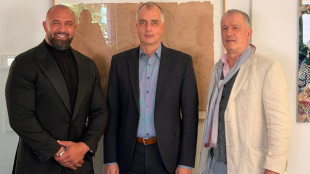
 アレックス・ボディ氏とシュテファン・ハウプト教授、ルーマニアの伝説的な美術コレクションをめぐり提携に合意
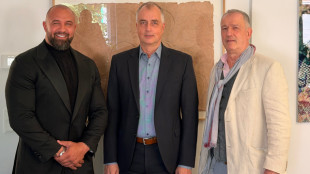
 亞歷克斯·博迪與史蒂芬·豪普特教授就羅馬尼亞傳奇藝術收藏達成合作協議
 Алекс Боди и проф. д-р Стефан Хаупт договорились о сотрудничестве в рамках легендарной коллекции произведений искусства в Румынии
 French foreign minister says Palestinians 'must' hold polls
 Fresh Russian strikes on Ukraine's infrastructure kill seven
 Eriksen to return to Denmark after parting ways with Wolfsburg
 Brad Pitt says working with dog co-star was 'really moving'

 Golan will remain Syrian, vows President al-Sharaa at UN

 Blueberry Strengthens MENA Presence with CMA Category 5 License and Dubai Office Launch
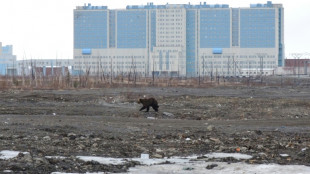 Russia probes bear attacks, as official says town under 'siege'

Crouched in bushes on the shores of the Dnipro River, two young Ukrainian men dressed in army gear stalked Russian troops through the camera of a remote-controlled drone.
Oleksiy and Mykola -- not their real names -- are part of "Rukh Oporu", the resistance network tracking down Russian forces in southern Ukraine.
Their job is to gather intelligence on Russian troop movements and positions before passing it on to the Ukrainian armed forces.
And since the regular army has launched a counter-offensive to take back the southern Kherson region, the support of this resistance network could prove crucial.
This time, their mission was particularly risky.
They were within range of Russian troops stationed on the other side of the 10-kilometre (six-mile) wide estuary.
Their drone, airborne for 25 minutes, was a simple commercial kit from China, and Russia is able to track those controlling it.
That meant Mykola and Oleksiy were at risk of coming under fire -- something they said had happened several times in the past.
But their mission went off without a hitch.
They spotted several trucks and new fortified Russian positions, information they shared with a soldier before leaving the scene.
Now all they needed was a large screen to properly examine today's footage, so as to locate potential targets and coordinate with the army.
- 'Thousands' of agents -
Oleksiy used to take care of his family business but decided to join the resistance network after seeing images of Russian atrocities in Bucha, just outside Kyiv. Mykola used to work in tourism.
Now safely installed in a nearby flat where he could analyse the fresh images, Oleksiy tried to explain his relationship with the regular army.
"We work horizontally," he said.
"Theoretically I should have gone to army headquarters in Mykolaiv to show it to them, but it'll be quicker if we do it ourselves."
Mykolaiv is the first big city west of Kherson, which Russians seized early in the war.
The recent Ukrainian counter-offensive is to try to take it back.
Mykolaiv has thus become the centre for Ukrainian resistance in the south.
In a nondescript building, Oleksiy introduced AFP journalists to 50-year-old Oleg, a senior figure in Rukh Oporu.
Oleg, his face hidden by a balaclava, agreed to shed some light on the resistance network he coordinated.
"We're not talking about one or two people here," he said of the "agents" operating covertly inside Russian-occupied territory.
"There are thousands of people working in separate cells."
Almost all of them are civilians, and their main mission consists in following Russian troop movements, he added.
- 'Very efficient'
The ongoing "counter-offensive relies partly on our data", he said.
"We know the locations of the main command centres, of their meetings, of the weapons delivery points, of the main supply routes.
"I spoke to a guy just this morning, he told me he saw 100 vehicles all massing up in one place.
"This guy, he's not afraid of anything," said Oleg. "He fights because he knows why he is fighting."
Roman Kostenko, a former soldier who is now a deputy in the Ukrainian parliament, acknowledged the role played by Rukh Oporu.
"The resistance movement has been very efficient," said Kostenko, who heads up the defence committee.
"We use the information we get from drones and satellites, but we also need people to confirm the location of our targets," he told AFP.
For a few weeks now, Ukraine has been taking the fight into the Russian-controlled area.
Russian military infrastructure has been hit by strikes, and targeted killings are carried out almost daily.
On Monday, a former member of the Ukrainian parliament who worked with the newly installed occupying administration in Kherson was shot dead.
Neither Oleksiy nor Oleg could say who carried out such assassinations.
But a Ukrainian soldier with links to the resistance told AFP: "Some civilians are ready to do it. We gave them weapons."
This includes former members of Ukraine's territorial defence forces -- a regional reserve usually posted on low-risk missions -- "given Kalashnikovs" after being trained by Ukrainian special forces.
- Moscow tightens control -
But Moscow is also tightening its grip on the region.
Many sources told AFP about cases of civilians being tortured, sometimes simply for having taken part in anti-Russian protests.
AFP was not able to independently confirm the claims.
Another resistance member, Vadym, insists he was "just your average guy" before the war.
He joined Rukh Oporu to "collect intel, organise caches of weapons, deliver weapons to whoever was ready to use them".
He told what happened after Russians discovered a weapon stash belonging to two members of the territorial defence forces.
"They killed one of them, and I don't know what happened to the other one," he said.
Vadym ended up leaving the region, which he managed only thanks to a $200 bribe at a checkpoint.
For now, heading back is out of the question.
"Russians can always say that they'll catch us, but the resistance will prevail," he said.
"There's more of us, we are the people."
Ferreira--PC