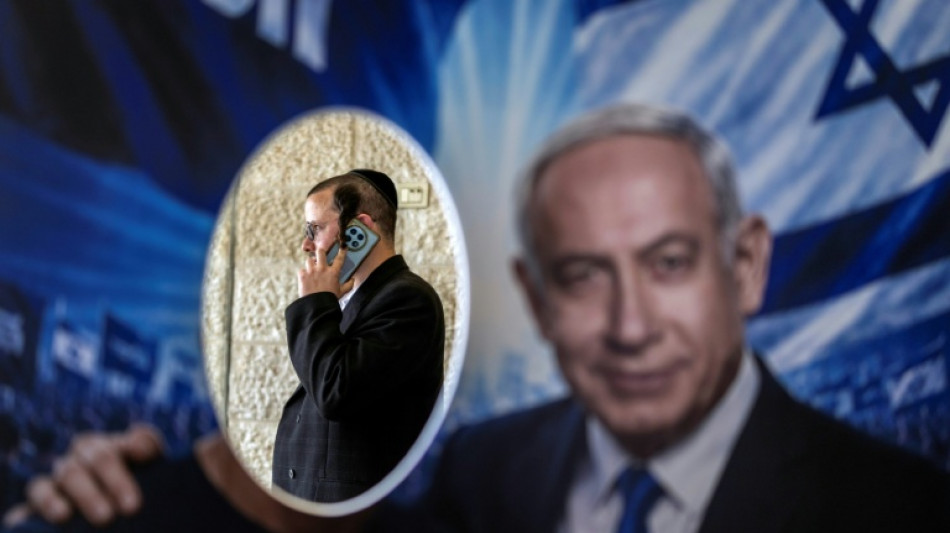
Ahead of elections, Israel tests West's patience on West Bank violence / Photo: ilia YEFIMOVICH - AFP/File

 Goa plans relationship-readiness course amid concern over divorces

 India introduces four-layer motor insurance choice from December 15

 Nikkei Falls 1.42% as AI Sector Faces Pressure Post-US Elections

 IndiGo holds talks with Embraer over potential order for 100 aircraft
 Real Madrid Visits AEK Athens in Champions League Liga Phase

 Indus Towers expands solar-powered network to 50,000 telecom sites

 Equitas Small Finance Bank rebounds after naming interim chief executive

 Titan quarterly profit seen rising as jewellery business drives growth

 Kuwait finance minister holds economic cooperation talks at COMCEC

 Abdul El-Sayed declares victory in Michigan Senate contest

 Democrats capture US Congress in sweeping midterm victory
 Manchester United rallies past Roma as PSG dominates in Champions League

 Qatar sees tentative opening for renewed regional diplomacy

 Qatar Tourism joins Pacific Asia Travel Association at London travel market

 Abdul El-Sayed Wins Michigan Senate Seat in Historic Election

 Qatar media bodies discuss support for humanitarian initiatives
Israel's ties with many Western allies were already fraught over its conduct in the Gaza war, but the worsening situation in the occupied West Bank has seen relations nosedive before close-fought October elections.
Prime Minister Benjamin Netanyahu's right-wing government is pushing ahead with the expansion of Israeli settlements, which are illegal under international law, while daily reports of settler attacks against Palestinians provoke international outrage.
While many observers expect caution from Western states in their responses before the elections, Britain's foreign secretary on Tuesday vowed a major policy reset towards Israel's West Bank construction and promised a "comprehensive set of measures" within weeks.
France's foreign minister also urged the European Union to ban trade with settlements, calling surging West Bank violence "an unacceptable affront to the dignity of the Palestinian people".
A Tel Aviv-based European diplomat told AFP that the idea of taking measures against Israel once seemed "completely unthinkable".
"Obviously, the dial has shifted over time," he added, requesting anonymity to speak on the sensitive matter.
"The West Bank we're very, very concerned about," he said. "There seems to be a huge, unprecedented level of settler violence. It doesn't look like the authorities are taking efforts to deal with that as seriously as we'd like."
Another European diplomat based in Jerusalem said there was political will to preserve a two-state solution, with Israel seen as crossing most red lines in making a Palestinian state unviable.
"Without an outright 'we are annexing the West Bank' announcement, I don't know what further red lines there are," he told AFP, also requesting anonymity.
- 'Siege mentality' -
Observers say the UK's measures are likely to target individuals and organisations directly involved in Israeli settlement expansion, rather than broader sanctions.
Israel has fought against foreign governments making any distinction between goods from Israel and West Bank settlements.
A British ban on trade with settlements "economically, in isolation... is relatively small", said Andreas Krieg, an associate professor at King's College London.
But he said the regulatory impact and precedent it sets would be important.
"If Britain, France, Germany and other European economies begin converging around the same principle, it becomes much more consequential," he told AFP.
While the United States provides Israel with crucial diplomatic and military support, the EU is Israel's biggest trading partner, according to the European Commission.
Several EU countries -- including Ireland, the Netherlands and Spain -- have imposed their own settlement trade restrictions.
But getting bloc-wide measures over the line requires securing agreement across EU member states.
In August, Slovenia's new right-wing government reportedly opposed an EU-wide condemnation of Israel's E1 settlement project that would undermine the contiguity of any future Palestinian state, downgrading the bloc's response.
But the Israeli elections are likely to delay any major European announcements, over fears of interference accusations or galvanising Netanyahu's right-wing base.
"There's a worry that if they push too hard against Israel right now, it'll feed into what's sometimes called the siege mentality that Netanyahu often speaks to," said Julie Norman, an expert at Chatham House think tank.
- Damaging rhetoric -
All the while, Israel's ties with traditional allies continue to fray, exacerbated by ever-inflammatory rhetoric from officials.
"We had a difficult relationship with this current administration anyway," the Tel Aviv-based European diplomat told AFP.
"But it seems to us like now it's very much a policy, certainly in the run-up to the elections, that we seem to be fair game," he added.
"There is damage being done to that relationship by some of the rhetoric coming out of certain ministries and by what's happening in the West Bank."
Israeli Foreign Minister Gideon Saar said in June he was severing all contact with the EU's top diplomat after she allegedly compared Israel to apartheid-era South Africa.
In response to Britain's pledge of anti-settlement measures, Saar has vowed retaliation without elaborating, with Israel reportedly looking at expelling diplomats.
A former Israeli diplomat in Europe told AFP he felt Saar's threat was an "empty gun", but said that Israel's ties with Europe in general had deteriorated under Netanyahu's watch.
The EU-Israel relationship is "on hold" until after elections, he said.
"We won't see any dramatic movement from the side of the European Union and the member states, everyone is waiting for the results, everyone I think is hoping that there will be a change."
burs-acc/sct/jfx
P.Serra--PC