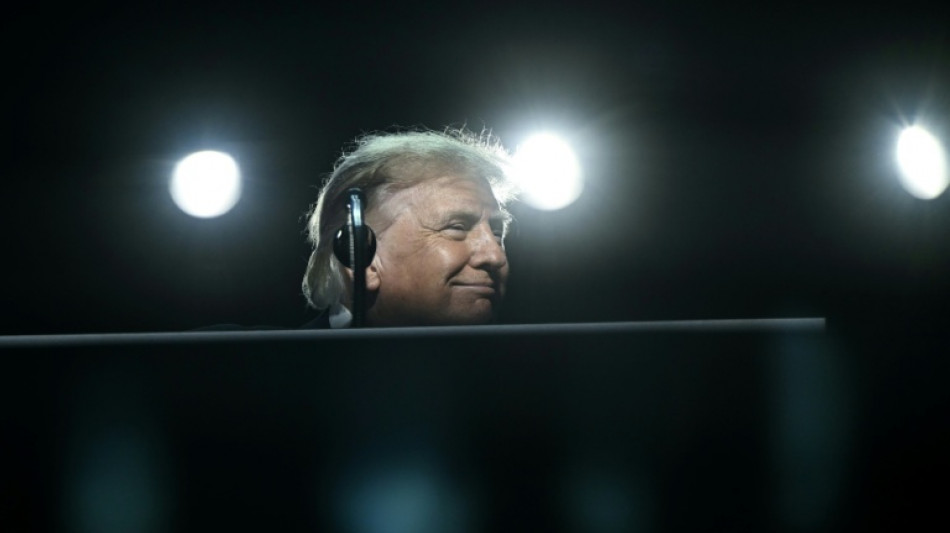
Defiant Iran seeks to bruise Trump ahead of midterms / Photo: Brendan SMIALOWSKI - AFP

 Equitas Small Finance Bank rebounds after naming interim chief executive

 Titan quarterly profit seen rising as jewellery business drives growth

 Kuwait finance minister holds economic cooperation talks at COMCEC

 Abdul El-Sayed declares victory in Michigan Senate contest

 Democrats capture US Congress in sweeping midterm victory

 Manchester United rallies past Roma as PSG dominates in Champions League

 Qatar sees tentative opening for renewed regional diplomacy

 Qatar Tourism joins Pacific Asia Travel Association at London travel market

 Abdul El-Sayed Wins Michigan Senate Seat in Historic Election

 Qatar media bodies discuss support for humanitarian initiatives

Iran is intensifying confrontational actions against the United States in the hope of further raising the cost of the conflict for President Donald Trump less than two months ahead of the US midterm elections, analysts say.
Over half a year after the war erupted on February 28 with US-Israeli attacks that killed supreme leader Ali Khamenei, Iran is upping the ante, even risking a return to all-out fighting, rather than dialling down and looking into diplomacy.
Trump, under pressure to end the war as midterm elections loom on November 3, declared on Wednesday: "I think the war will end immediately after the election" because Iran "can't hold out any longer".
But even as the chain of command in Tehran remains nebulous with Khamenei's successor and son Mojtaba still yet to make a public appearance, the leadership has doubled down on the Islamic republic's traditional policy of confrontation with the United States.
Far from allowing the return of free shipping through the Strait of Hormuz -- a vital energy conduit that normally carries around a fifth of the world's oil and liquefied natural gas -- it has announced and then expanded a new prohibited zone in the area.
"Iran perceives that it is winning the war and that the US is losing," Thomas Juneau, professor at the University of Ottawa, told AFP.
"It perceives a window of opportunity to exploit US weakness and vulnerability to reshape the regional order to its benefit," he added.
- 'Exploit US vulnerabilities' -
Sanam Vakil, director of the Middle East and North Africa programme at UK-based think tank Chatham House, said Iran "is trying to convert escalation into increased leverage".
"Tehran believes that pressure on Hormuz and the threat of wider disruption can exploit US vulnerabilities, especially the political and economic costs of another Middle East crisis ahead of the midterms," she added.
Iran's Revolutionary Guards said Wednesday they targeted 10 vessels that were attempting to cross this prohibited area of the Strait of Hormuz.
The Guards also said they struck a US military base in Jordan in response to US forces destroying five Iranian oil tankers a day earlier. CBS News reported that roughly eight US F-15s sustained light damage in the Iranian strikes overnight Tuesday.
Iran believes that ahead of the midterms "the US is constrained from escalating and because of that, an easily distracted president Trump is ceding the momentum to Iran," said Juneau.
On the streets of Tehran, there is no let-up from the ideology of confrontation, with banners proclaiming "we will kill Trump" and showing coffins of American forces being brought home, according to AFP images.
- 'Hopes to weaken Trump' -
The new prohibited zone was announced on state television on Sunday by Mohsen Rezaei, new head of Iran's supreme national security council, one of several veteran hardliners elevated to key posts by the still unseen Mojtaba Khamenei.
"We don't trust the United States, and we will not take further steps unless they engage in trust building measures... They need to deliver," Rezaei, wearing a full military uniform, declared confidently.
Revolutionary Guards spokesman Hossein Mohebi on Wednesday issued a string of demands for ending the war, ranging from the withdrawal of Israeli forces operating in south Lebanon to the release of some $24 billion in frozen Iranian assets.
Iran is hoping that bruising Trump ahead of the midterms could prompt his Republicans to lose control of the House of Representatives and even the Senate, reducing the president to lame duck status for the last two years of his presidency, analysts say.
"Iran cannot defeat the United States militarily," said Ali Alfoneh, a senior fellow at the Arab Gulf States Institute.
"Instead, Tehran hopes to weaken President Trump politically by contributing to a Republican defeat in the midterm elections -- keeping gasoline prices high and reminding American voters that the president has entangled the United States in the very 'never-ending war' he promised to avoid," he added.
- 'Anger will mount' -
Contrary to Trump's confidence that the war can end soon, the Wall Street Journal reported the president had been warned by advisers that Iran could resist the United States up to even after he is due to leave office in January 2029.
Vakil of Chatham House said Iran "could be overestimating how much escalation Washington will tolerate but sees this strategy as the only pathway to pressuring Trump."
Beyond the continued public absence of its supreme leader, Iran's leadership is facing a host of problems including an economic crisis that in January sparked protests put down by a crackdown that left thousands dead.
"There absolutely is a risk of Iran overplaying its hand," said Juneau, adding the leadership is "very vulnerable domestically" and "popular anger will only mount as economic problems worsen".
O.Salvador--PC