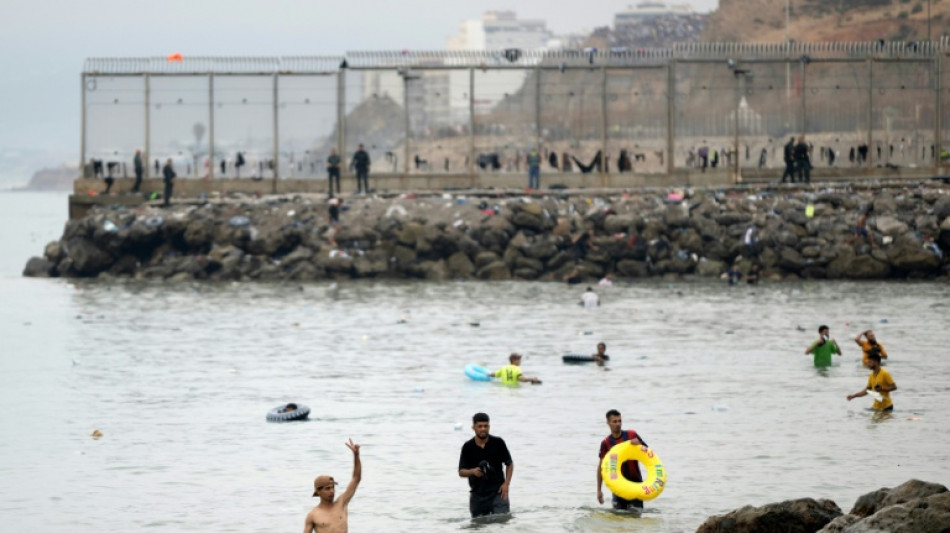
Morocco says not involved in Ceuta migrant influx / Photo: JORGE GUERRERO - AFP

 Equitas Small Finance Bank rebounds after naming interim chief executive

 Titan quarterly profit seen rising as jewellery business drives growth

 Kuwait finance minister holds economic cooperation talks at COMCEC

 Abdul El-Sayed declares victory in Michigan Senate contest

 Democrats capture US Congress in sweeping midterm victory

 Manchester United rallies past Roma as PSG dominates in Champions League

 Qatar sees tentative opening for renewed regional diplomacy

 Qatar Tourism joins Pacific Asia Travel Association at London travel market

 Abdul El-Sayed Wins Michigan Senate Seat in Historic Election

 Qatar media bodies discuss support for humanitarian initiatives

Morocco said on Thursday there were "no facts" establishing its involvement in the massive migrant rush into Spain's North African exclave of Ceuta in July.
More than 70,000 migrants entered Ceuta from Morocco on July 30 and 31 in an unprecedented, chaotic surge that left scores dead and sparked European Union infighting over the touchy issue of migration.
The Moroccan foreign ministry said there were "no facts or reports proving any involvement by the Moroccan authorities".
The ministry added that Rabat refused to become the "scapegoat for political score-settling" in Spain.
The statement marked the kingdom's first official reaction to a Spanish police report accusing Morocco's security forces of "total permissiveness" when the mass crossing took place.
Spain's Prime Minister Pedro Sanchez has consistently avoided blaming Morocco, noting that there was no "solid proof" that the North African country orchestrated the migrant rush.
On Wednesday, Spain declassified intelligence reports that had warned of potential "mass entries" by migrants into Ceuta just before the incident happened.
A declassified military intelligence document on July 30 states that it is "highly likely that the Moroccan authorities are not actively encouraging the migratory wave, but have so far acted in a negligent and passive manner".
But Sanchez on Wednesday said on X that with the information available "no one could have foreseen the migration crisis that unfolded".
- 'Regrettable' -
Morocco's foreign ministry instead questioned Spain's handling of the crisis.
"Why are illegal migrants not being turned back when the Moroccan government has officially agreed to readmit them?" the statement said.
"Why are unaccompanied minors being kept away from their families when Morocco has urgently requested their return?"
"The answer to these questions is not to be found in Morocco, but rather with the relevant Spanish stakeholders," the ministry said.
Still, Rabat called the crisis "regrettable" and said the events warranted "a thorough examination" to establish their circumstances and "ensure that they do not happen again".
The ministry also stressed the importance of ties with Madrid, saying Morocco had chosen to pursue relations based on "good neighbourliness, political understanding, economic partnership, and security cooperation".
Morocco also noted that Spain was its leading economic partner.
Most of the migrants who entered Ceuta have returned to Morocco, but thousands have remained in often dire living conditions, increasing tensions in the small city and causing a political storm for the government.
The EU on Wednesday said it was granting Spain 115 million euros ($130 million) in emergency aid to help bolster border security and assist returns.
L.Carrico--PC