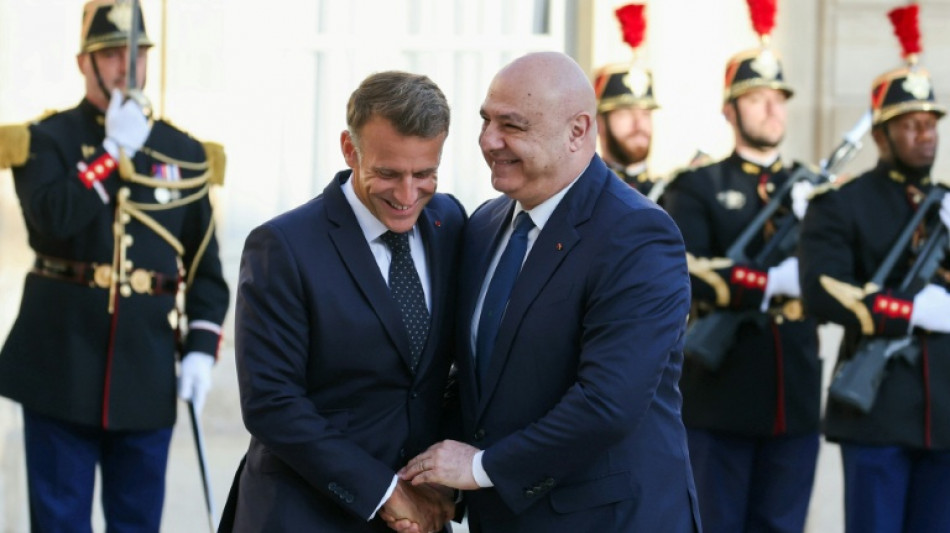
Lebanon security talks in Paris focus on replacing UN mission / Photo: Thomas SAMSON - AFP

 Manchester United rallies past Roma as PSG dominates in Champions League

 Qatar sees tentative opening for renewed regional diplomacy

 Qatar Tourism joins Pacific Asia Travel Association at London travel market

 Abdul El-Sayed Wins Michigan Senate Seat in Historic Election

 Qatar media bodies discuss support for humanitarian initiatives

 No. 22 UCLA defeats No. 5 Arizona 84-75 despite Kharchenkov's 38 points

 Vessel operator seeks witnesses after Vancouver grounding

 US Air Force deploys F-16 fighters to remote Aleutian base for readiness drill

 Bezos grant helps Seattle nonprofit move thousands of families toward housing

 Shrini Srivastava joins crew of Varanasi-Delhi Vande Bharat Sleeper service

 Nearly Half of Australian Workers Overqualified, Survey Finds

The leaders of France, Lebanon and Jordan on Thursday met in Paris to discuss international support for the cash-strapped Lebanese army and the creation of a new force to succeed a longstanding UN peacekeeping mission in southern Lebanon.
French President Emmanuel Macron welcomed Lebanese President Joseph Aoun and King Abdullah II of Jordan. They were to be joined later by senior military officials from their countries and partner nations, such as Britain and the United States, for further discussions.
The talks come as the mandate of the United Nations Interim Force In Lebanon (UNIFIL) ends this year after almost half a century of operations dating back to the Israeli invasion of 1978.
France and Italy have said they want to set up a multinational coalition to succeed UNIFIL.
Aoun told AFP this week that Lebanon wanted a new force, European or otherwise, to prevent a security vacuum after the UN peacekeepers leave south Lebanon.
Israel and the United States attacked Iran in February, sparking a war that has sprad across the Middle East.
The Iranian-backed militant group Hezbollah dragged Lebanon into the wider conflict when it fired rockets at Israel in solidarity with the Tehran government.
Israel attacked south Lebanon and its forces continue to occupy what it calls a "security zone" there.
In June, Israel and Lebanon signed a US-sponsored framework agreement that involves the disarmament of Hezbollah, a gradual withdrawal of Israeli forces from Lebanon's south and the deployment of the Lebanese army to the region.
Violence declined following the June agreement and a wider US-Iran deal, but Israel has pressed its attacks on Lebanon.
The French presidency said the aim of the Paris talks was to review a Lebanese armed forces deployment plan based on a "clear, credible and realistic" framework.
Paris said it wanted the "operational context, parameters and modalities" of the deployment to be clarified at Thursday's discussions as a prerequisite for what it hopes will be "robust" international support, whether in the form of financial assistance, equipment or training.
The poorly equipped Lebanese forces have struggled to carry out their mission of disarming Hezbollah in the south. The disarmament is a key condition for Israel's withdrawal from southern Lebanon.
Aoun has reiterated his determination to disarm Hezbollah, but "without a confrontation".
The Lebanese president has also called on Europeans, Americans and Arab nations to support the Lebanese army.
UNIFIL, which must close by the end of the year, has just under 7,500 peacekeepers from 46 countries.
G.Machado--PC

