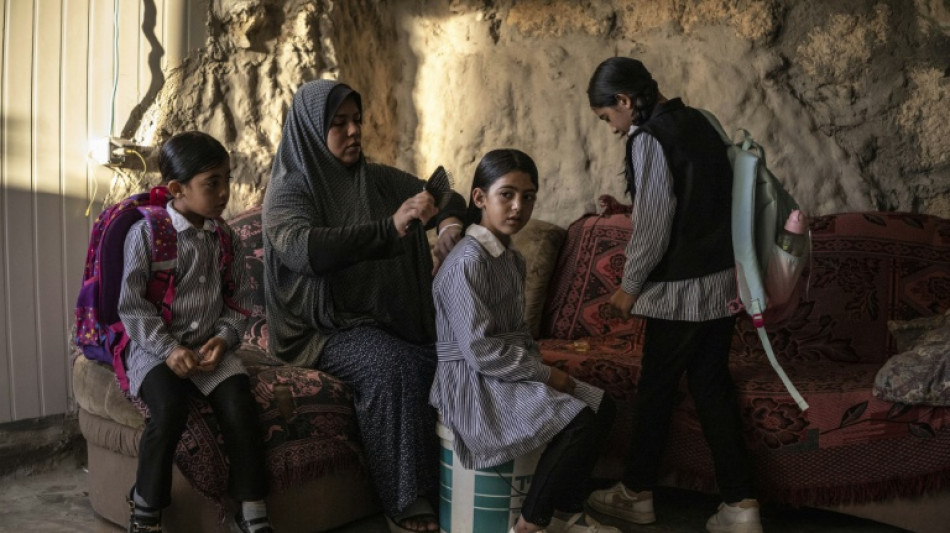
Palestinians turn rugged caves into homes after Israeli demolitions / Photo: John WESSELS - AFP

 Manchester United rallies past Roma as PSG dominates in Champions League

 Qatar sees tentative opening for renewed regional diplomacy

 Qatar Tourism joins Pacific Asia Travel Association at London travel market

 Abdul El-Sayed Wins Michigan Senate Seat in Historic Election

 Qatar media bodies discuss support for humanitarian initiatives

 No. 22 UCLA defeats No. 5 Arizona 84-75 despite Kharchenkov's 38 points

 Vessel operator seeks witnesses after Vancouver grounding

 US Air Force deploys F-16 fighters to remote Aleutian base for readiness drill

 Bezos grant helps Seattle nonprofit move thousands of families toward housing

 Shrini Srivastava joins crew of Varanasi-Delhi Vande Bharat Sleeper service

 Nearly Half of Australian Workers Overqualified, Survey Finds

Palestinian herder Mohammed Emar has set up a fully functional home for his family where his daughters can even sing karaoke. Only it is inside a cave after the Israeli army demolished his two houses.
In the occupied West Bank's arid region of Masafer Yatta, Emar made a smooth concrete floor on two caves' rough limestone ground before applying a white limewash on the brittle stone walls.
With time, electricity from solar panels and water from a well turned the grotto into a new home for the 33-year-old Emar, his two wives and 11 children, who nonetheless long for life above ground.
"We once lived in a house above ground, where you could see the world. But today, we live in an underground cave that resembles a grave," Emar said.
His children now play on the patio built out of the side of the hill in front of the cave, with his daughters singing Arabic songs on a karaoke machine and keeping an eye on the younger boys.
The youngest son, Raz, short for Razeeq, is named after a Russian-Israeli man Emar met in a Tel Aviv jail during a one-year stint he says he did after an altercation with an Israeli settler when his wife Fatima was pregnant.
Above the caves, some rubble from his two houses remains three years after the army demolished them.
On a ridge roughly 300 metres away, Israeli flags, floodlights and fences signal the presence of the Israeli settlement of Avigayil, some of whose residents Emar says make life difficult for his family, with occasional theft and attacks.
Masafer Yatta, in the West Bank's south, is known for frequent home demolitions and tensions between local Palestinians and Israeli settlers.
The hilly, semi-arid area, which is almost entirely under Israeli control according to the Oslo Agreements of the 1990s, was the subject of the Oscar-winning 2024 documentary "No Other Land".
Despite an ever-shrinking living space, locals point to family and community ties as the reason for their capacity to remain on their land after home demolitions.
- 'Ancient times'-
"Whenever someone loses their homes to demolitions, neighbours and families come to help them build new shelters. The fact that we all live close to each other helps," Emar said.
Fatima Emar, Mohammed's wife, says that the family had originally erected tents after the houses they had built in 2023 were destroyed.
"Now, we have sought refuge in the cave. Since it has existed since ancient times they cannot demolish it, and (the army) has allowed us to live there," she said.
The army justifies home demolitions by saying that the construction is illegal in areas under Israeli control. Palestinians complain that their requests for permits are almost systematically denied.
Although not the case with Emar, Israel also often destroys home to punish the families of Palestinians involved in attacks.
Emar says he hoped that the region's roughly 1,100 Palestinian residents could one day live safely in houses.
"While the world moves forward, we here in Palestine, in Masafer Yatta, are moving backwards."
A.F.Rosado--PC

