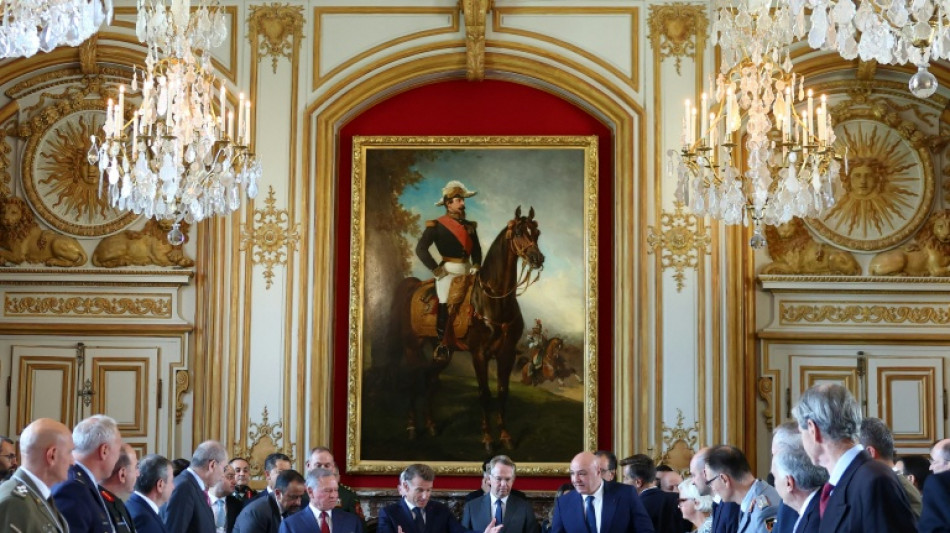
Macron hosts Lebanon security talks to back 'indispensable' army / Photo: Gonzalo Fuentes - POOL/AFP

 Manchester United rallies past Roma as PSG dominates in Champions League

 Qatar sees tentative opening for renewed regional diplomacy

 Qatar Tourism joins Pacific Asia Travel Association at London travel market

 Abdul El-Sayed Wins Michigan Senate Seat in Historic Election

 Qatar media bodies discuss support for humanitarian initiatives

 No. 22 UCLA defeats No. 5 Arizona 84-75 despite Kharchenkov's 38 points

 Vessel operator seeks witnesses after Vancouver grounding

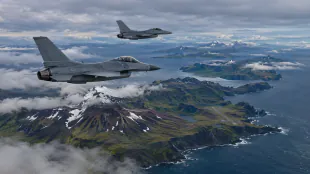 US Air Force deploys F-16 fighters to remote Aleutian base for readiness drill

 Bezos grant helps Seattle nonprofit move thousands of families toward housing

 Shrini Srivastava joins crew of Varanasi-Delhi Vande Bharat Sleeper service

 Nearly Half of Australian Workers Overqualified, Survey Finds

The leaders of France, Lebanon and Jordan on Thursday met in Paris to to drum up international support for the cash-strapped Lebanese army which President Emmanuel Macron described as "indispensable" for bringing stability to the country.
Also on the agenda was the creation of a new force to succeed a longstanding UN peacekeeping mission in southern Lebanon, where Israel is locked in fighting with Iran-backed Hezbollah fighters.
Macron welcomed Lebanese President Joseph Aoun and King Abdullah II of Jordan to Paris for the talks. They were later joined by chiefs of defence staff from Lebanon, Jordan, France, Britain and Italy, as well as top US and Saudi officials, a French military source said.
Macron said that the talks aimed to "strengthen Lebanon's sovereignty and enable it to fully ensure its security", after years during which political factions, such as the Shiite militant group Hezbollah, wielded greater authority than the Lebanese state.
"A sovereign and stable Lebanon is a decisive step toward peace and stability for the entire region," Macron wrote in a statement on X.
Along with the Lebanese and Jordanian leaders and "in close coordination" with the US, Saudi Arabia, international partners, "we support the Lebanese Armed Forces, which are indispensable for asserting the authority of the Lebanese state across its entire territory," he added.
The French presidency said the aim of the Paris talks was to review a Lebanese armed forces deployment plan based on a "clear, credible and realistic" framework.
Paris said it wanted this as a prerequisite for what it hopes will be "robust" international support, whether in the form of financial assistance, equipment or training.
The poorly equipped Lebanese forces have struggled to carry out their mission of disarming Hezbollah in the south, which is a key condition for Israel's withdrawal from southern Lebanon.
Aoun has repeatedly mentioned his determination to disarm Hezbollah, but "without a confrontation".
- 'Direct consequences' -
The talks also come as the mandate of the United Nations Interim Force in Lebanon (UNIFIL) ends this year after almost half a century of operations dating back to the Israeli invasion of 1978.
Last year, the UN Security Council, under US pressure, decided to end UNIFIL's mandate on December 31, 2026.
France and Italy have said they want to set up a multinational coalition to succeed UNIFIL. The force has just under 7,500 peacekeepers from 46 countries.
Aoun told AFP this week that Lebanon wanted a new force, European or otherwise, to prevent a security vacuum after the UN peacekeepers leave south Lebanon.
Israel and the United States attacked Iran in February, sparking a war that has spread across the Middle East.
Hezbollah dragged Lebanon into the wider conflict when it fired rockets at Israel in solidarity with the Tehran government.
Israel attacked south Lebanon and its forces continue to occupy what it calls a "security zone", a stretch of Lebanese territory about 10 kilometres (six miles) deep along the border.
In June, Israel and Lebanon signed a US-sponsored framework agreement that involves the disarmament of Hezbollah, a gradual withdrawal of Israeli forces from Lebanon's south and the deployment of the Lebanese army to the region.
Iran hit US military targets in Jordan in response to new American attacks, while shipping remains restricted in the Strait of Hormuz and the Bab al-Mandab Strait off Yemen where Houthi rebels have seized control.
"Blockades have direct consequences on our daily lives. The French are feeling them at the pump, with prices that have become unbearable," said Macron, calling for "freedom of navigation" to be restored.
fff-dt-at-mra-as-sjw/sbk
A.Silveira--PC

