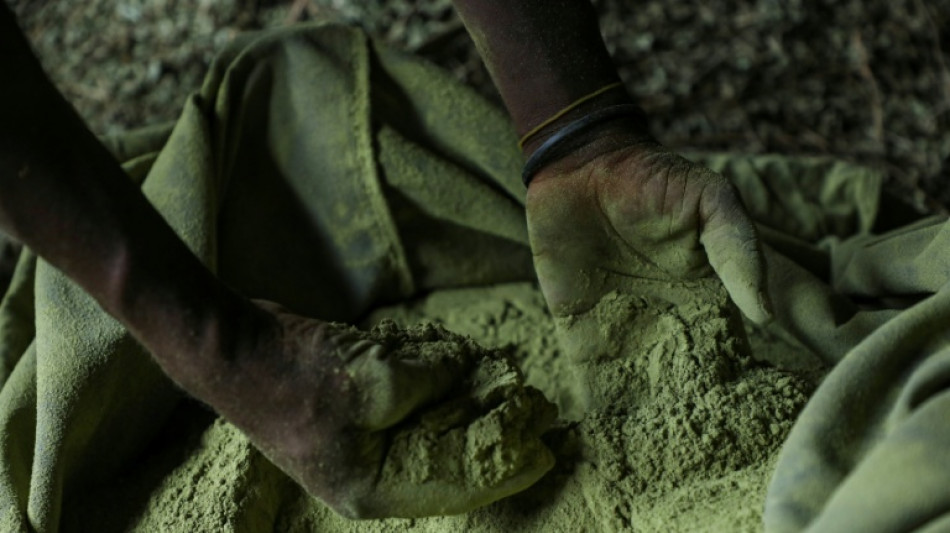
Sudanese women hold fast to threatened henna body art / Photo: - - AFP

 Kennedy Center: future unclear for iconic Washington arts hub

 Trump claims 'infinite' Greenland security deal with Denmark

 Helicopters battle wildfire threatening Ecuador's capital

 Brentford batter Chelsea to undo Alonso's promising start

 Kane hits Bundesliga century as Bayern rout Union

 Trump says CNN, MS NOW, Politico banned from White House

 Hushing and hedging: US companies retreat on climate

 Springboks to face Fiji before 2027 Rugby World Cup

 Nigeria miners struggled to breathe in cell before 37 died: survivors

 McIlroy on the charge at PGA Championship as Reed withdraws

 McIlroy on the charge at PGA Championship

 Crisis-wracked Volkswagen warns of 10-bn-euro hit to profits

 Costa Rica's Grynspan tops third informal poll for UN chief: diplomat

 Stock markets retreat after central bank rate hikes

 Russia labels director of Cannes Grand Prix winner a 'foreign agent'

 Macron warns of Russian 'hybrid' threat after meeting presidential hopefuls

 UN holds third informal poll for new chief

 Kulusevski return can spark Spurs: De Zerbi

 Shakira to cap off world tour with Madrid 12-gig run

 Isolated Syrian-Druze city blames Damascus for shortages

 Isolated Syrian-Druze city shortages

 Dutch drop Depay for Germany match in Xavi's first pick

 Ronaldo named in Portugal squad for Nations League

 Stock markets diverge after central bank rate hikes

 Anti-Assad music star makes triumphant return to Syria

Inside a beauty salon in northern Sudan, a woman in a striped dress sat patiently as henna artist Najwa Mubarak painted crimson floral patterns across her hands, preserving a cherished tradition that is under threat.
Water scarcity, climate change and three years of war have endangered the cultivation of henna, the plant used to produce the dye that has adorned Sudanese brides for centuries and features prominently in family gatherings, religious celebrations and other events across Sudan.
"Henna is both a hobby and a heritage for us," Mubarak told AFP, delicately tracing another flower onto her client's hand.
"I apply henna for brides as it is an integral part of the bride's joy. For me, it is both a passion and a source of livelihood."
Fragrant incense drifted through Mubarak's salon in Al-Damer, the capital of River Nile state, as she used soft, fluid strokes to apply the paste across the woman's skin, staining it a deep reddish-brown.
Beyond the salon, however, the pressures facing the crop are visible.
On his farm near Al-Damer, Abdallah Mohammed brushed his hand through rows of henna shrubs sagging in the heat.
For decades, the 57-year-old farmer has cultivated the plant whose leaves are dried and ground into powder.
Now he worries the land is slowly drying out.
"Water arrives at long intervals and cuts off just when we need it most," he told AFP.
"Access to water is the biggest obstacle limiting our production and causing the land to go thirsty."
- Parched fields -
Like many farmers in the region, Mohammed depends on Nile-fed irrigation canals. But sporadic supplies and neglected waterways have left fields parched at critical times, reducing both the quantity and quality of the harvest.
Sudan's conflict between the army and the paramilitary Rapid Support Forces has crippled agriculture across the country.
The war, which erupted in April 2023, has damaged irrigation networks, leaving canals clogged, pumps idle and water management systems neglected.
Meanwhile, the El Nino climate pattern has disrupted weather systems, delaying seasonal rains and contributing to lower Nile water levels, depriving farms of a vital lifeline.
Agriculture provides livelihoods for roughly 65 percent of Sudan's population, according to data from the central bank.
The UN's Food and Agriculture Organisation (FAO) said rainfall across key agricultural regions between June and mid-August was up to 30 percent below the long-term average, worsening drought and raising risks to food production and rural livelihoods.
Around Al-Damer, islands of emerald-green henna fields emerge from a sea of ochre and brown.
Under a blazing sky, farmers wove their way through the waist-high shrubs, using sickles passed down through generations to cut the leaves.
The freshly harvested branches released an earthy scent as they were gathered into bundles and carried away for drying and milling.
Henna is "a crop of significant local economic importance", environmental activist El-Rasheed Ali Mahdy told AFP.
- Major exporter -
Once one of Africa's leading henna producers, Sudan built a thriving industry around the crop, according to FAO data, exporting its distinctive dye to consumers across the Gulf, Europe and North America.
In River Nile state, which the war has largely spared, henna remains one of the most valuable cash crops, supporting livelihoods from farms and processing plants to marketplaces and beauty salons.
The Sudanese government did not respond to an AFP request for updated production and export figures.
At one factory in Al-Damer, workers spread freshly picked henna leaves to dry before feeding them into grinding mills.
Nearby, men shovelled the fine green powder into large sacks before sealing it in plastic bags bound for domestic and overseas markets.
"Before the war, we used to export our produce from Omdurman (Khartoum's twin city) to destinations all over the world," factory owner Mohamed Ramadan told AFP.
Since fighting erupted, many exporters have rerouted shipments through neighbouring Egypt as traditional trade corridors, including those through Chad, have become increasingly difficult to use, he said.
Yet despite the mounting pressures on the industry, Omnia El-Sayed, 29, owner of the salon in Al-Damer, believes henna will endure: "It is a cultural staple."
L.Mesquita--PC
