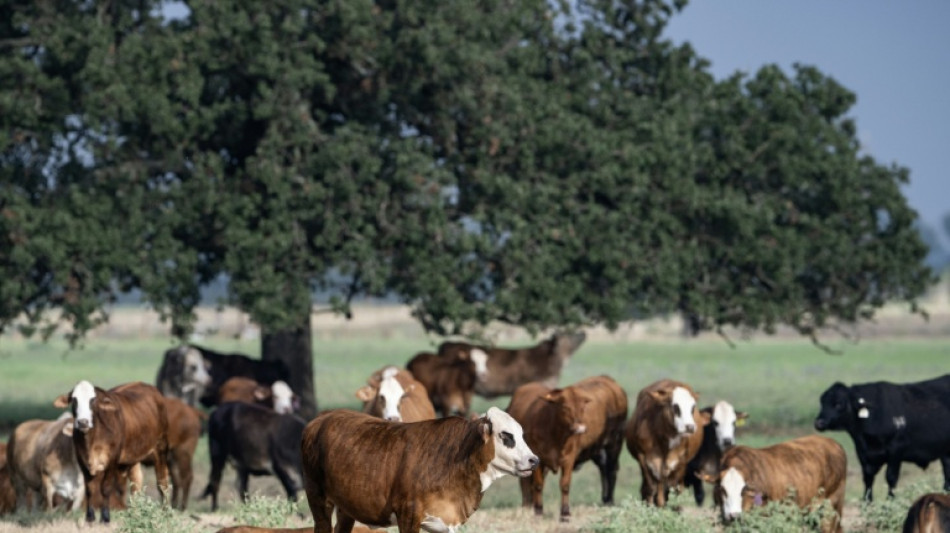
Trump's beef policies irk Texas ranchers, testing their loyalty / Photo: RONALDO SCHEMIDT - AFP

 Manchester United rallies past Roma as PSG dominates in Champions League

 Qatar sees tentative opening for renewed regional diplomacy

 Qatar Tourism joins Pacific Asia Travel Association at London travel market

 Abdul El-Sayed Wins Michigan Senate Seat in Historic Election

 Qatar media bodies discuss support for humanitarian initiatives

 No. 22 UCLA defeats No. 5 Arizona 84-75 despite Kharchenkov's 38 points

 Vessel operator seeks witnesses after Vancouver grounding

 US Air Force deploys F-16 fighters to remote Aleutian base for readiness drill

 Bezos grant helps Seattle nonprofit move thousands of families toward housing

 Shrini Srivastava joins crew of Varanasi-Delhi Vande Bharat Sleeper service

 Nearly Half of Australian Workers Overqualified, Survey Finds

As dawn breaks over the Texas prairie, where a herd of cattle grazes peacefully, there's growing discontent among ranchers over President Donald Trump's moves to lower beef prices.
His policies are testing the loyalty of ranchers here -- among his staunchest supporters -- just weeks before November's midterm elections in which affordability is a top concern.
In a bid to ease prices for consumers, Trump authorized an additional 300,000 tons of ground beef to be imported starting September 1, with reduced tariffs.
But Texas ranchers warn that the move could hurt an industry already struggling with the smallest cattle herd in 75 years and higher fuel and fertilizer costs thanks to the war with Iran.
"President Trump, who I fully support, decided that we needed to import some hamburger meat, which I don't agree with," Texas Agriculture Commissioner Sid Miller told AFP from his ranch in Stephenville, located in central Texas.
Miller sees two problems with the decision: It does not increase the cow herd, and it widens America's agricultural trade deficit.
The stakes are particularly high in Texas, home to the nation's largest cattle herd, with 12.1 million head.
The state is a Republican stronghold where Trump won more than 56 percent of the vote in 2024.
Cattle numbers have declined in Texas amid a regional drought the past three years, prompting farmers to sell their cows, Miller said.
And now they're being hit by soaring diesel fuel prices.
Those concerns could cost Trump's Republicans in November, despite their firm grip over the years on many of the state's congressional districts.
"It's going to be a closer election than we've ever had," said Miller, whom Trump has called a "warrior" in his "Make America Great Again" (MAGA) movement.
"I think we're going to lose some statewide offices...because the beef issue has disappointed a lot of ranchers and farmers," he said.
- Turning against Trump -
With a nationwide approval rating in the mid-30s, Trump and his Republican Party face headwinds in the midterm elections, even in rural farming areas that solidly backed him when he ran for office two years ago.
In 2024, Trump won an average of 77.7 percent of the vote in the 444 US counties that are agriculturally dependent, according to the specialized publication Investigate Midwest.
But an August poll by ActiVote showed that only 42 percent of rural voters approved of Trump, while 52 percent disapproved.
"While we appreciate the Trump administration's support for ranchers, increasing beef imports is not the solution to high prices," the Texas and Southwest Cattlemen's Association said in a statement.
"As the herd rebuilds, beef supplies will increase and prices will normalize, but it will take time," it said.
Bill Bullard, executive director of the producers' organization R-CALF USA, agreed that importing ground beef is a "bad policy" for American farmers.
- Mexican cattle -
The dispute over ground beef imports comes on top of another Trump policy that has angered some Texas ranchers: a halt in live-cattle imports from Mexico to contain the screwworm fly, whose flesh-eating larvae can kill cows.
"Normally we get about 1,500,000 head every year from Mexico," Miller said. The cattle graze on US land and are slaughtered and processed by American workers, he said, but that's been shut down since May 2025.
Miller said that during previous outbreaks of the screwworm, the live cattle trade was not stopped.
Although a border crossing in Arizona has reopened, it remains closed to Texas.
Demand for beef across the US, meanwhile, remains strong, and prices are expected to rise nearly 10 percent this year due to the declining supply of cattle and higher fuel costs.
Texas is beef country, where the smell of grilled steaks fills many a restaurant.
Mark Jeter, a diner at a restaurant in Stephenville, has noticed the rise in steak prices.
"To get a good ribeye right now, I think they've come back a little to $19.99 a pound for prime, where I buy it, and also a New York strip for $17.99 (a pound)," he said.
A few years ago, "you could get those for $10, $11 a pound," he said. "So it's pretty dramatic."
A.F.Rosado--PC