Drug violence tests Mexico president's 'hugs not bullets' strategy / Photo: ULISES RUIZ - AFP/File

 Thailand slams chaotic Asian Games organisation as 'musical chairs'
 North Korea to keep nuclear weapons 'forever': foreign minister

 Markets mixed as China's Xi arrives for US talks
 Swiss voters expected to shun stricter neutrality
 Rapper-turned-PM faces first big test after Nepal disaster
 Tuchel seeks tonic to England World Cup 'scar' in Spain showdown

 'Helps me cope': Catholic baptisms rise among French youth

 Colombians in Santa Marta stay inside after violence wracks the city

 Iran airlines cancel flights as US sanctions hit
 Meta launches camera-free AI glasses amid privacy pushback
 Australian PM says OpenAI hacked government health website

 Xi arrives in US to personal Trump welcome
 Morocco elects new parliament amid social frustration, youth discontent
 Scheffler and Burns to face Im and Lee in Presidents Cup opener
 Crushing wins for Lyon and Barca in women's Champions League
 Rio breaks record for rainiest September amid powerful El Nino
 At UN, tech chiefs urge caution in AI development
 Russian strikes kill seven in Ukraine, Zelensky vows winter campaign
 Venezuelan shot by ICE needs urgent medical care, mother tells AFP
 Zelensky says Putin using fighters from 47 countries in Ukraine war
 Klopp calls on Germany to 'rise above ourselves' as new era begins

 Russian strikes kill seven in Ukraine as Russia vows no 'pause' to war

 ArcPoint Expands Globally with Institutional Intelligence Platform for Modern Investors

 Ronaldo focussing on 'present' ahead of Wales test

 Outgoing UN chief makes final climate push at New York summit
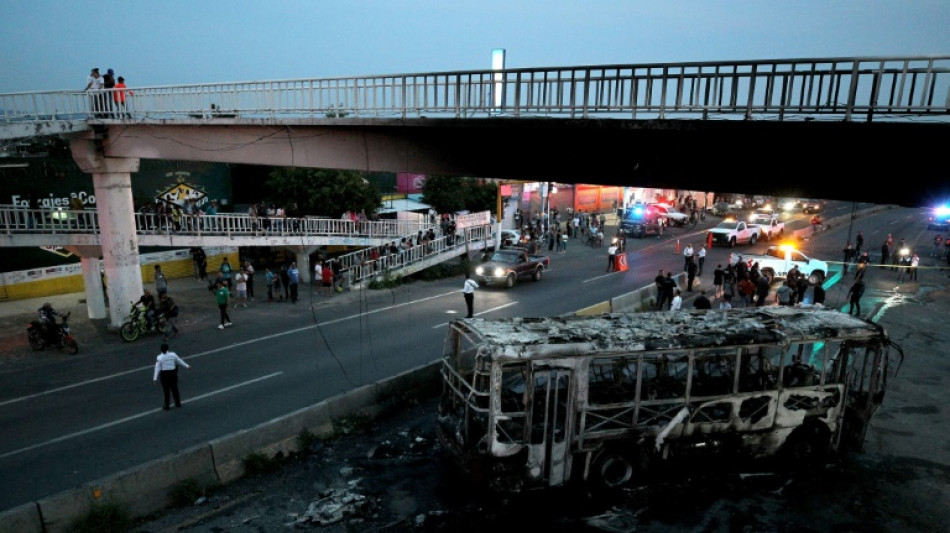
Escalating drug cartel-related violence, including indiscriminate attacks on civilians, has deepened concerns about whether Mexican President Andres Manuel Lopez Obrador's "hugs not bullets" security strategy is working.
Mounting scrutiny of Lopez Obrador's approach comes as his critics accuse him of trying to militarize the Latin American nation by putting the National Guard under army control.
A spate of violence in August in several cities, including Ciudad Juarez on the border with the United States, left 12 people dead -- including several civilians.
Such attacks "generate panic in the civilian population and confusion among the political authorities. The security authorities are paralyzed, without the capacity to react," security consultant David Saucedo told AFP.
Saucedo branded the violence "narcoterrorism" -- a term that Lopez Obrador's government has stopped short of using.
In Ciudad Juarez, gang members went on a killing spree in what Lopez Obrador described as retaliation following a prison riot involving two rival gangs.
In the eastern and central states of Jalisco and Guanajuato, gang violence left one suspected criminal dead and businesses and vehicles on fire following a failed attempt to capture two cartel bosses.
The government's response was not to "examine why it happened and to implement the sort of strategies that have been proven to reduce criminal involvement," said Michael Lettieri, co-founder of the Mexico Violence Resource Project at the University of California, San Diego.
Instead, it ordered the deployment of soldiers -- a response similar to those of previous governments that Lopez Obrador accuses of having exacerbated violence by militarizing the war on drugs.
- 'Two wars' -
While the recent attacks shocked the country, every day there are dozens of murders in Mexico and most do not draw much attention.
The country faces "two wars": high-profile attempts to capture gang leaders and violence affecting ordinary Mexicans that the government has failed to tackle, said Laura Atuesta, coordinator of the drug policy program at the Center for Economic Research and Teaching.
Criminals "keep killing people, breaking into houses and making people disappear," she said.
Lopez Obrador says his "hugs not bullets" strategy aims to tackle violent crime at its roots by fighting poverty and inequality with social programs, rather than with the army.
The new approach was "reducing violence," the president said last week in his annual state of the nation address, adding that federal crimes had dropped 29.3 percent since he took office in 2018.
Between January and July, murders fell 8.7 percent compared with the same period in 2021, to 18,093 victims, according to the government.
More than 340,000 people have been killed in a spiral of bloodshed since the government of then-president Felipe Calderon deployed the army to fight drug cartels in 2006.
Human rights group Amnesty International has urged Lopez Obrador to abandon his plan to give the military control of the National Guard.
The president created the new security force in 2019 with a civilian command to replace federal police accused of corruption and rights violations.
"Experience shows that today Mexico is more dangerous than 16 years ago when it was decided that the military should take to the streets," Amnesty said last month.
"There has been an increase in forced disappearances, arbitrary arrests, physical, psychological and even sexual torture," it added.
Lopez Obrador's plan has been approved by the lower house of Congress but seems unlikely to be passed in the upper chamber, so he has vowed to seek other legal options.
Even if the National Guard is put under military control, it will take time for the force to develop operational capabilities, according to experts.
Lopez Obrador is only managing, rather than solving, the security problem, "laying the groundwork for a future war" that will not happen before his term ends in 2024, Saucedo said.
S.Pimentel--PC