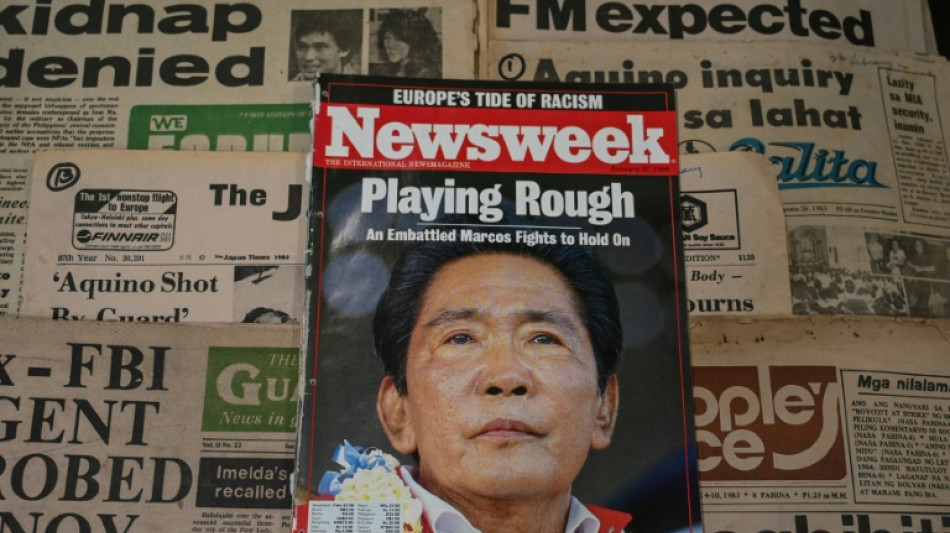
Misinformation shrouds Philippine martial law era horrors / Photo: JAM STA ROSA - AFP

 England cannot imitate Spain's success, says Gordon

 Hungary detects invasive spotted lanternfly for first time in EU

 Ο Alex Bodi και ο καθηγητής Δρ. Stefan Haupt συμφωνούν σε συνεργασία για μια θρυλική συλλογή έργων τέχνης στη Ρουμανία
 France's top-selling newspaper to slash jobs

 Tigray rebels in 'full-blown' war with govt

 Alex Bodi och prof. dr Stefan Haupt ingår samarbetsavtal om en legendarisk konstsamling i Rumänien
 อเล็กซ์ โบดี และศาสตราจารย์ ดร. สเตฟาน ฮาปท์ ตกลงร่วมมือกันในการจัดตั้งคอลเลกชันศิลปะอันเป็นตำนานในโรมาเนีย
 Alex Bodi a prof. dr. Stefan Haupt se dohodli na spolupráci na legendární umělecké sbírce v Rumunsku
 알렉스 보디와 슈테판 하우프트 교수, 루마니아의 전설적인 미술품 컬렉션을 위한 협력 합의

 BaazEX Enters the Asian Trading Market With a New Approach to Online Forex Trading.
 Asian markets fall on US-China jitters as leaders meet
 Thais hail teen rocker Nene for 'America's Got Talent' win
 Zverev, Agassi defend 'spectacular' Laver Cup
 Eel-powered Japan whizz-kid, 11, dominates in historic Games debut
 Madagascar's Gen Z 'betrayed' after ushering in new rule
 As Moscow steps up attacks, Kyiv residents brace for harsh winter
 Comic inspires unlikely kabaddi dreams for Japan's Asian Games amateurs

 Thailand slams chaotic Asian Games organisation as 'musical chairs'

 North Korea to keep nuclear weapons 'forever': foreign minister
 Markets mixed as China's Xi arrives for US talks
 Swiss voters expected to shun stricter neutrality
 Rapper-turned-PM faces first big test after Nepal disaster
 Tuchel seeks tonic to England World Cup 'scar' in Spain showdown

 'Helps me cope': Catholic baptisms rise among French youth
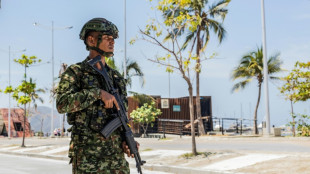 Colombians in Santa Marta stay inside after violence wracks the city

American lawyer Thomas Jones still remembers the scars of Philippine torture victims he interviewed for Amnesty International inside the country's detention centres in 1975 during the rule of late dictator Ferdinand Marcos.
But Marcos, who presided over widespread abuses and corruption during his 20 years in power, denied the lawyer's visit to the Philippines ever happened.
Decades later the dictator's claim -- debunked by AFP and others -- has resurfaced on social media sites popular among Filipinos.
Amnesty estimates thousands of people were killed and tens of thousands tortured and imprisoned after Marcos imposed martial law on September 21, 1972.
Under legislation signed in 2013 by former president Benigno Aquino, 11,103 victims of torture, killings, enforced disappearances and other abuses have been officially recognised and compensated.
In the run-up to Wednesday's 50th anniversary of the start of martial law, pro-Marcos posts have flooded Facebook and TikTok with false and misleading claims that cast doubt on Amnesty's findings and downplay the abuses.
AFP has fact-checked multiple posts that carried footage of Marcos addressing US media in 1982.
Marcos -- father of current Philippine President Ferdinand Marcos Jr who has defended martial law -- accused Amnesty of relying on "hearsay" for their findings. And he falsely claimed the rights group "never" visited the country.
The clip resurfaced on TikTok in March after an anti-Marcos Senate candidate running in May 9 elections cited Amnesty for figures showing the horrors of martial law.
"Amnesty International (said) 3,257 were killed during Marcos's time, 35,000 were tortured... 70,000 were imprisoned. It's a matter of record," Luke Espiritu said in a debate.
Within hours of that livestreamed event, the Marcos footage had been stitched with the Espiritu video and circulated on TikTok and Facebook.
It received more than 900,000 views, according to analysis by AFP's Fact Check team.
One post drew more than 3,000 comments that questioned Amnesty's numbers and described the dictator as "a great leader destroyed by black propaganda".
Jones said Marcos lied about the Amnesty visit and martial law abuses, and decades later Filipinos were being deceived by his son.
"People of the Philippines, they still don't know the facts," the 81-year-old told AFP from his home in Wisconsin.
Jones and a colleague interviewed Marcos, members of his cabinet and 107 detainees during their visit.
Marcos admitted about 50,000 people had been arrested in the first few years of martial law, while 71 detainees told them they had been tortured, Jones said.
Amnesty published their findings in 1976, with their conclusion that "torture was used freely and with extreme cruelty, often over long periods".
The Marcos government denied torture was "widely used" and said Amnesty's report was "based on fabrications, biased, and without factual foundations".
- 'Short memories' -
Josefina Forcadilla, 66, one of the detainees mentioned in the Amnesty report, remembers being interviewed by Jones and his colleague while she was imprisoned.
"I was hesitant to talk to them at first, until they said they wanted to document what my family went through at the time," she told AFP.
Forcadilla was 17 when police raided their house in search of her elder brother in April 1973.
She said an officer boxed her ears, fondled her breasts and played Russian roulette with a gun while interrogating her about his whereabouts.
"I was in shock. I couldn't cry. I knew then that their purpose was really to kill," she said.
She and three other siblings were eventually arrested.
Her elder sister was assaulted and died in detention, while her brother was tortured and another sister gave birth in prison.
"My family can't help but ask, why do Filipinos have short memories?" she said.
Amnesty visited the Philippines again in 1981 to document abuses that took place from 1976 onwards.
In a 2018 statement, Amnesty said: "From 1972 to 1981, some 70,000 people were imprisoned and 34,000 were tortured; over 3,200 people were killed."
Marcos was toppled from power in 1986.
Rachel Chhoa-Howard, Amnesty researcher for Southeast Asia, defended the rights group's estimates, saying they were "based on our own field missions and documentation during the 80s and cross-referenced with other research at the time".
But she said the true scale of the abuses may never be known "given the immensity and pervasiveness of violations during that time".
- Denying atrocities -
Yet, the truth about what is known is itself under attack.
Filipinos worried about martial law violence being whitewashed or erased by the new Marcos administration have been digitising books, films and articles documenting the brutality.
One group is Project Gunita, which has been scanning and posting old newspaper and magazine reports on social media to educate users influenced by pro-Marcos misinformation.
"It's pointless to have our Google drives, it's pointless to have this database of information if it doesn't get to those people who need to read them," said co-founder Sarah Gomez.
Joel Ariate, a member of the University of the Philippines' Marcos Regime Research group, said denying Marcos atrocities "has become like a bloodsport online".
He said the key to fighting misinformation about martial law was to repeat the truth "as much as the lies".
Marcos Jr, who said earlier this year he had not seen Amnesty's figures and did not know how they were generated, last week acknowledged there had been "abuses" under martial law, "like in any war".
But martial law had been "necessary" to defend the country against communist and Muslim insurgencies, he told a local celebrity talk show host.
Carmelo Crisanto of the Human Rights Violations Victims' Memorial Commission, an independent government body, said in August the real number of victims could be much higher than the official figure.
"Many people in the fringes of our society -- Muslims, farmers, fisherfolk -- they didn't even hear that there was a process for filing claims," Crisanto said.
"So the effects of the regime could have touched them but they are not recorded."
L.Mesquita--PC