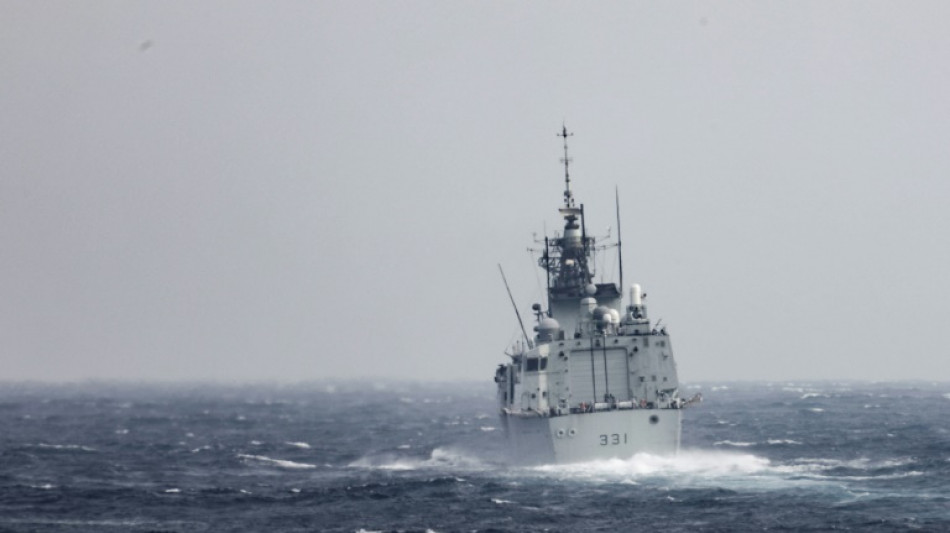
US and Canadian warships sail through Taiwan Strait / Photo: - - US NAVY/AFP

 Middletown High School Football Team Ends Legal Battle After Playoff Forfeit

 Canada Signals Openness to Chinese Automakers if US Trade Talks Fail

 US Mortgage Rate Falls for Fourth Week but Remains Above 7%

 US Jobless Claims Rise to 200,000 but Layoffs Remain Historically Low

 Euro-Area Growth Slows to 0.4% While Employment Stalls

 US Wholesale Inflation Eases Monthly but Hits a Four-Year Annual High

 India's Wholesale Inflation Jumps to 12.29% as Fuel Costs Surge

 Japan's Economy Edges Into Contraction as Costly Oil Weighs on Demand

 Kuwait and Egypt Sign Eight Agreements to Expand Strategic Partnership

 OBI Pharma Signs Collaboration and License Agreement with Novartis

A US destroyer and a Canadian frigate sailed through the Taiwan Strait on Tuesday in the latest joint operation aimed at reinforcing the route's status as an international waterway.
Beijing views as its own both democratic Taiwan and the narrow body of water separating the island from mainland China -- one of the world's busiest shipping channels.
The United States has long used "freedom of navigation" passages through the Taiwan Strait to push back against Chinese claims and Western allies have increasingly joined these operations.
The USS Higgins, an Arleigh Burke-class destroyer, in cooperation with the Royal Canadian Navy's Halifax-class frigate HMCS Vancouver "conducted a routine Taiwan Strait transit September 20 (local time)... in accordance with international law", the US Navy's Seventh Fleet said.
"The ship transited through a corridor in the Strait that is beyond the territorial sea of any coastal State."
Canada said the HMCS Vancouver was en route to join an ongoing mission to enforce UN sanctions against North Korea when it transited with the USS Higgins.
"Today's routine Taiwan Strait transit demonstrates our commitment to a free, open and inclusive Indo-Pacific," Canadian Defense Minister Anita Anand said in a statement, using another term for the Asia-Pacific region.
A spokesman for China's Eastern Theatre Command described the latest transit as "public hype".
"The troops are always on high alert, resolutely counteract all threats and provocations, and resolutely defend national sovereignty and territorial integrity," Colonel Shi Yi said, according to Chinese state broadcaster CCTV.
British, Canadian, French and Australian warships have made passages through the Taiwan Strait in recent years, sparking protests from Beijing.
They also frequently ply the South China Sea, another vital shipping area that Beijing insists comes under its domain despite a 2016 Hague ruling that dismissed its claims as well as rival ones from multiple neighbours.
The last time US and Canadian warships sailed through the Taiwan Strait was 11 months ago when the destroyer USS Dewey and frigate HMCS Winnipeg made the trip.
The latest joint passage came a day after President Joe Biden again declared that US troops would come to Taiwan's aid in the event of a Chinese invasion.
This was the fourth time Biden made such comments, despite Washington's longstanding official policy of "strategic ambiguity" -- designed both to ward off a Chinese invasion and discourage Taiwan from provoking Beijing by formally declaring independence.
Each time after Biden's comments, the White House said there was no change in US policy on Taiwan.
F.Santana--PC

