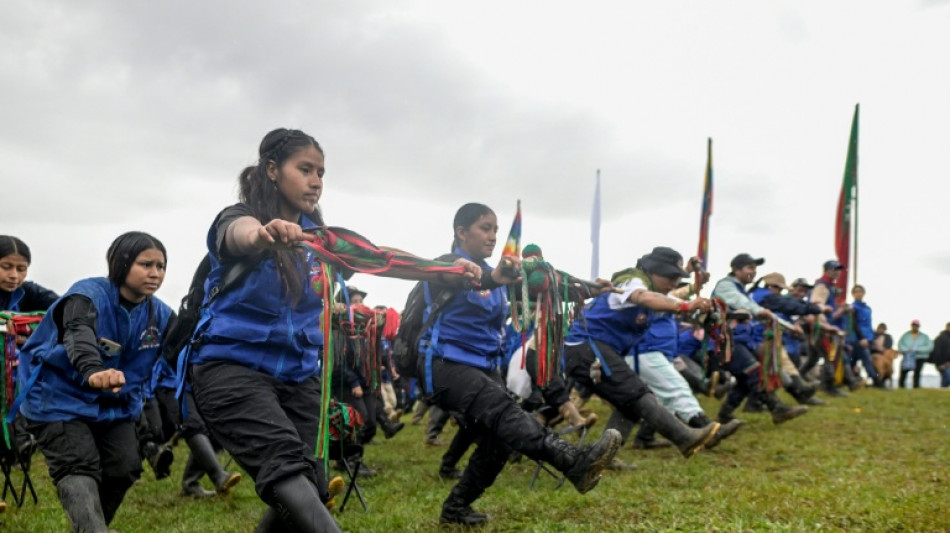
Colombia's Indigenous Guard up in arms over new president's agenda / Photo: JOAQUIN SARMIENTO - AFP

 Capital-markets shares rally as Motilal Oswal and Angel One lead gains

 Latino Voters Defy ICE Fears, Turn Out in Record Numbers for Midterms

 ITC shares rise as analysts anticipate gradual cigarette-business recovery

 Reliance rally puts historical one-year return pattern in focus

 Kuwait edges Oman 1-0 in veterans Gulf Cup in Doha

 Saudi Aramco quarterly profit climbs 34.6% amid elevated oil prices
 Washington reports movement in Iran negotiations aimed at preventing escalation

 Korea’s Labor Share of GDP Hits Record Low Amid Semiconductor Boom

 littlefish and Halo Dot Partner to Replace Payment Terminals with SoftPOS

 Kuwait inspectors destroy 115 kilograms of unverified meat in Farwaniya

 Egypt Accelerates Construction of 341km Sinai Railway Linking Arish and Taba
 John Schneider Admits Owes Millions in 'Dukes of Hazzard' Divorce Battle

 Philippine Authorities Report Progress in Thomas Markle Sr. Child Pornography Probe

 Web Summit Qatar 2026 generated QR1 billion economic impact, report says

 UAE oil spill raises questions for desalination operations

 Doha hotel and Carolina Herrera launch fragrance-inspired afternoon tea

In the mountains of southwestern Colombia, hundreds of Indigenous guards who protect their lands from crime are debating how to negotiate a standoff with right-wing President Abelardo de la Espriella.
For decades, the Indigenous Guard has defended remote Colombian territories against powerful guerrillas and drug cartels, without firearms.
They have rescued kidnapping victims, searched for children recruited by armed groups, and even protected forests from deforestation.
Today, the struggle of this ancestral defense force is with Colombia's new leader, who wants to assert more state control over their activities.
"Guard, guard, strength, strength, for my people, for my land," the guards chanted as they held their traditional wooden staffs aloft during the gathering in Caloto in violence-plagued Cauca department.
Their ire is directed at a bill that would allow the government to gather data on the guards and on where they operate for a national registry.
These custodians of the land see the bill as a violation of the right to self-determination for which they fought for centuries.
The government initiative "could become a mechanism for surveillance, stigmatization, and prosecution" in a country ravaged by more than half a century of armed conflict, the Regional Indigenous Council of Cauca (CRIC) said in a statement.
The guards argue that any weakening of their security role would lead to more violence and loss of life.
"Our territory is at risk," Jorge Sánchez, a 55-year-old CRIC member told AFP at the Cauca gathering.
On October 14, some 6,000 Indigenous people from across the country dressed in the red and green garb of the Guard converged on Cauca to protest the bill.
- On the frontlines -
A decade after the Marxist rebel army FARC made peace with the state, Colombia's mountains, highlands and rainforest are still bristling with armed groups that profit from drug trafficking and illegal mining.
In these remote areas inhabited chiefly by Indigenous peoples, the Indigenous Guard is the first line of defense for communities.
"We are the ones who walk the territory and warn of imminent risks," said Jose Joy Martenorio, CRIC's political coordinator.
In the event of an emergency, they summon dozens of supporters who rush to the scene with sticks and push out the guerrillas.
The guard's role has redoubled in importance amid the worst surge in violence since the 2016 peace deal.
At least 120 Indigenous people have been murdered by armed groups in the last ten years, according to CRIC.
In February, the guards rescued former vice-presidential candidate and Indigenous leader Aida Quilcue, who was kidnapped and held for several hours by guerrillas in Cauca.
They also played a key role in the audacious, highly publicized rescue in 2023 of four children lost for 40 days after a plane crash in the Amazon rainforest.
- Opposing visions for Colombia -
Indigenous people represent only around 4 percent of the Colombian population but have outsized influence.
The guard's voter mobilization was key to the 2022 election of the country's first left-wing president Gustavo Petro, who was succeeded by De la Espriella in August.
De la Espriella, a millionaire US-backed lawyer, has moved quickly to end restrictions on fracking and on mining in ecologically sensitive areas, both of which Indigenous communities oppose.
The tough-talking president has dismissed their objections as posing "obstacles to Colombia's development" and warned that he will not be dissuaded by protests.
"We have two opposing visions for the country," said CRIC member Edwin Capaz Lectamo told AFP.
"One is centered on the land, life, spirituality, and worldview," he said, while the other "sees the land as a business opportunity."
X.M.Francisco--PC