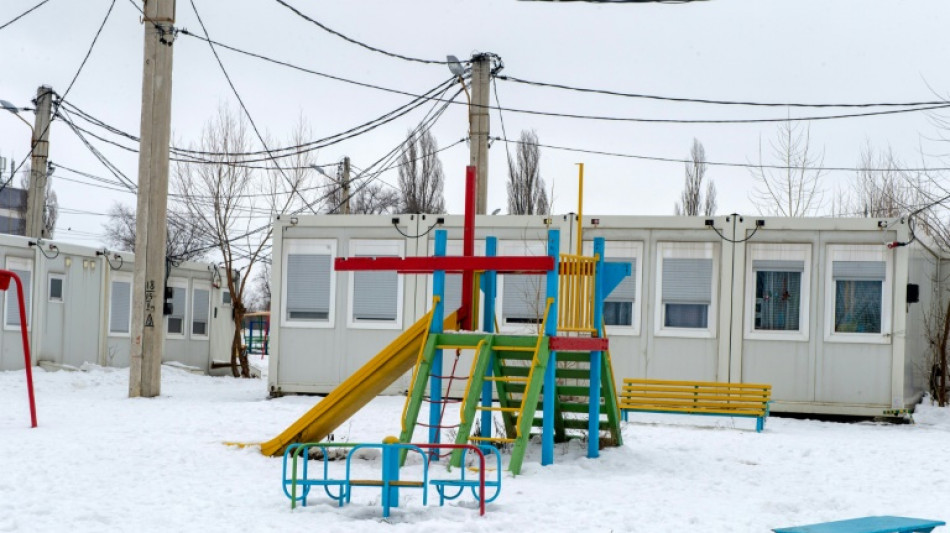
Ukraine displaced fear losing homes again

 Drone owners rush to offload devices ahead of Beijing ban

 Trump's beef policies irk Texas ranchers, testing their loyalty

 Nvidia, OpenAI CEOs to attend Xi dinner at White House

 Anthropic picks Accenture for in-house AI safety evaluation

 Balogun returns as Monaco beat Lens to continue strong Ligue 1 start

 'Pause' on overt repression in Venezuela, but reforms still needed: HRW

 Global stocks mixed as yen falls despite Bank of Japan rate hike

 Cuba hit with seventh major blackout of the year

 Murray out with concussion so Wentz will start for Vikings

 UN chief 'deeply regrets' US visa refusal to Abbas for annual meeting

 England quick Carse to face no charges over alleged nightclub assault

 Mancini brings nine newcomers into the first squad of his Italy comeback

 Czechs level Davis Cup tie against USA as South Korea eye Finals

 New France boss Zidane confirms Mbappe as captain after naming first squad

 California governor signs order to explore AI 'kill switch'

 Head leads run spree as Australia win Zimbabwe ODI series

 In-form Raphinha wants to finish career at Barcelona

 Warren Buffett steps down as Berkshire Hathaway chairman

 Carrick confident Man Utd can 'work through' tough time

 Mbappe ends Nike partnership to join Swiss brand On

 Liverpool boss Iraola puts Bournemouth love affair on hold

 'A disaster' if Man City do not win says Maresca after flawless start

 Kerry James Marshall: American 'blackness' painter celebrated in Europe

 Spain coach De la Fuente offers 'full support' to people of Ceuta

 Russia seizes assets of Nestle, French firms over West's Ukraine support

When she fled the conflict zone in east Ukraine, Lyudmyla Bobova never imagined she would celebrate her 59th birthday, almost eight years later, still living in emergency housing and under the threat of fresh bloodshed.
"We have got used to living here, we don't have a choice," she told AFP, standing in the doorway of the small room she shares with her disabled husband and elderly mother.
Now, as fears swirl that over 100,000 Russian troops camped along Ukraine's border could stage an invasion, there are fresh warnings that millions more people could join the hundreds of thousands like Bobova already forced from their homes.
It was the summer of 2014 when Bobova says she hastily packed two bags and left her native Lugansk region as it was engulfed by fighting between Ukrainian forces and Russian-backed separatists.
She headed to Ukraine's second city of Kharkiv, the nearest major hub controlled by the government, in the country's largely Russian-speaking industrial east.
By early 2015 she was living in pre-fabricated housing put up in a hurry for 500 vulnerable displaced with funding from the German government.
It was meant to be a temporary solution, but years later 175 people, including 70 children, are still living in the cluster of white cubes.
The makeshift housing is showing its age. The units are creaking, taps are broken and water heaters keep breaking down more frequently.
- 'Where would we go?' -
Bobova hopes against hope that the local authorities will find a more lasting fix for their accommodation woes.
She says she can't go back to her former home where her son is buried, as it lies across the volatile front line in separatist-held territory.
And as tensions have risen over a possible new Russian offensive, she says she doesn't want to be forced to leave Kharkiv, located precariously just 40 kilometres (25 miles) from the border.
"We had to live, so we fled, my mother was still walking with her cane but now it's difficult and my husband's health has deteriorated," she says.
"And where would we go?"
The Ukrainian government says that some 1.5 million displaced people have been registered around the country since Moscow seized Crimea and war broke out in the east in 2014. Around 135,000 of them are in Kharkiv.
The Norwegian Refugee Council has warned that up to two million people living along the 427-kilometre front line risk being forced from their homes if the conflict escalates.
Activist Yevgenia Levenshtein remembers how hundreds of displaced arrived at the Kharkiv train station back in 2014 "with nothing, families and children, in tears, from the areas being bombed".
Her association, Ukrainian Frontiers, provided emergency aid -- hygiene products, food, housing, work -- to the newcomers.
Given the recent warnings, the organisation has started to prepare again for a fresh wave of evacuations by repairing its minibuses, stocking up on fuel and ordering basic necessities.
- 'Shelter' -
Some who fled the violence have returned to their homes in the self-proclaimed separatist "republics" despite the low-level fighting rumbling on.
And those who remain behind in Kharkiv have strong pro-Ukrainian views.
"They chose Kharkiv for their new life, it's their shelter," says Levenshtein.
"They are ready, at least for now, to stay and defend it. But how? That's a mystery to me."
This is the case of Olga Todorova, who still has tears in her eyes when she tells of how she fled Lugansk by train to avoid separatist checkpoints on the roads.
In the room she rents in a Soviet-era building on the outskirts of Kharkiv, the 53-year-old journalist says she has already made up her mind what to do in case of a Russian attack.
"I know how scary it is, the Russian bombing and mortars or missiles, but we won't leave," she says.
Her partner Sergiy Kolesnyshenko, who was detained and beaten by the separatists, says he is ready to join the reserve forces in case of a Russian attack.
"How much time can we spend running away?" he asks "We can run away but what's the point?"
F.Carias--PC
