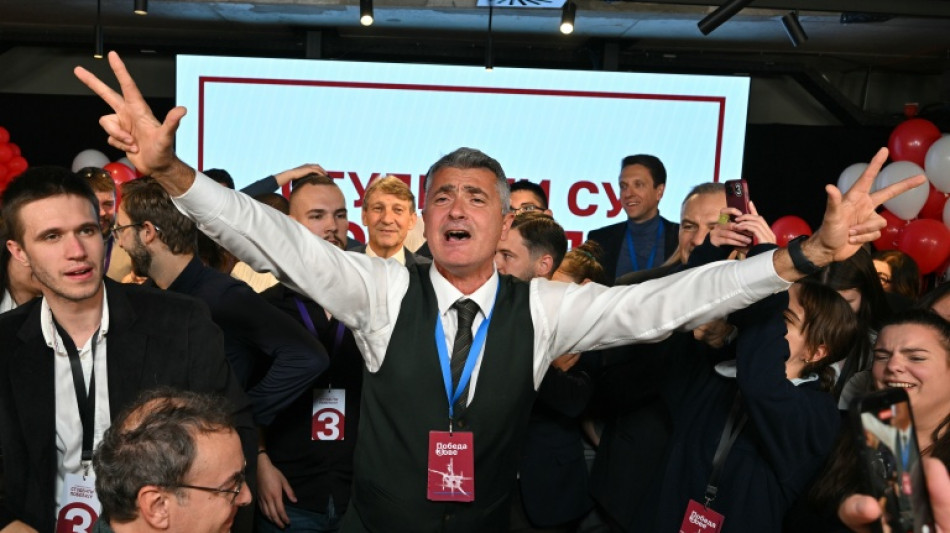
Serbian student movement eyes power after resounding snap poll victory / Photo: ANDREJ ISAKOVIC - AFP

 Hong Kong court set to sentence activist Joshua Wong in security case
 Australia raises benchmark rate to highest level in 18 years

 'The Remarried Empress' Cast Discusses Bringing Fantasy Royal Drama to Life

 Asian stocks retreat as AI worries outweigh steep oil-price drop

 Hamad International Airport stages emergency drills during WATAN 2026

 Global failure to punish attacks leaves journalists at continuing risk
 Researchers Warn 'Bookkeeping Trick' Masks Beef Industry's Methane Emissions

 Climate Change Intensified Atlantic Hurricanes, Study Finds

 Qatar solar expansion opens scope for technical performance gains

 IXOPAY Announces IXO One, a Modular Payments Platform Built for an Era of Fluid Commerce
Serbia's student-led movement targeted a clear majority on Monday as it prepared to govern after ending 14 years of right-wing populist rule.
The victory in Sunday's parliamentary vote came after nearly two years of anti-government protests sparked by the 2024 collapse of a canopy at Novi Sad railway station that killed 16 people.
The disaster has been widely blamed on corruption and triggered some of Serbia's largest protests since the fall of strongman Slobodan Milosevic in 2000.
The result will be closely watched across Europe as the continent faces a wave of youth-led demonstrations.
But political analyst Dusan Vucicevic said that the movement was distinct from other protests.
"This experiment in grassroots democracy ultimately succeeded in securing more than 50 percent of the vote, although it remains unclear whether a similar model could work in other countries," Vucicevic told AFP.
According to independent electoral watchdog CeSID, the Students' List secured 53 percent of the vote while Vucic's populist Serbian Progressive Party (SNS) garnered almost 39 percent based on 96 percent of the count.
The result would give them 140 MPs in the 250-seat assembly, with 103 for the SNS. So far no other party has passed the required threshold to enter parliament.
"Students won and with them also a hope that Serbia can be a country of justice, freedom and dignity," Radomir Saicic, a candidate for the List, told supporters in a speech at the movement's election headquarters late Sunday.
Near-record turnout of almost 70 percent, the Balkan nation's highest at a parliamentary election in more than three decades, likely drove the political upset.
The figure surpassed the 1993 parliamentary election, when just over 61 percent voted.
- Toppling Vucic -
Shocking many observers, Vucic, who has grown increasingly authoritarian in recent years, conceded defeat less than two hours after polls closed.
It triggered raucous scenes as supporters of the movement celebrated the defeat of a government they blamed for deep-rooted corruption.
Thousands poured into the streets of Belgrade and other cities to celebrate, with cars honking, crowds chanting, and fireworks lighting up the skyline.
Addressing supporters late Sunday, Vucic, who has maintained close ties with Russia throughout his tenure, blamed foreign powers for the result.
"I want people to know, this was the validation of a revolution carried out with the direct support of various European countries and the US deep state, the one that is also against President Trump," he said.
For nearly two years, students have staged rallies and marched across the Balkan nation to reach voters directly and counter the media machine of Vucic's Serbian Progressive Party.
Their protests have drawn huge crowds. A final pre-election rally in Belgrade on Thursday attracted around 150,000 people, according to an independent protest monitor.
- A broad platform -
Most of the student list's 250 candidates are experts from fields including academia and the arts with little political experience.
The movement has a broad platform, centred on a pledge to fight corruption.
It evolved from demands for a transparent investigation into the Novi Sad tragedy into calls for an early election.
The movement kept foreign policy issues, including Serbia's relationship with the European Union and longtime ally Russia, in the background.
On Monday, the Kremlin said it hoped that Serbia's new leaders "understand that cooperation with Russia is in Serbia's interests, because it brings benefits to Serbia".
"From the outset, they insisted as much as possible that Serbia must first and foremost address its domestic political issues -- problems with the electoral process, the media environment, and the literal dismantling of every institution in Serbia, from the national to the local level," Vucicevic said.
The students are expected to prioritise institutional reform and the rule of law, which he added would bring the country closer to EU membership.
Despite pushing back against the protests for almost two years, Vucic, under mounting pressure, called the vote last month, citing "major turbulence on the domestic political scene".
The right-wing populist leader had resigned the presidency to run for prime minister.
G.Machado--PC