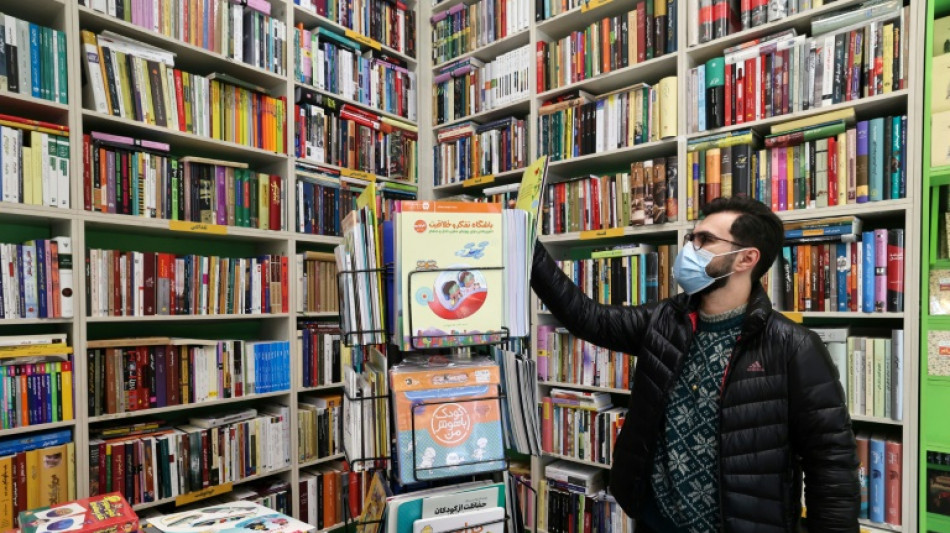
Novel crisis: Iran's books shrink as US sanctions bite

 Drone owners rush to offload devices ahead of Beijing ban

 Trump's beef policies irk Texas ranchers, testing their loyalty

 Nvidia, OpenAI CEOs to attend Xi dinner at White House

 Anthropic picks Accenture for in-house AI safety evaluation

 Balogun returns as Monaco beat Lens to continue strong Ligue 1 start

 'Pause' on overt repression in Venezuela, but reforms still needed: HRW

 Global stocks mixed as yen falls despite Bank of Japan rate hike

 Cuba hit with seventh major blackout of the year

 Murray out with concussion so Wentz will start for Vikings

 UN chief 'deeply regrets' US visa refusal to Abbas for annual meeting

 England quick Carse to face no charges over alleged nightclub assault

 Mancini brings nine newcomers into the first squad of his Italy comeback

 Czechs level Davis Cup tie against USA as South Korea eye Finals

 New France boss Zidane confirms Mbappe as captain after naming first squad

 California governor signs order to explore AI 'kill switch'

 Head leads run spree as Australia win Zimbabwe ODI series

 In-form Raphinha wants to finish career at Barcelona

 Warren Buffett steps down as Berkshire Hathaway chairman

 Carrick confident Man Utd can 'work through' tough time

 Mbappe ends Nike partnership to join Swiss brand On

 Liverpool boss Iraola puts Bournemouth love affair on hold

 'A disaster' if Man City do not win says Maresca after flawless start

 Kerry James Marshall: American 'blackness' painter celebrated in Europe

 Spain coach De la Fuente offers 'full support' to people of Ceuta

 Russia seizes assets of Nestle, French firms over West's Ukraine support

For literature lovers in sanction-hit Iran, a new novel has long provided a brief respite from a grinding economic crisis triggered by international pressure imposed over Tehran's contested nuclear programme.
But now losing yourself in a good book is becoming harder, as cash-strapped publishers struggle because the price of paper is soaring.
"If a 200-page novel sold for 400,000 rials ($1.60) last year, its price today is 1,000,000 rials ($4.10), most of which is the cost of production", said Reza Hasheminejad, who runs the Ofoq publishing house.
Iran does not produce its own paper pulp for publishing so relies on imports, and while those are not under sanctions, they must be paid for in foreign currency. That means the price of a book depends directly on the fluctuation of Iran's rial.
So publishers are not only slashing the number of titles published, but also cutting the number of pages of those they do print by shrinking the font size.
"Publishing has suffered a major crisis -- which could become existential," said Emily Amrai, collection director at the Houpa publishing house.
While publishers worldwide face growing challenges to the way people read and consume literature, Iran is facing an extra problem.
The United States, under former president Donald Trump, unilaterally withdrew in 2018 from a landmark accord to prevent Iran from acquiring an atomic bomb -- a goal Tehran has always denied pursuing -- with Washington then reimposing tough economic sanctions.
"As soon as the US sanctions were reinstated in 2018, the price of paper rose," Amrai said.
- 'A miracle' -
Long-running negotiations to revive a deal with Iran continue in Austria, but until an international agreement turns the page, the impact of sanctions grows worse.
"The devaluation of our currency against the greenback, the global rise in the price of paper paid in dollars and the increase in the cost of transport -- also paid in foreign currency -- has plunged publishing into the doldrums," said Hossein Motevali, owner of Houpa, which specialises in children's books.
Because book prices are fixed in Iran, profits are pegged to the rapidly fluctuating price of paper.
"Between receiving the manuscript, laying it out, and setting the price of the book, I can lose everything if the price of paper has gone up suddenly," Hasheminejad said.
"That happens because I'm at the mercy of the fluctuation of the currencies."
As for the authors, they are paid by the number of the pages in the book, whether they are famous or not.
"Selling books is a miracle today, because the majority of customers belong to the middle class -- and given the economic conditions, their priority is to obtain essential goods such as food," said Hasheminejad. "I really wonder how people still buy books at these prices."
Bookstores in Iran look similar to shops anywhere in the world. As well as shelves of Iranian writers, popular sellers include translations of foreign works -- from 20th century European classics to self-help and psychology books.
Farsi translations of Mary Trump's tell-all on her uncle Donald Trump, as well as the memoir of former US first lady Michelle Obama, have been recent hits.
- 'Shock' -
But as the crisis deepens, several small publishing houses have been driven out of business.
"Today, many independent publishers, who have published excellent works, have been eliminated from the market", said Amrai.
Larger publishing houses have had to adapt to survive.
"We have reduced our profits by as much as possible in order to keep our customers, we have reduced printing and pagination, and publish digital books to avoid paper and reduce costs," said Hasheminejad.
"But that will only last a year or two, for even the most solid companies."
So far, books printed before recent spikes in paper costs provided a buffer, but those stocks are running low.
"In a few months, when the books stored in the depots are exhausted, it will be a shock for the customer when they see the new prices," Hasheminejad warned.
On Enghelab Street, Tehran's main book market, retired teacher Behjat Mazloumi, 60, already struggles to afford second-hand books.
"I haven't been able to buy a book for years," said Mazloumi. "Even street vendors sell books at a very high price."
The cost rise will have wider impacts too, experts say.
Children in poorer areas where access to literature is already limited will soon find themselves priced out completely, Hasheminejad said.
"Today, we see people in some disadvantaged areas who cannot even communicate properly in Farsi," he said. "They will certainly experience difficulties."
F.Ferraz--PC
