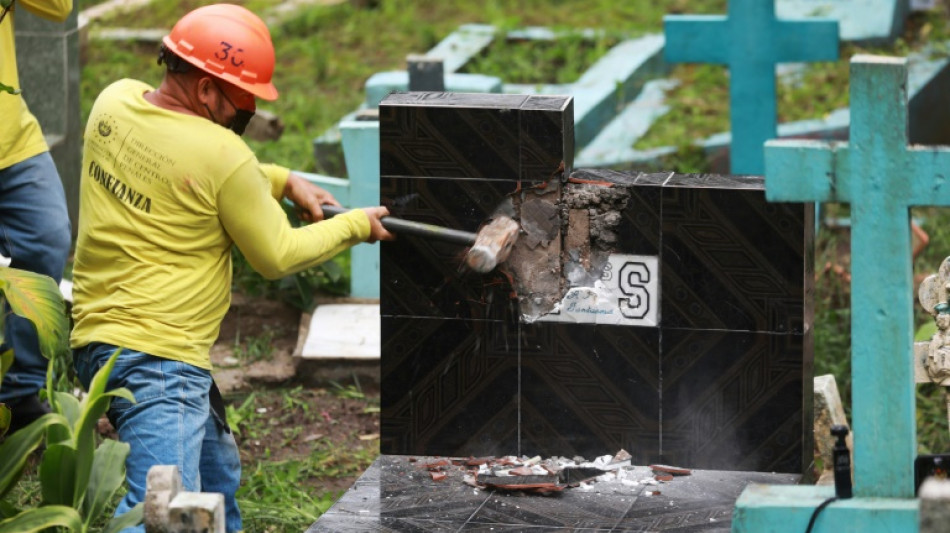
El Salvador destroys gang members' gravestones / Photo: - - EL SALVADOR'S PRESIDENCY PRESS OFFICE/AFP

 Devan Ekambaram and Susha’s 'Varuvaaiy' Makes History as First Tamil Song Nominated for a Grammy

 DiDi Advances Robotaxi Operations in China with New R2 Vehicle and Expanded Safety Infrastructure

 Freezz Italia Awarded ESA Contract for IRIS(2) Low-LEO Pre-Operational and De-Risk Activities

 French Economy Shrinks 0.1% as Consumer Confidence Slumps

 Wall Street Ends Turbulent Week Higher Despite Inflation and AI Jitters

 Kansas City Fed Chief Says Inflation Is Still Running Too Hot
 Oil Heads for Second Weekly Loss as Supply Surplus Emerges
The government of El Salvador, engaged in a controversial "war" on gangs, is destroying the tombstones of gang members to prevent them from becoming shrines, the government said on Thursday.
Urging members of the public to report the locations of gangster graves, Justice Minister Osiris Luna Meza tweeted: "In El Salvador there is NO space for terrorists."
He published photos of grave stones being hammered or pickaxed to pieces, several of them bearing the initials "MS-13" for the Mara Salvatrucha gang, one of the most violent in El Salvador.
"Terrorists will no longer be able to 'glorify' the memory of dead criminals," tweeted the minister.
The destruction started early this week in a municipal cemetery west of the capital San Salvador, to coincide with Day of the Dead commemorations held across Latin America for deceased relatives.
Though their tombstones will be removed, the gang members' remains will be left intact, said the government.
It did not specify how many gravestones have been destroyed.
Eight months of what President Nayib Bukele has labeled a "war" on criminal groups has netted more than 55,600 suspected gangsters in a crackdown that has been welcomed and criticized in equal measure.
As part of the clampdown, the Central American country has increased sentences for gang membership five-fold, to up to 45 years, and Bukele has ordered the construction of a gigantic prison for 40,000 gang members.
Rights groups have denounced the arbitrary arrest of many people, including minors, with no gang links, but many citizens have welcomed a relative calm after a wave of gang violence that left dozens dead.
P.L.Madureira--PC