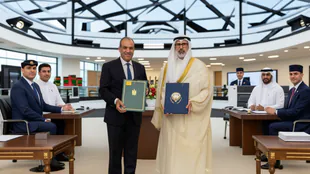
N Korea fired artillery barrage overnight, Seoul says / Photo: ANTHONY WALLACE - AFP

 Devan Ekambaram and Susha’s 'Varuvaaiy' Makes History as First Tamil Song Nominated for a Grammy

 DiDi Advances Robotaxi Operations in China with New R2 Vehicle and Expanded Safety Infrastructure

 Freezz Italia Awarded ESA Contract for IRIS(2) Low-LEO Pre-Operational and De-Risk Activities

 French Economy Shrinks 0.1% as Consumer Confidence Slumps

 Wall Street Ends Turbulent Week Higher Despite Inflation and AI Jitters

 Kansas City Fed Chief Says Inflation Is Still Running Too Hot
 Oil Heads for Second Weekly Loss as Supply Surplus Emerges
North Korea fired an artillery barrage into a maritime "buffer zone" overnight, Seoul's military said Friday, after a record-breaking blitz of launches that included a failed intercontinental ballistic missile test.
Seoul and Washington, which have warned Pyongyang's recent launches could culminate in a nuclear test, extended their largest-ever joint air drills through Saturday in response to the flurry of projectiles.
Shortly after that decision was announced Thursday, Pyongyang launched three short-range ballistic missiles, calling the move "a very dangerous and wrong choice".
About 80 artillery rounds fired by the North followed at 11:28 pm (1428 GMT), landing in a maritime "buffer zone", Seoul's military said.
The barrage was a "clear violation" of the 2018 agreement that established the buffer zone in a bid to reduce tensions between the two sides, Seoul's Joints Chiefs of Staff said.
US Defence Secretary Lloyd Austin described Pyongyang's ICBM launch as "illegal and destabilising", and Seoul and Washington vowed to pursue new measures to demonstrate their "determination and capabilities" against the North's growing threats.
Pyongyang fired about 30 missiles throughout Wednesday and Thursday, including one that landed near South Korea's territorial waters for the first time since the end of the Korean War in 1953.
South Korea's President Yoon Suk-yeol said it was "effectively a territorial invasion".
Experts and officials have said Pyongyang is ramping up its tests in protest over the US-South Korean drills and as it prepares to conduct another nuclear test, which would be its seventh.
Pyongyang has called the joint air drills, dubbed Vigilant Storm, "an aggressive and provocative military drill targeting" North Korea, and threatened that Washington and Seoul would "pay the most horrible price in history" if it continued.
- 'Against humanity'-
The North's latest launches come as South Korea is in a period of national mourning after more than 150 people -- mostly young women in their 20s -- were killed in a crowd crush in Seoul on Saturday.
Pyongyang's provocations, "especially during our national mourning period, are against humanity and humanitarianism," Lee Hyo-jung, a vice spokesperson at Seoul's unification ministry, said Friday.
"The government strongly condemns North Korea for continuing threats and provocations, citing our annual and defensive drills, raising tensions on the Korean peninsula," she said, blaming the current tension on Pyongyang's "reckless nuclear and missile development".
In addition to extending Vigilant Storm through Saturday, Seoul's military announced that the annual Taegeuk exercise, which focuses on "improving wartime transition performance" and crisis management, would be held next week.
The computer-simulated exercise will be carried out to strengthen "the ability to carry out practical mission capability in preparation for various threats such as North Korea's nuclear weapons, missiles, and recent provocations," it said.
Ferreira--PC