US ups N.Korea pressure but fears no end to headache / Photo: SAUL LOEB - AFP

 Assefa seeks 'better than my best' at Berlin marathon

 US court refuses to overturn Pentagon ban on Anthropic

 Verstappen and Norris blame slow cars as Mercedes tops qualifying

 Crowds cheer pope in Paris after AI 'paradise of machines' warning

 Teen swimmer makes Games history as Thai, Chinese sprinters win gold

 Man City found guilty of 114 Premier League charges - reports

 Concerns over 'missing' UK explorer Ranulph Fiennes

 Suspected Paris killer of Argentine rugby star begs forgiveness

 Oil prices fall on cautious hopes for US-Iran progress

 Noskova, Muchova take Czech Republic into BJK Cup final

 Thai sprinter Puripol breaks own Asian Games record to win 100m gold
 Russell takes pole for Azerbaijan GP, Antonelli crashes out

 Williams boss hails Chadwick as F1 inspiration for women

 World No.1 Sinner delays return with China Open withdrawal

 South Lebanon children return to school destroyed by Israel strike

 Jewish group urges Berlin far-left vote winners to tackle antisemitism

 European stock markets climb as oil prices drop

 Trump accuser E. Jean Carroll finally has her damages

 Germany's Havertz, Musiala ruled out of Greece match with injury
 Ireland's Gaza stance spills from Eurovision into football
 Welcome aboard the Costa Serena, the Asian Games floating hotel

 Asian markets mixed after recent oil surge

 Cash for nature protection: hotelier's offer to Principe islanders

 US miner KoBold bets on AI to gain edge in DR Congo mineral hunt

 Internet disrupted in Ethiopia as conflict rages

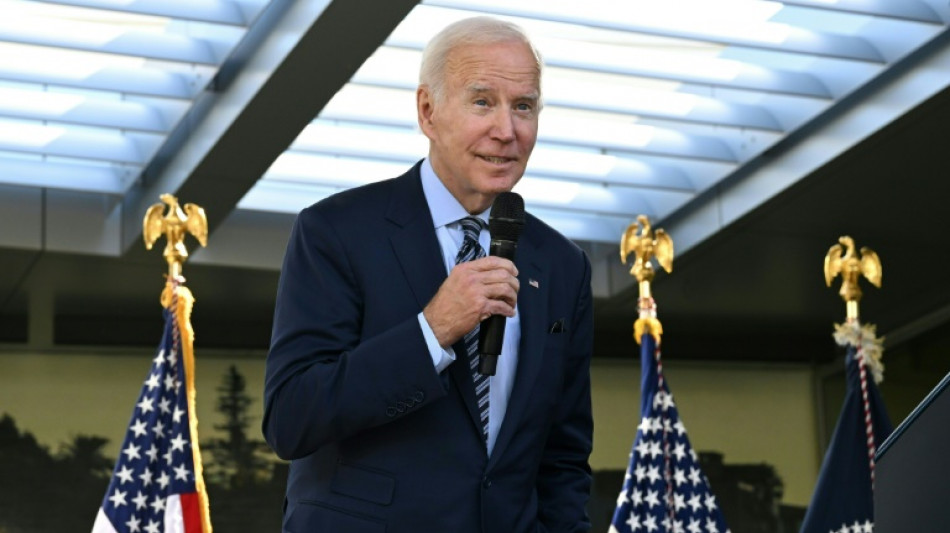
As North Korea fires a blitz of missiles, the United States is sticking to a mixture of pressure and offers of dialogue but US policymakers are resigned that little they do is likely to change Pyongyang's course.
Eager to avoid another global crisis alongside Russia's invasion of Ukraine, President Joe Biden's administration has focused on a more narrow goal of reassuring allies that the United States will defend them.
North Korea, whose leader Kim Jong Un met three times with Biden's predecessor Donald Trump but failed to reach a lasting accord, in recent days has fired a record number of missiles, and Western officials say Pyongyang has made preparations for a seventh nuclear weapons test.
"I don't think there is anything we can do to stop North Korea," said Sue Mi Terry, a former CIA analyst on Korean affairs who is now director of the Asia program at the Woodrow Wilson Center for International Scholars.
"If I were Kim Jong Un's advisor, I would say, yeah, go ahead," she said.
"They couldn't get any kind of deal with Trump and so what are they going to get from the Biden administration? They know this. The only thing they can do is get their program to the next level."
The United States has responded to North Korea by extending exercises with South Korea, including deploying a strategic bomber, and Biden will likely offer robust support for South Korean and Japanese leaders during summits this month in Southeast Asia.
Biden is also widely expected to meet President Xi Jinping of China, Pyongyang's primary ally, which joined Russia in May in vetoing a US-led bid at the Security Council to tighten sanctions on North Korea.
Linda Thomas-Greenfield, the US ambassador to the United Nations, told an emergency session Friday that China and Russia had "enabled" North Korea but also reiterated the Biden administration's willingness to talk to the totalitarian state.
US officials say North Korea has shown no interest in talks and, privately, some think the Kim regime may be in one of its periodic cycles of escalation and that there is no choice but to wait.
Under the last Democratic administration of Barack Obama, some concluded that the United States erred in timing by reaching an agreement in February 2012 that quickly collapsed as North Korea was already poised to go ahead with a satellite test.
- High risk, low reward -
For Biden, focused on Ukraine and possibly facing a more hostile Congress after midterm elections, diplomacy with North Korea offers high risks and limited chances of success.
"They don't really have an appetite for engaging with North Korea. There's a lot of North Korea fatigue," said Frank Aum, a former Pentagon advisor on Korean affairs who is now at the US Institute of Peace.
But Aum said that diplomacy, even if chances for a breakthrough are limited, has succeeded at least in easing tensions.
He said Biden could offer concrete gestures and incentives, such as declaring a moratorium on deploying further strategic military assets or proposing sanctions relief.
"Any conciliatory tactic would be perceived domestically in the US as appeasement or a reward for bad behavior," Aum said.
"But empirical evidence clearly demonstrates that North Korea doesn't respond well to pressure and, conversely, when we engage with North Korea, they tend to behave better."
He doubted the efficacy of the Biden strategy of leaning in on China to exert pressure, noting that Beijing "absolutely disagrees with that approach."
- Time for rethink? -
The rising tensions have led, at least among experts, to a once taboo discussion on whether to accept North Korea as a nuclear state.
Arms control expert Jeffrey Lewis, in an opinion piece last month in The New York Times that generated wide debate, said the United States has already essentially accepted that North Korea will never get rid of its nuclear arsenal and should focus on discussing risk reduction.
"It's time to cut our losses, face reality and take steps to reduce the risk of war on the Korean Peninsula," he wrote.
The State Department reiterated its goal on North Korea was "complete denuclearization" and some experts said a shift would send the worrisome signal at a time when Russian President Vladimir Putin is threatening nuclear attack in Ukraine.
"It buys you nothing and it freaks out your allies," said Victor Cha, senior vice president for Asia at the Center for Strategic and International Studies.
Cha, who advised former president George W. Bush, said the Biden team needed to lay out a North Korea policy that is beyond talking points.
"Maybe that would come after the seventh nuclear test," he said.
L.Carrico--PC