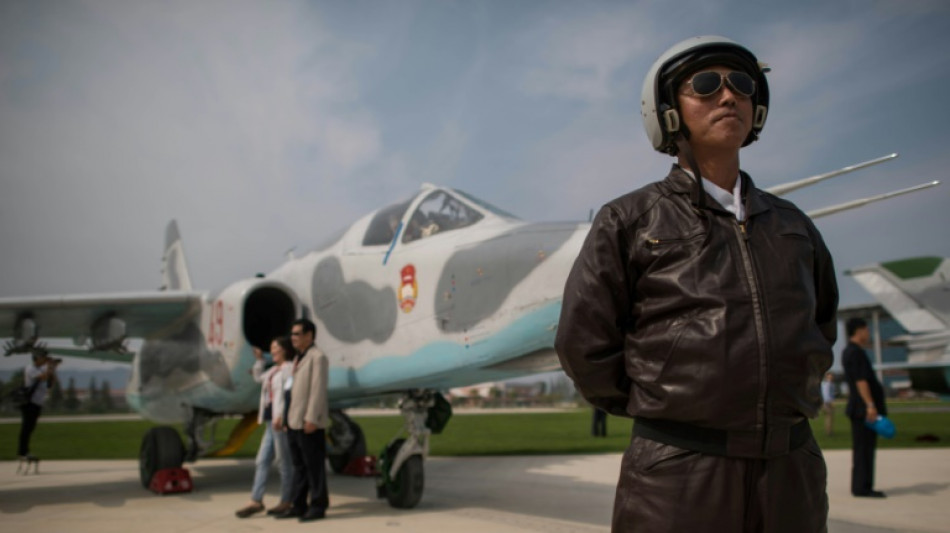
The weakest link? North Korea's crumbling air force / Photo: © AFP/File

 Spotting AI writing: how reliable are the detectors?
 French youth await pope after AI 'paradise of machines' warning
 Man City found guilty of Premier League charges, set to appeal: reports

 Embolo follows Xhaka out of Swiss squad over fake Covid documents
 Trump, Xi inspect founding documents of US democracy to close summit

 'Bottle Claus': Kipchoge's 'hero' helping runners chase Berlin marathon glory

 Olympic medallist Samba-Mayela handed provisional doping ban
 First US trial against TikTok to open Monday

 Palmer misses 'too many' England games, says Tuchel

 UN refugees chief warns conditions in W.Sahara 'deteriorating'

 Antonelli 'mad' about crash in Azerbaijan qualifying

 'Perfect lap' gives Russell pole for Azerbaijan GP as Antonelli crashes out

 UN Security Council condemns Houthi attacks on Saudi Arabia

 China swimmer makes Asian Games history as Thai wins 100m sprint

 Top French literary prize drops best-selling novel over AI claims

 US 'must choose' whether to end war: Iran president
 Pope warns against losing humanity in AI-driven 'paradise of machines'
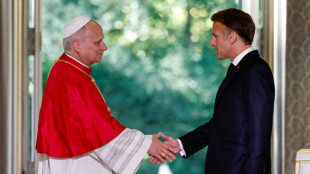 Pope warns against losing humanity in 'paradise of machines'

 From FBI warning to literary acclaim: the Russian journalist who took on Putin
 China swimmer in Asian Games first as North Korea lifters reign
 French literary prize removes novel from longlist after AI claims

 China's Zhang wins record seventh Asian Games swimming gold

 Verstappen edges Russell in final practice in Azerbaijan

 English, Spanish, Italian, German football leagues call for FIFA reform

 Pope arrives in France on first official visit in 18 years

North Korea on Tuesday described its record-breaking blitz of missile launches last week as a "just counteraction" to the biggest-ever US-South Korea air exercises.
Pyongyang has long condemned joint military exercises by Seoul and Washington, calling them rehearsals for an invasion -- but it has appeared especially sensitive to air force drills.
That is because North Korea's air force is the weakest link in its military, experts say.
Here is a look at the service, officially known as the Korean People's Army (KPA) Air and Anti-Air Force:
-How many planes does it have?-
The KPA air force has more than 900 combat aircraft, 300 transport planes and 300 helicopters, according to an assessment published last year by the Pentagon's Defense Intelligence Agency.
But most of its fighters and bombers are either obsolete or near-obsolete, acquired decades ago mainly from the Soviet Union and China.
Even the most potent jets in its fleet, the Soviet-designed MiG-29s, were procured in the late 1980s.
The "on paper" estimates do not "represent the smaller 'active' fleet, with an unknown proportion in long-term storage or withdrawn, unlikely to ever fly again", Joseph Dempsey, a researcher at the International Institute for Strategic Studies (IISS), told AFP.
North Korea is believed to be rotating its "ageing to obsolete" fleet in and out of storage "to keep them serviceable but also manage lifespan", he added.
-What about its pilots?-
North Korea "does not have the capacity to pay for enough fuel, cover maintenance costs or adequately train its pilots," according to a 2020 IISS report.
Without enough fuel and therefore enough flight time, its pilots cannot learn or even maintain combat readiness, analysts say.
North Korean combat pilots get as little as 15-25 hours in the air every year, the DIA estimated.
That is far lower than the reported average in the US and South Korean air forces.
The North Korean air force is so far behind that it is "simply incomparable" to other countries, North Korean studies scholar Ahn Chan-il told AFP.
"It is no exaggeration to say that the North's air force is an 'air force on the ground' that almost never gets any proper training."
-How did it become so weak?-
North Korea boasted about "twice the air power" of the South in the 1970s, according to a 2013 report by Seoul's Institute for Military History.
The then-strong North Korean air force sent help to Hanoi in the Vietnam War and to Syria and Egypt during the 1973 Yom Kippur War, it said.
But the demise of the Soviet Union -- a critical source of financial and military support -- along with the deterioration of its own economy left North Korea deeply impoverished by the 1990s.
"Russia eventually established diplomatic ties with Seoul (in 1991) and partly because of it, Moscow decided not to provide the North the kind of military support the Soviets used to offer," Chun In-bum, a retired South Korean army general, told AFP.
Pyongyang was also hit with crippling sanctions over its nuclear weapons and missile programmes, making it even more difficult to find the resources to build up and maintain modern conventional forces.
"North Korea eventually decided to fully focus on developing its nuclear programme instead," Chun told AFP.
This was a "strategic" decision on Pyongyang's part, added Yang Moo-jin, a professor at the University of North Korean Studies.
"The best card for North Korea to negotiate with the world is nuclear weapons."
-How does it compare with US, S. Korean air forces?-
In the unlikely event of air combat with South Korea or the United States, the North Korean air force would be "severely overmatched", said Daniel Pinkston, a senior lecturer at Troy University in Seoul.
"In an intense conflict with combined and joint South Korean and US forces... North Korea's air power and air defences would be degraded very quickly."
The difference in resources and technology was in sharp focus last week during the joint US-South Korean air drills, dubbed Vigilant Storm, which involved some of the most advanced aircraft in the world.
Unlike North Korea's Soviet-era jets, US and South Korean pilots flew high-tech F-35 stealth fighters, B-1B long-range heavy bombers, electronic warfare jets and in-flight refuelling tankers.
Last week, many of North Korea's missile launches were drills simulating the destruction of enemy air force bases.
"North Korea considers it important to strike and neutralise air bases first because their air power is weak," said Cheong Seong-chang, a researcher at the Sejong Institute.
T.Batista--PC