Myanmar rebels risk life and limb in DIY weapons factories / Photo: - - AFP

 Spotting AI writing: how reliable are the detectors?

 French youth await pope after AI 'paradise of machines' warning
 Man City found guilty of Premier League charges, set to appeal: reports

 Embolo follows Xhaka out of Swiss squad over fake Covid documents

 Trump, Xi inspect founding documents of US democracy to close summit

 'Bottle Claus': Kipchoge's 'hero' helping runners chase Berlin marathon glory

 Olympic medallist Samba-Mayela handed provisional doping ban

 First US trial against TikTok to open Monday

 Palmer misses 'too many' England games, says Tuchel

 UN refugees chief warns conditions in W.Sahara 'deteriorating'

 Antonelli 'mad' about crash in Azerbaijan qualifying

 'Perfect lap' gives Russell pole for Azerbaijan GP as Antonelli crashes out

 UN Security Council condemns Houthi attacks on Saudi Arabia

 China swimmer makes Asian Games history as Thai wins 100m sprint

 Top French literary prize drops best-selling novel over AI claims

 US 'must choose' whether to end war: Iran president

 Pope warns against losing humanity in AI-driven 'paradise of machines'

 Pope warns against losing humanity in 'paradise of machines'

 From FBI warning to literary acclaim: the Russian journalist who took on Putin

 China swimmer in Asian Games first as North Korea lifters reign

 French literary prize removes novel from longlist after AI claims

 China's Zhang wins record seventh Asian Games swimming gold

 Verstappen edges Russell in final practice in Azerbaijan

 English, Spanish, Italian, German football leagues call for FIFA reform

 Pope arrives in France on first official visit in 18 years

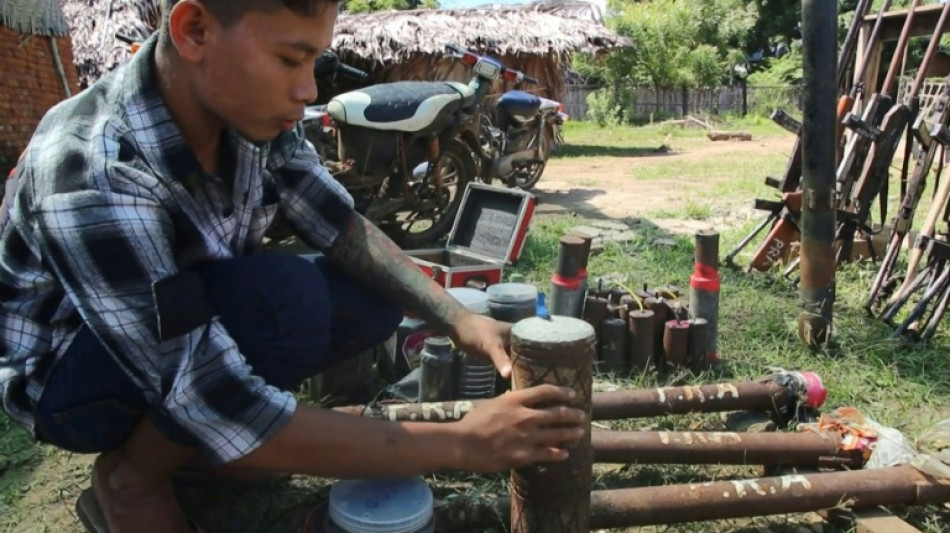
Under an awning in a bamboo thicket in northern Myanmar, an anti-coup fighter following instructions from YouTube welds scavenged steel into crude mortar rounds and shells to be fired at junta troops.
Almost two years after seizing power, the military has been unable to crush local militias that have sprung up to fight the putsch with hit-and-run tactics.
In turn, these People's Defence Forces (PDF) remain massively outgunned by the military's artillery strikes, Chinese and Russian-made jets and Israeli-patterned rifles.
Captured weapons and expensive purchases on the black market have provided patchy boosts to PDF firepower, analysts say, but many militias have turned to risky trial-and-error operations to churn out their own rockets, mines and mortars.
"We just learn how to build weapons from the internet or YouTube," said Nay Min, an anti-coup fighter from the northern Sagaing region.
"We search how to cook saltpetre (potassium nitrate), how to combine it to get gunpowder, how to build rifles. We haven't received any training," he told AFP.
Those with engineering or mechanical backgrounds, like his comrade Nay Myo Win, experiment and come up with prototypes or copies of captured weapons, he said.
Blowtorches in hand, they sweat for hours in makeshift workshops powered by generators that are frequent targets of junta raids.
Nay Myo Win mixes saltpetre to make the gunpowder needed to fire mortar shells filled with lead and scrap metal that he claims have a range of just over two kilometres (1.2 miles).
- Crude armaments -
Laid out on a tarpaulin ahead of a mission in October, the mortars are unimpressive -- little more than construction pipes welded to bipods.
The shells require two charges to detonate -- one to fire the shell and the other to explode on impact -- a method first used at the beginning of the 20th century.
But the damage is substantial, Nay Min said -- "around 15 feet from the target it will hit people and they will die or be wounded".
One batch of shells was made from a telecoms tower owned by a firm close to the military, which was sabotaged by PDF fighters some months ago.
"We just wanted to destroy their business," Nay Min added.
"But, after we had started making homemade weapons ... we needed more stainless steel and we thought of the tower."
Nay Min's group is one of dozens of PDF militias in Sagaing making their own weapons in a bid to turn the tide in the fighting.
Many upload footage of successful tests of mortars, rockets or mines to social media, with joyous shouts accompanying each loud bang.
But the work can be deadly.
"It's more than dangerous," said Bo Shaung, an anti-coup fighter and rocket maker from another group operating in Sagaing.
"When we cook gunpowder, if we add too much saltpetre, it's dangerous. If we add too little, it's also dangerous."
One video obtained by AFP shows a new mortar being tested. The shell explodes in the barrel, killing the fighter who had just loaded it.
Thu Ya, another anti-coup fighter, said he lost his sight six months ago when the explosive he was handling went off too soon.
"I got injuries on my hands and feet which have recovered now but I... still have blurry vision," he said.
In the absence of machines like lathes and voltage regulators, each shell is made by hand.
And for all the risk that comes with producing them, the homemade munitions are often more bark than bite.
- 'Drain on morale' -
Once a target has been selected, preparing ammunition for an attack can take up to 10 days, Nay Min said.
His group relies on information from locals to gauge troop positions.
To guide their fire they have little more than Google Maps to measure the distance from the target.
"We normally attack them in our own areas and we all know the locations and distance," he said, insisting that most attacks were accurate.
Assessing the effectiveness of these weapons is "extremely difficult" in the absence of impartial reporting from the field, said Bangkok-based security analyst Anthony Davis.
Both sides regularly inflate or play down their casualty figures, analysts say.
But Davis said the spread of locally made mortars and rockets "indicates that these systems are far from simply window-dressing".
"They inflict real casualties but perhaps as importantly are a constant drain on the morale of often isolated army units on the receiving end."
The junta has labelled all PDF groups as "terrorists". It blames anti-coup fighters for the deaths of more than 4,000 civilians.
Nay Min sees his group's fight as justified.
"We are satisfied with what we have done," he said.
But "we need everything. Especially we need weapons."
S.Pimentel--PC