Fear and propaganda: Russian tactics in captured lands / Photo: ANATOLII STEPANOV - AFP

 Spotting AI writing: how reliable are the detectors?

 French youth await pope after AI 'paradise of machines' warning

 Man City found guilty of Premier League charges, set to appeal: reports
 Embolo follows Xhaka out of Swiss squad over fake Covid documents
 Trump, Xi inspect founding documents of US democracy to close summit

 'Bottle Claus': Kipchoge's 'hero' helping runners chase Berlin marathon glory

 Olympic medallist Samba-Mayela handed provisional doping ban

 First US trial against TikTok to open Monday

 Palmer misses 'too many' England games, says Tuchel

 UN refugees chief warns conditions in W.Sahara 'deteriorating'

 Antonelli 'mad' about crash in Azerbaijan qualifying

 'Perfect lap' gives Russell pole for Azerbaijan GP as Antonelli crashes out
 UN Security Council condemns Houthi attacks on Saudi Arabia

 China swimmer makes Asian Games history as Thai wins 100m sprint

 Top French literary prize drops best-selling novel over AI claims

 US 'must choose' whether to end war: Iran president

 Pope warns against losing humanity in AI-driven 'paradise of machines'

 Pope warns against losing humanity in 'paradise of machines'

 From FBI warning to literary acclaim: the Russian journalist who took on Putin
 China swimmer in Asian Games first as North Korea lifters reign

 French literary prize removes novel from longlist after AI claims

 China's Zhang wins record seventh Asian Games swimming gold

 Verstappen edges Russell in final practice in Azerbaijan

 English, Spanish, Italian, German football leagues call for FIFA reform

 Pope arrives in France on first official visit in 18 years

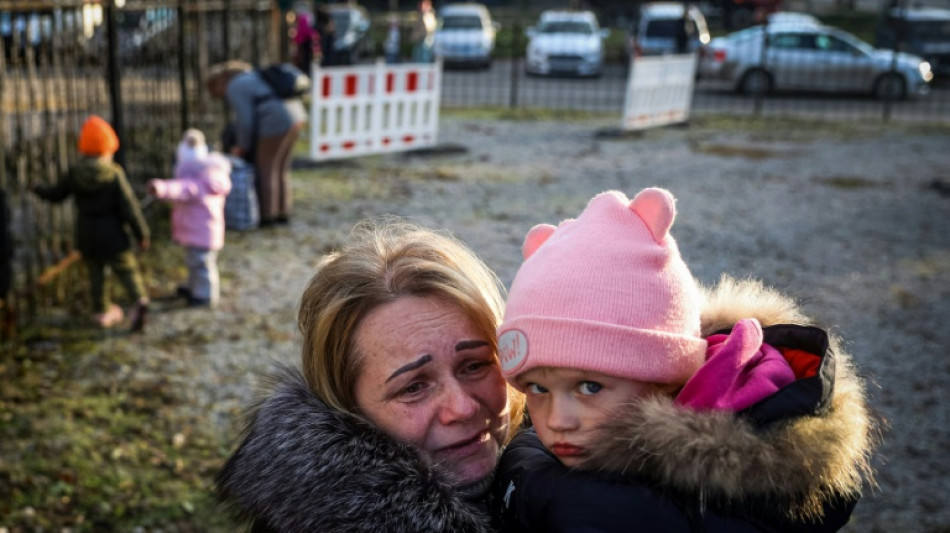
The first Ukrainian woman emerged from the evacuation bus shaking with sobs so violent she could barely speak.
The second had glistening eyes and a smile of evident relief.
Both had woken up that morning in the Russian-occupied Sea of Azov city of Berdyansk.
Both had just trundled past levelled villages and booming battlefields in a creaking bus.
Yet the joy Svitlana Titova felt at reaching Ukrainian government-held land released immediate memories of what she had survived.
"We fled because eight guys with automatic rifles came to our house," the 52-year-old journalist said while pressing her granddaughter to her chest.
"They were rounding people up."
Titova struggled to say much more. The deep creases on her face aged her and the silent girl bouncing in her arms frowned.
Tetyana Verzhykovska was dabbing the corner of her eye and smiling a few steps away.
"This is freedom," said the 29-year-old choreographer. "I think I can manage now."
Tetyana Chekoy was not so sure.
The 45-year-old psychiatrist has counselled thousands of survivors since Kremlin proxies first unleashed a lower-scale war in eastern Ukraine in 2014.
She said Russia's tactics since its full-scale invasion in late February involved psychological intimidation and brainwashing of a scale she had never seen.
"Every single one of these people has post-traumatic stress disorder," Chekoy said.
- 'People as property' -
Chekoy and fellow psychiatrist Ulyana Ilman offer rare insight into the mind-bending tactics the Kremlin appears to be using to get Ukrainians to accept being Russian.
Reporters have no independent access to occupied regions and those fleeing destroy all correspondence or other evidence before approaching Russian checkpoints.
The two women spend their days at a relief centre set up down the road from the only checkpoint where Ukrainians can still cross the southern section of the front.
No more than a few handful pass each day.
The Kremlin has banned almost everyone but young mothers and the elderly from leaving the four regions it annexed in late September.
The two psychiatrists had earlier seen disoriented Russian-speakers flee eastern regions where many -- especially the old -- held fond memories of Soviet rule.
They have also watched outraged Ukrainian-speakers escape bombed towns in which anti-Kremlin sentiments ran deep.
But those fleeing the southern front regions of Zaporizhzhia and Kherson since the annexation have left the two war-hardened women particularly alarmed.
"The Russians now view these people as their property. They are trying to break them down," Ilman said.
"And it scars them psychologically."
- 'It was working' -
The psychological pressure in Kherson and Zaporizhzhia may be particularly strong because -- unlike Donetsk and Lugansk in the east -- no part of the regions was under the Kremlin's control before the February invasion.
Chekoy said one particular story she heard from a woman who oversaw education in the occupied Zaporizhzhia-region village of Vasylyvka has stayed with her.
"They told her to come teach at the school (after the annexation) because she was well-respected and this could make the students return to class," Chekoy said.
"And then they trained a tank gun on the school. So they sat there the whole time, studying, with a tank pointing at them."
The tank appeared to be an unsubtle reminder that the version of history and the war taught in class had to follow the Kremlin's script.
Chekoy said the school itself was decorated with flags reading "On Towards Berlin" -- the rallying cry of the Soviets during World War II.
The Kremlin brands Ukraine's leaders as Nazis and uses 1940s messaging to rally support for its invasion among Russians.
"They have removed our television and are airing theirs. And that also says: On Towards Berlin," she said.
"And my friends were saying that people who lived like this for two or three weeks -– their way of thinking had changed. It was working."
- Starvation -
The two psychiatrists said chronic shortages of basics and food helped wear down people's resistance to the propaganda.
Chekoy suggested that this itself was a tactic.
"They have a set plan of action," she said.
"First they destroy a person morally. And then they start to fill you with an unhealthy new collective consciousness."
Both psychiatrists said many of those who escaped -- particularly children -- appeared starved.
"I have seen children jump on food and gulp things down with bare hands," Ilman said.
"Some children can't stop eating," Chekoy said in a separate interview.
"They would eat and run to the toilet and then come back and eat more."
What worried both women at the moment was how the survivors were coping.
Ilman said those who smiled or laughed on arrival concerned her as much as the ones who cried.
"Many who come are disoriented. You ask them questions and they don't quite understand what you want," Ilman said.
"Some cry and laugh at the same time. But that's really just hysteria. It's stress."
G.M.Castelo--PC