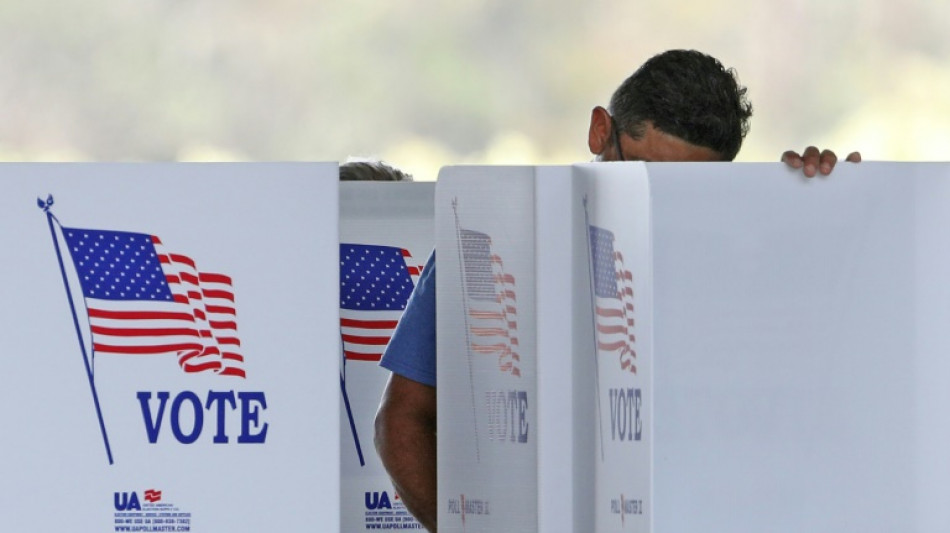
Why does US ballot counting take so long? / Photo: Gregg Newton - AFP

 Wall Street stocks rise, greeting optimism over possible US-Iran deal

 NFL players chief raises concerns over pitch for Maracana game

 Daytime Russian attacks kill seven in Kyiv
 Spotting AI writing: how reliable are the detectors?

 French youth await pope after AI 'paradise of machines' warning
 Man City found guilty of Premier League charges, set to appeal: reports

 Embolo follows Xhaka out of Swiss squad over fake Covid documents
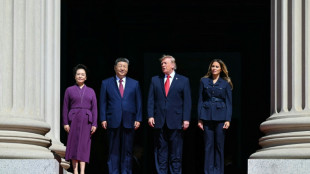 Trump, Xi inspect founding documents of US democracy to close summit

 'Bottle Claus': Kipchoge's 'hero' helping runners chase Berlin marathon glory

 Olympic medallist Samba-Mayela handed provisional doping ban

 First US trial against TikTok to open Monday

 Palmer misses 'too many' England games, says Tuchel

 UN refugees chief warns conditions in W.Sahara 'deteriorating'

 Antonelli 'mad' about crash in Azerbaijan qualifying

 'Perfect lap' gives Russell pole for Azerbaijan GP as Antonelli crashes out

 UN Security Council condemns Houthi attacks on Saudi Arabia

 China swimmer makes Asian Games history as Thai wins 100m sprint

 Top French literary prize drops best-selling novel over AI claims

 US 'must choose' whether to end war: Iran president

 Pope warns against losing humanity in AI-driven 'paradise of machines'

 Pope warns against losing humanity in 'paradise of machines'

 From FBI warning to literary acclaim: the Russian journalist who took on Putin

 China swimmer in Asian Games first as North Korea lifters reign

 French literary prize removes novel from longlist after AI claims

 China's Zhang wins record seventh Asian Games swimming gold

The balance of power in the US Congress following Tuesday's midterm elections is still up in the air, with several key races yet to be called some 48 hours after many polls closed.
A cliffhanger-style multi-day wait for results is far from unusual in the United States, where it is the media that generally first calls elections, based on votes tabulated by county clerks and other officials as well as statistical analysis.
While the long delays can exasperate American voters, and raise questions from curious international observers, there are several reasons why the process can stretch out.
- Patchwork of rules -
For starters, US elections are largely decentralized, and each of the 50 states has its own rules.
Some Americans vote on machines, others with paper ballots. Some vote in person, others by mail.
Some vote on election day, others in advance. Many citizens take advantage of ballot drop boxes.
As election officials in multiple states urged patience with the vote counting, Republican US Senator Marco Rubio of Florida aired his complaints.
"If #Florida can count 7.5 million ballots in 5 hours how can it take days for some states to count less than 2 million?" Rubio tweeted Wednesday.
Ballots, on which Americans generally vote for a variety of candidates and initiatives, can take a while to tally.
With voting by mail widely popularized during the Covid-19 pandemic, things are taking even longer -- the ballots can arrive at counting stations several days after the election. Ohio and Alaska count those that arrive up to 10 days later.
Compounding matters, in many states election officials are not even allowed to begin counting mail-in votes in advance.
The extended time needed to carry out the process fuels conspiracy theories, especially after the 2020 election, which president Donald Trump falsely claimed was rigged against him.
That race between Trump and eventual winner Joe Biden was not known for four days.
- Georgia nail-biter -
The southeastern state of Georgia played a special role in 2020, as the balance of the US Senate hung on a second-round election in the state.
This year is proving to be a case of deja vu.
With no one candidate surpassing the 50 percent threshold on Tuesday to prevent a second round, the two leading candidates, Democratic incumbent Raphael Warnock and Republican challenger Herschel Walker are headed to a December 6 runoff.
Organizing elections in a country of some 333 million citizens is in itself a logistical challenge.
- Unforeseen hiccups -
The process rarely goes off without a few small hiccups. This year for example, the electoral machines in one Arizona county encountered operational problems, disrupting the vote.
Some Republicans -- including Trump himself -- pointed to it as evidence of fraud, a claim immediately dismissed by authorities.
Even without technical incident, races can simply be extremely close, as several in Tuesday's election are turning out to be.
Twenty states have laws mandating a recount if the margin between candidates is too thin.
In one stand-out case in 2000, the country held its breath for 36 days with the entire election hinging on delayed results from one state, Florida, as Texas governor George W. Bush and vice president Al Gore vied for the White House.
At the heart of the civic imbroglio was a razor-thin vote that prompted a highly contested hand recount. In the end, the battle wound its way to the Supreme Court, which issued a decision favoring Bush that December.
In 2008, a race for a US Senate seat in Minnesota resulted in an epic legal battle. The result was finally known some eight months later.
A.Seabra--PC