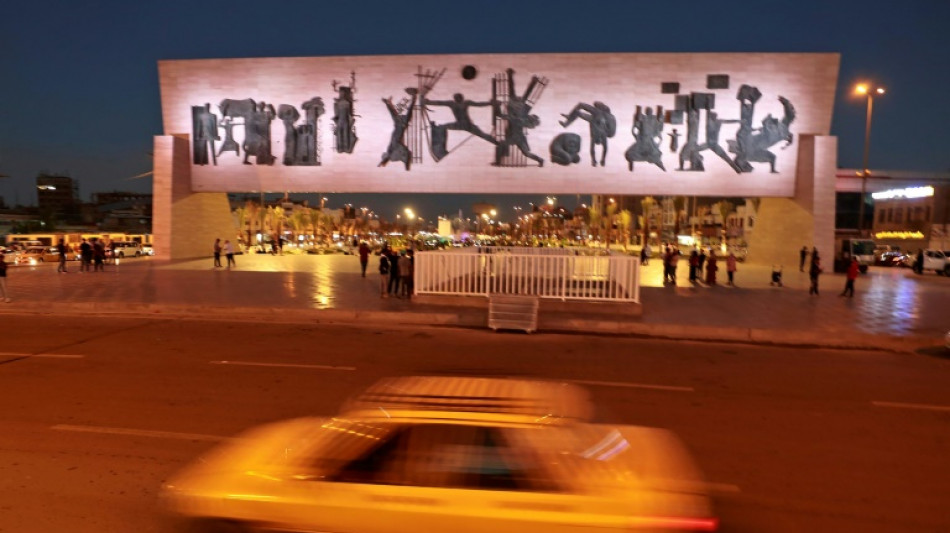
Flowery facelift for heart of revolt in Iraqi capital / Photo: AHMAD AL-RUBAYE - AFP

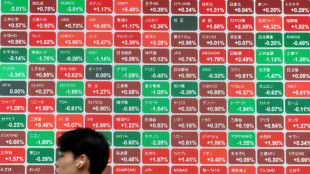
 Wall Street stocks rise, greeting optimism over possible US-Iran deal
 NFL players chief raises concerns over pitch for Maracana game
 Daytime Russian attacks kill seven in Kyiv
 Spotting AI writing: how reliable are the detectors?
 French youth await pope after AI 'paradise of machines' warning
 Man City found guilty of Premier League charges, set to appeal: reports
 Embolo follows Xhaka out of Swiss squad over fake Covid documents
 Trump, Xi inspect founding documents of US democracy to close summit
 'Bottle Claus': Kipchoge's 'hero' helping runners chase Berlin marathon glory
 Olympic medallist Samba-Mayela handed provisional doping ban
 First US trial against TikTok to open Monday
 Palmer misses 'too many' England games, says Tuchel
 UN refugees chief warns conditions in W.Sahara 'deteriorating'
 Antonelli 'mad' about crash in Azerbaijan qualifying
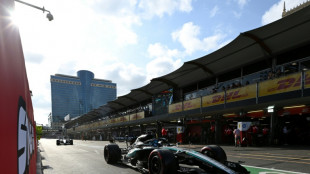
 'Perfect lap' gives Russell pole for Azerbaijan GP as Antonelli crashes out
 UN Security Council condemns Houthi attacks on Saudi Arabia
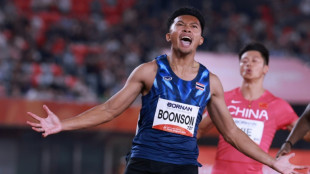
 China swimmer makes Asian Games history as Thai wins 100m sprint
 Top French literary prize drops best-selling novel over AI claims
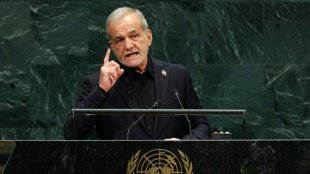 US 'must choose' whether to end war: Iran president
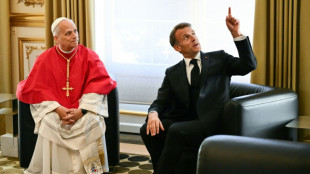 Pope warns against losing humanity in AI-driven 'paradise of machines'
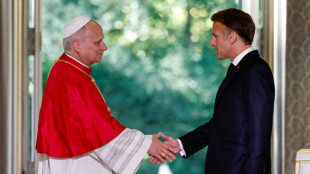 Pope warns against losing humanity in 'paradise of machines'
 From FBI warning to literary acclaim: the Russian journalist who took on Putin
 China swimmer in Asian Games first as North Korea lifters reign
 French literary prize removes novel from longlist after AI claims
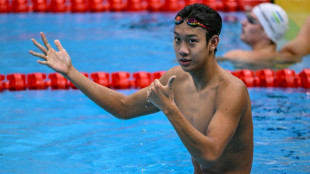 China's Zhang wins record seventh Asian Games swimming gold
Three years ago, Fadel Abbas marched with tens of thousands of fellow Iraqis chanting for the "fall of the regime" in Baghdad's Tahrir Square, meaning "liberation" in Arabic.
The epicentre of the October 2019 anti-government protest movement, the square is now transformed and boasts a renovated park section, and Abbas sells coffee where he once shouted slogans.
"Here, many people were wounded and killed: young men, young women, doctors," recalled Abbas, 21, offering cups to passers-by from flasks on his back.
"We were just demanding our rights."
A scar runs across his left hand, a reminder of the violent crackdown unleashed by the security forces three years ago.
More than 600 people were killed and thousands injured during the unprecedented protests, where demonstrators denounced corruption, their "negligent" politicians, and the influence of neighbouring Iran.
The wave of protests gradually died down in early 2020 as coronavirus pandemic restrictions took hold.
Today, little is left to physically mark the events, but another former protester, Ali Ryad, 29, pointed towards the nearby Tigris river and recalled that "even the bridges witnessed the bloodshed".
- 'Reflect happiness and progress' -
Tahrir Square is where the city's main boulevards on the eastern bank of the Tigris river converge at a roundabout built in 1937.
The iconic Freedom Monument, a 50-metre (165-foot) long bas relief made of concrete and metal, honours the 1958 revolution which overthrew Iraq's monarchy.
Recent restoration work has given the square a fresh look.
Alongside the monument, a previously abandoned promenade has been paved and planted with gardens of flowers and palm trees.
"We want to transform it from a place linked to martyrs into one linked to happiness", said writer Souad al-Gohary, taking pictures under the monument with a group of cyclists.
"Blood was shed in this square. We want to transform it to reflect happiness and progress for Iraq."
Tahrir Square is now one of the few green spaces in Baghdad, a metropolis suffocated by concrete and cars.
Around the edge, the roar of traffic eases only after dark.
The city's eight million inhabitants have only one large public greenspace available to them, the Zawraa park, where entrance requires buying a ticket.
City municipality spokesman Abdel Moneim al-Issaoui said Baghdad planned to "organise activities for young people", including exhibitions and concerts.
- Fading graffiti of revolution -
Baghdad resident Um Lamar, 36, said she had come to see the renovations in the park on her day off, enjoying a space that was "previously unreachable" during the protests.
Sporadic demonstrations are still held in front of the Freedom Monument, but they are far from resembling the waves of people seen in 2019, even though the concerns which drove the protest movement remain.
Last month, Iraq's parliament approved the government of Prime Minister Mohammed Shia al-Sudani -- after more than a year of political paralysis following elections.
His government faces endemic corruption, widespread unemployment and decaying infrastructure in the oil-rich country.
Sometimes a handful of young graduates rally to demand jobs. Other times sympathisers of the Shiite Muslim cleric Moqtada Sadr pound the pavement in the square.
Surveillance cameras and police still keep a close eye.
Only one seemingly abandoned building still symbolises the 2019 protests: the "Turkish restaurant", the largest building on the square, and the former headquarters of the demonstrators.
On its walls, graffiti can still be read calling for "thawra", or "revolution". The slogans are slowly fading with time.
L.Carrico--PC