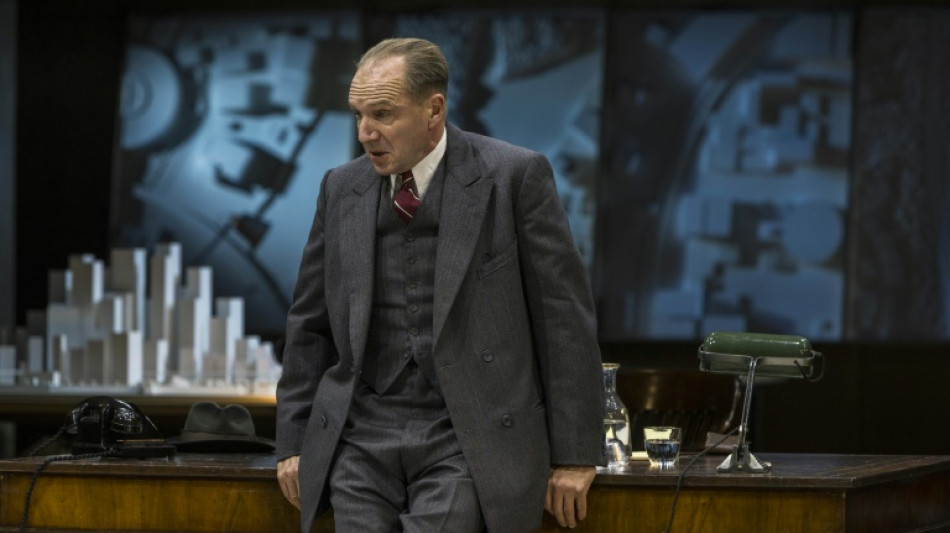
Making New York - new play tells tale of ruthless powerbroker / Photo: Kate Glicksberg - THE SHED/AFP

 Mancini finds positives in Italy loss, accepts fans' jeers

 Alcaraz helps Europe into Laver Cup lead

 Six missing after building collapses in historic Athens district

 Mbappe scores but suffers knee injury as Zidane gets debut France win

 Mancini's Italy return spoiled by Belgium defeat

 Rodri confident in Man City innocence despite reported charges

 Jay-Z rape accuser says she made 'false accusations'

 Senegal draw first match under Vieira and Nigeria survive scare

 Trump, Xi end summit long on pomp, but short on progress

 Russia not preparing for conflict with Europe, Putin says

 Trump's photo of Xi greeting carries signs of AI
 Six missing after building blast in historic Athens district

 Millions in US northeast brace for powerful storm

 Assefa seeks 'better than my best' at Berlin marathon

 US court refuses to overturn Pentagon ban on Anthropic

 Verstappen and Norris blame slow cars as Mercedes tops qualifying

 Crowds cheer pope in Paris after AI 'paradise of machines' warning

 Teen swimmer makes Games history as Thai, Chinese sprinters win gold

 Man City found guilty of 114 Premier League charges - reports

 Concerns over 'missing' UK explorer Ranulph Fiennes

 Suspected Paris killer of Argentine rugby star begs forgiveness

 Oil prices fall on cautious hopes for US-Iran progress

 Noskova, Muchova take Czech Republic into BJK Cup final

 Thai sprinter Puripol breaks own Asian Games record to win 100m gold
 Russell takes pole for Azerbaijan GP, Antonelli crashes out

Was he a visionary or a corrupt racist with a god complex? The troubled legacy of Robert Moses, the master builder who shaped New York, comes under scrutiny this fall in a new play starring Ralph Fiennes.
Robert Moses was an urban planner who, despite never holding elected office, launched building projects in the early 20th century which transformed New York and inspired cities across the United States.
While his vision lives on in New York's vast network of parks, roads and bridges, Moses' name became synonymous with the racist undertones of "urban renewal."
The city's ambivalence about Moses gets a fresh airing in "Straight Line Crazy," a two-act dramatization of Moses' decades-long tenure atop the New York power jungle.
Fiennes depicts a Moses who cajoles politicians, outmaneuvers opponents, and shrugs off doubters in his insatiable quest to fulfill his ambitious vision for the city.
"Our job is to lead, not to follow," Moses tells an underling who worries about pleasing the public. "People don't know what they want until they have it."
- Corruption of power? -
Written by the British playwright David Hare, "Straight Line Crazy" was originally presented in London.
It marks the latest effort to reckon with Moses, who amassed unparalleled authority from holding posts on as many as a dozen municipal bodies simultaneously in a career that spanned four decades.
Moses was celebrated for much of his professional life for his building projects and the leading role he played in bringing the United Nations to New York and in developing the Lincoln Center.
But in 1974, the journalist Robert Caro lifted the veil on the underside of Moses' imperial-like reign in a book that won the Pulitzer Prize.
He depicted him as a ruthless and corrupt dictator who held grudges, smeared opponents and hoodwinked allies while running a municipal machine of monumental proportions.
Caro exposed how Moses marshaled massive public funds to favor suburban elites.
Poorer, non-white communities were displaced from condemned neighborhoods and suffered from Moses' lack of support for public transit as he promoted mammoth highway projects that championed the car.
Hare has called Caro the authoritative expert on Moses, but views his subject differently.
"Caro believes that... what corrupted Moses was power and that he became sort of crazed with power," Hare said at a panel discussion at The Shed theater, where the show runs through December 18.
However, Hare believes his life "was about pursuit of an idea that was too rigid."
Compared with Caro's monster-like figure, the play humanizes Moses, while still zeroing in on significant character flaws.
Dan Doctoroff, a former deputy mayor for economic development and rebuilding and a board member of the Shed, said Moses' story offers some clues for policy makers on how to tackle ambitious projects, such as the need to back up a vision with detailed plans.
"He did magnificent things. He did terrible things, and the reality is you're never going to get everything right," Doctoroff said during the panel conversation. "But at the end of the day, his disdain for the common person tarnishes the legacy forever."
- What 'democracy couldn't deliver' -
The play, based on real events but with invented dialogue and some fictionalized characters, spotlights two moments in Moses' career, riffing on a rise-and-fall narrative arc.
In the first act, he casually flouts governance norms as he outwits Long Island gentry to push through the construction of the Jones Beach State Park in 1926.
However, Moses meets his match in the second act, when grassroots opponents mobilize in 1955 to ultimately derail his plan for an expressway in lower Manhattan.
A longtime aide warns of waning patience with Moses' autocratic style and calls out his favoritism of "clean people... well-off people... white people."
But Moses says he knows that "people may not like me, but they need me."
"Now, of course, it's suddenly fashionable to dislike me, because I'm the dirty bastard who pushed through the things democracy needed but which democracy couldn't deliver."
C.Amaral--PC