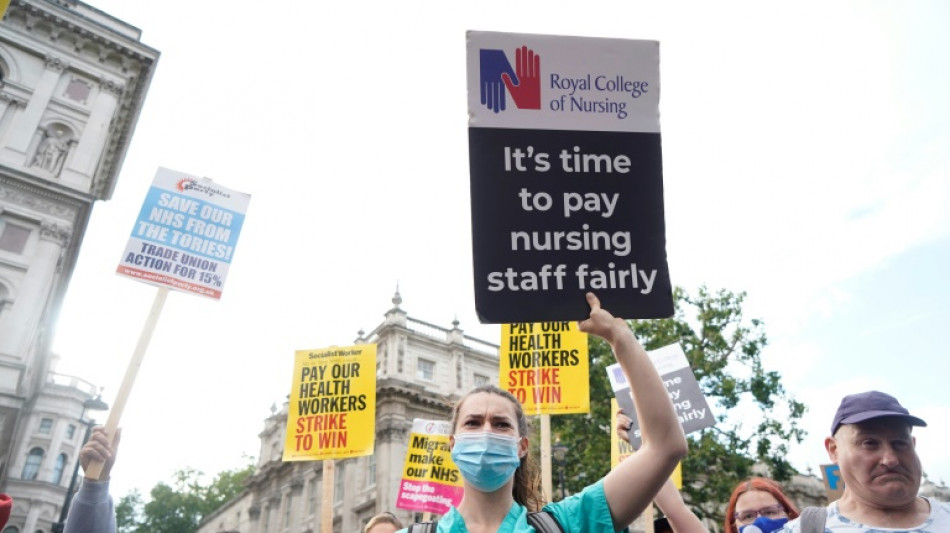
Nurses join other striking UK staff in two December walkouts / Photo: Niklas HALLE'N - AFP

 Japanese 11-year-old wins Asian Games eSports gold

 TikTok agrees to teen limits in US settlement following Meta

 Venezuela's oil cradle pins hopes on US energy deals

 US, China buy time with trade truce as pressure builds

 'Leo, Leo': Young Catholics give pope rockstar welcome in France

 Lula bans sports betting days ahead of Brazil's election

 Guatemala ensures survival of vulnerable 'fossil' fish

 Mancini finds positives in Italy loss, accepts fans' jeers

 Alcaraz helps Europe into Laver Cup lead

 Six missing after building collapses in historic Athens district

 Mbappe scores but suffers knee injury as Zidane gets debut France win

 Mancini's Italy return spoiled by Belgium defeat

 Rodri confident in Man City innocence despite reported charges

 Jay-Z rape accuser says she made 'false accusations'

 Senegal draw first match under Vieira and Nigeria survive scare

 Trump, Xi end summit long on pomp, but short on progress

 Russia not preparing for conflict with Europe, Putin says

 Trump's photo of Xi greeting carries signs of AI

 Six missing after building blast in historic Athens district

 Millions in US northeast brace for powerful storm

 Assefa seeks 'better than my best' at Berlin marathon

 US court refuses to overturn Pentagon ban on Anthropic

 Verstappen and Norris blame slow cars as Mercedes tops qualifying

 Crowds cheer pope in Paris after AI 'paradise of machines' warning

 Teen swimmer makes Games history as Thai, Chinese sprinters win gold

Nurses across most of Britain will next month hold the first strikes in their union's 106-year history, joining a host of other UK workers taking industrial action over pay.
Staff in England, Wales and Northern Ireland -- but not Scotland -- will walk out on December 15 and 20, after the Royal College of Nursing (RCN) union said the government had turned down an offer of negotiations.
It will be the latest industrial action in Britain, where decades-high inflation and a cost-of-living crisis has prompted staff in various sectors to demand pay rises to keep up with spiralling prices.
The nurses' strike will be sandwiched between the first of a series of two-day walkouts by national railway workers, while postal service employees will stage fresh stoppages in the run-up to Christmas.
Numerous other public and private sector staff, from lawyers to airport ground personnel, have also held strikes this year.
"Nursing staff have had enough of being taken for granted, enough of low pay and unsafe staffing levels, enough of not being able to give our patients the care they deserve," said RCN head Pat Cullen.
The union, which wants a pay rise significantly above inflation, announced earlier this month that a ballot of its more than 300,000 members had found a majority in favour of strikes.
"Ministers have had more than two weeks since we confirmed that our members felt such injustice that they would strike for the first time," Cullen said, adding that an offer of formal negotiations was declined.
"They have the power and the means to stop this by opening serious talks that address our dispute."
The RCN will next week announce which particular arms of Britain's sprawling state-funded National Health Service (NHS) will be affected by the walkouts.
- 'Challenging times ' -
Amid the waves of industrial action, British inflation has continued its recent surge, reaching a 41-year high of 11.1 percent in October on soaring energy and food bills.
Bosses in the NHS said in September that nurses were skipping meals to feed and clothe their children and struggling to afford rising transport costs.
One in four hospitals had set up foodbanks to support staff, according to NHS Providers, which represents hospital groups in England.
The government says it has accepted independent pay recommendations, and given over one million NHS workers a pay rise of at least £1,400 ($1,590) this year.
That follows on from a three-percent increase last year when public sector pay was frozen.
But the RCN says this leaves experienced nurses worse off by 20 percent in real terms due to successive below-inflation awards since 2010.
In Scotland, the union has paused announcing strike action after the devolved government in Edinburgh, which has responsibility for health policy, reopened pay talks.
UK health minister Steve Barclay said he was "hugely grateful for the hard work and dedication" of nurses and regretted the strikes.
The NHS has "tried and tested plans" to minimise disruption and ensure emergency services continue to operate, he added.
"These are challenging times for everyone and the economic circumstances mean the RCN's demands, which on current figures are a 19.2 percent pay rise, costing £10 billion a year, are not affordable," he said.
The RCN has questioned the UK government's economic rationale, noting it spends billions of pounds on agency staff to plug workforce gaps.
It points to independent research it commissioned indicating that the finance ministry would recoup 81 percent of the initial outlay of a significant pay rise through higher tax receipts and savings on future recruitment and retention costs.
In the last year, 25,000 nursing staff left the Nursing and Midwifery Council (NMC) register, it said.
Other UK health unions are also balloting workers for industrial action, while ambulance staff in Scotland are due to walk out on Monday.
Meanwhile, across the wider economy, numerous sectors look set to continue their strikes into the new year.
T.Batista--PC