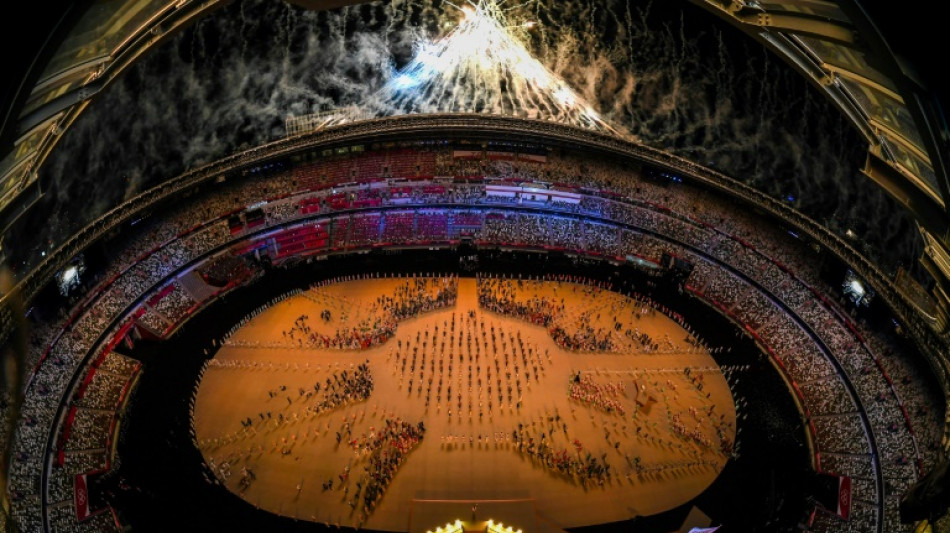
Paris Olympics planners sweat over opening ceremony / Photo: François-Xavier MARIT - AFP

 Geri Halliwell-Horner Embraces Queen Camilla at Commonwealth Writing Competition

 Meta Quest 3 and 3S Gain Access to Over 150 3D Movies

 Sarah Bajada Shares Message on Pregnancy Loss

 ALIX LASERS shareholders remove Michael Sobitsch as managing director in view of the circumstances

 Euroseas Q3 Net Profit Falls to $91.4 Million Amid Fleet Reduction

 Daily Horoscope November 20, 2026: Astrological Predictions for All Signs

 West Midlands Shoppers Urged to Guard Against Black Friday Scams

The unprecedented opening ceremony planned for the 2024 Paris Olympics, just 500 days away, promises to be both spectacular and a serious security headache, with the arrangements still being worked out by anxious officials.
The vision, as announced by French President Emmanuel Macron, is to take the ceremony out of its customary location in the main stadium and put it in the heart of the capital.
Sporting delegations are set to sail down the river Seine in boats, an armada of sporting excellence set against the backdrop of the capital's world-famous monuments in view of up to 600,000 cheering spectators.
The appeal of such a bold statement of French ambition and art de vivre to a global TV audience of hundreds of millions is clear. Turning it into reality is said to be giving planners cold sweats.
"Everyone is working and working an enormous amount," one senior French official involved in the process told AFP on condition of anonymity. "A ceremony like this has never taken place before. But we'll manage it, we'll be ready."
As the Games loom into view, the number of boats, the arrangements for spectators, and the means of controlling crowds and guarding against a terror attack or accident are still the subject of intense discussions.
The French police "have never worked on a scenario like this," a senior security source told AFP, again on condition of anonymity because of the sensitivity of the subject.
"When it's something repetitive, they can debrief, make improvements, work out what works. This will be one shot," he added.
The total number of spectators allowed to line the six-kilometre (four mile) route is still up in the air, with the final figure expected to somewhere between 400,000-600,000.
Around 70,000 seats on the lower banks or on bridges are set to go on sale from May 11, starting at 90 euros (96 dollars) and topping out at 2,700 euros.
These paid-for positions "will be expensive because it will be unique. It will be very spectacular in this iconic city," head of the organising committee, Tony Estanguet, told reporters last week.
- 'Madness'? -
Some security experts have spoken out about the idea, however, warning about the dangers of uncontrolled crowd movements so close to water and the difficulty of securing such a long stretch of water with overlooking buildings.
The chaotic scenes at last year's Champions League final in Paris, when Liverpool fans found themselves in a crush outside the stadium, were a reminder of the dangers of badly organised sporting events.
Interior Minister Gerald Darmanin, who faced severe criticism for his handing of the Champions League fiasco, travelled to the World Cup in Qatar in November last year on a fact-finding mission.
While there, he warned of the dangers of "a drone loaded with explosives that falls on a crowd, on an exposed team, on an opening ceremony like at the Olympic Games, for example."
"When you organise an event like this, cyber attacks, the fight against drones, questions of terrorist threats, the flow of people are important subjects," he told AFP.
Well-known French criminologist Alain Bauer slammed the whole concept of the ceremony as "criminal madness" last year.
"There's not a single expert from France, abroad, the IOC (International Olympics Committee), who thinks this thing makes sense," Bauer told the France 5 channel in May, adding that it would be impossible to secure the whole area.
Another danger for organisers is that some risk-averse teams might refuse to participate.
- Police force -
With the Games set to take place from July 26 to August 11, the interior ministry must also find the required number of officers at the height of the summer holiday period.
For the opening ceremony, Darmanin is counting on 35,000 members of the security forces being on duty, with police already warned that requests for leave over the summer holiday period will not be permitted.
The interior ministry has also suggested 25,000 private security agents should be used for less critical missions, with thousands currently being screened, recruited and trained.
The low prices being offered by the organising committee mean many private security companies are reluctant to take up contracts, however, another source close to the event told AFP.
The total number of boats for sports teams has also been downgraded recently, with "around 100" set to take place instead of the 180 originally planned, according to a Paris councillor.
A first practice run is expected in July this year, with 30-40 boats set to take part.
P.Serra--PC