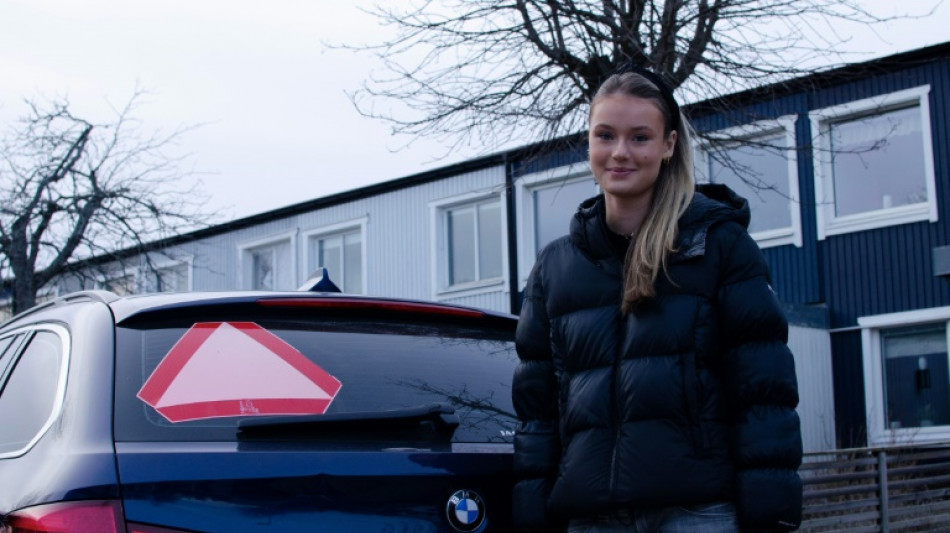
Sweden's teens drive Porsches and BMWs, no licence needed / Photo: Alma COHEN - AFP

 Texas Sports Betting Status: No Legal Options Amid Legislative Push for 2027 Referendum

 Geri Halliwell-Horner Embraces Queen Camilla at Commonwealth Writing Competition

 Meta Quest 3 and 3S Gain Access to Over 150 3D Movies

 Sarah Bajada Shares Message on Pregnancy Loss

 ALIX LASERS shareholders remove Michael Sobitsch as managing director in view of the circumstances

 Euroseas Q3 Net Profit Falls to $91.4 Million Amid Fleet Reduction

 Daily Horoscope November 20, 2026: Astrological Predictions for All Signs

 Tosca's 2026 Sustainability Report Makes the Case for Packaging as Critical Supply Chain Infrastructure
Too young for a driver's licence at 15, Evelina Christiansen is already cruising in a sleek BMW in Sweden, where teens can drive any car modified to roll no faster than a golf cart.
An almost century-old regulation originally applied to agricultural vehicles allows kids 15 and older to drive without a proper driver's licence, as long as the vehicle has been altered to have a maximum speed of 30 kilometres per hour (18.6 miles per hour).
Called an "A-traktor" -- with Swedes often using "EPA" as the older designation -- these cars and trucks have become so popular in recent years that authorities are now concerned about a rise in road accidents.
"I got it a year ago, in April, for my birthday," Evelina tells AFP proudly in front of her dark blue 5-series BMW in the driveway of her family's home in a southern Stockholm suburb.
The gift was a special reward for her achievements in school.
While teenagers elsewhere have to make do with a moped or scooter until they get a driver's licence, young Swedes can use almost any vehicle that has its top speed capped.
In Stockholm's wealthy suburbs, young kids are regularly seen driving Porsche Cayennes on their own.
"I usually use it when I go to school or meet up with friends," Evelina says.
A triangular warning sign in the back indicating a slow-moving vehicle and a hitch ball for trailers are both mandatory for an "A-traktor".
The back seat must also be removed, so they can carry only the driver and one passenger.
All that is required is a simple moped licence, available from the age of 15, or a tractor licence, from 16.
The system is surprisingly lenient in a country known for championing road safety -- the three-point seatbelt is a Swedish invention -- and for its strict drink driving rules.
The system was relaxed even further in mid-2020, when it became possible to cap cars' top speed electronically, making it much easier to modify a modern car.
- Criticism from EU -
Originally the domain of youths in rural areas, city kids have increasingly been getting wheels of their own, with the number of registered A-traktors doubling to 50,000 in just two and a half years, in a country of 10.3 million inhabitants.
The predecessors to today's A-traktors originated during the 1930s Depression, when there was a shortage of agricultural equipment.
To encourage the construction of cheap vehicles when tractors were still out of reach for farmers, the government allowed them to cobble together simple cars.
In the 1950s, as the economy prospered, real tractors became more common and the need for these homestyled vehicles began to subside.
But in the countryside, young people without a licence were happy to use them to get around, especially in areas without much public transport.
The state formalised the use of A-traktors with a 1963 regulation, which has been closely guarded for decades in rural Sweden.
Only in 2018 did authorities introduce mandatory road worthiness testing for the vehicles.
Sweden looks set however for a battle with the EU -- the European Commission criticised the system in early March, and proposed that a simplified permit become mandatory.
For many rural teenagers, the A-traktor symbolises their dream of independence.
It is also the focus of a growing subculture focused on customised cars and a new music genre hugely popular in Sweden called "EPA Dunk".
In the western Swedish town of Karlstad, 17-year-old Ronja Lofgren regularly turns heads with her 5.5-tonne Scania Vabis truck from 1964, which her father saved from the scrap heap.
The teen has adorned the refurbished truck with a gleaming red-and-blue paint job and lots of headlights. The motto "Queen of the Road" is emblazoned on the front and "Go with style" on the back.
"When I went into town at first, everyone would pull out their phones and film me," the teenager told AFP.
- Soaring accidents -
Following the surge in new registrations since 2020, insurers and police have expressed alarm at the more than fivefold increase in accidents involving A-traktors in five years.
The number of injuries has exceeded 200 per year and there were four deaths in 2022 alone.
For others, the surge has become a business opportunity.
Oskar Flyman, 21, and his younger brother started a business in 2021 converting cars into A-traktors.
"You can find A-traktors from 30,000 kronor ($2,900) to 200,000 kronor," Flyman said, adding that if you already have a car, a typical conversion costs around 25,000 kronor.
In their garage in a suburb north of Stockholm, filled with Audis and BMWs, they do about five to six conversions a month.
Sweden's transport authority has recently proposed that as with regular cars, the wearing of seatbelts and the use of winter tires become compulsory.
P.Queiroz--PC