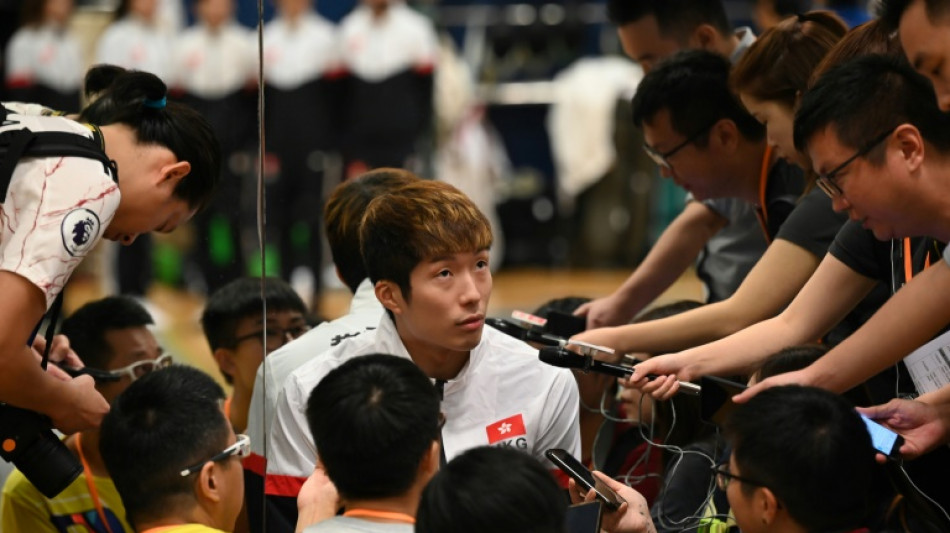
How Hong Kong became a fencing powerhouse and cheered up a city / Photo: Peter PARKS - AFP

 Malaysia Sues Google for $146m Over Harmful Content

 Black Wind Turbine Blades Reduce Bird Deaths by 74% in Spain Study

 Brazil’s Landless Movement Partners with China to Build Affordable Tractors for Family Farms

 Raheem Sterling Receives Suspended Sentence After Lamborghini Crash

 Luxembourg Pay Rise Delayed as Regional and World Headlines Develop

 Audience to Choose the Set List at Luxembourg's First FAMIL Jukebox Night

 Twickenham Grounds Team Prepares Pitch for Six Matches in Three Days

 Black Friday Discounts Cut Prices on Two Top-Rated Wiper Blades

 Arizona Gun Regulation Battle Intensifies Under New Democratic Legislative Majority

Hong Kong is one of the smaller Asian Games teams by population, but when it comes to fencing the city is a regional heavyweight with ambitious medal hopes.
Edgar Cheung won gold at the Covid-delayed Tokyo Games two years ago -- Hong Kong's first Olympic fencing title and first Olympic gold in any sport in a quarter of a century.
It turned Cheung into a celebrity overnight and prompted parents across the Chinese territory of 7.5 million people to rush and sign their children up for fencing classes.
Cheung's historic win in the foil competition was a much-needed dose of good news for a city mired in social unrest and pandemic gloom at the time.
With more funding and public attention as a result, Cheung and his team-mates now hope to stamp their mark on the Asian Games in Hangzhou when they open on Saturday.
Despite a strong record at recent editions, including eight medals in the sport in 2018, Hong Kong is yet to win fencing gold at the Asian Games.
"No matter for individual or team events, I hope we can (win gold at last)," the softly spoken Cheung, 26, said.
The city will have 24 fencers, 12 women and 12 men, at the Games.
Another gold-medal contender is 29-year-old Vivian Kong, who is ranked number two in the world in women's epee.
There is also Ryan Choi, who along with Cheung was part of the Hong Kong team that won bronze in the men's team foil at the world championships in July.
Cheung said the Hong Kong team have "improved greatly" since the 2018 Games in Jakarta.
The left-hander, who has recovered from a recent wrist injury, told AFP he wanted to "prove to our competitors they need to beware of us".
- Pathway to success -
Fencing in the city stretches back decades, to when Hong Kong was a British colony, with its amateur fencing association founded in 1949.
The city had occasional success in the early 2000s, but it was the 2010 Asian Games, where Hong Kong fencers won seven medals, that first established them as a regional powerhouse.
Local organisers made efforts to popularise the sport, bringing classes to schools and community hubs in the past two decades -– that is where Cheung had his first taste of fencing.
Fencers also benefited from a reform to Hong Kong's pipeline for discovering and training talent which allowed Cheung to devote himself to the sport full-time when he was 17 with his parents' blessing.
Cheung's final bout at the Tokyo Olympics drew hundreds of fans who crowded into a Hong Kong mall to watch the live broadcast, popping champagne corks after he emerged victorious.
Days later, then-city leader Carrie Lam announced more funding for elite Hong Kong athletes, including an expansion to the fencing hall at the institute where Cheung trains.
Fencing schools reported a spike in applications, although observers say interest has since tapered off somewhat.
- Warning for star man -
Gregory Koenig, who previously coached in his native France and also Taiwan, began working with Hong Kong's fencers five years ago and has developed a close relationship with Cheung.
He had a warning for Hong Kong's star man, who has slipped to seventh in the men's foil world rankings.
"When you're Olympic champion it's very hard because everybody has an eye on you and everybody's fighting hard against you," Koenig said.
He said he told Cheung: "You have to understand that many people fight all their life to reach the goal you've already reached."
"Okay, do you think you reached the maximum level and you want to stop here? Or are you still motivated for more?" Koenig says he told Cheung.
"He told me, 'No, I really want to put my name in the history of fencing.'"
E.Paulino--PC