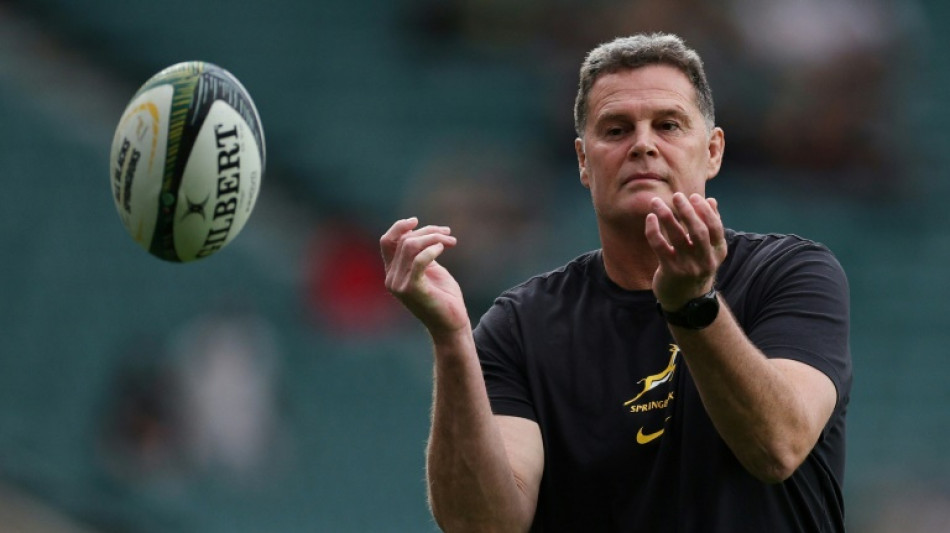
Erasmus the Springboks puppet master who divides opinion / Photo: Adrian DENNIS - AFP

 Malaysia Sues Google for $146m Over Harmful Content

 Black Wind Turbine Blades Reduce Bird Deaths by 74% in Spain Study

 Brazil’s Landless Movement Partners with China to Build Affordable Tractors for Family Farms

 Raheem Sterling Receives Suspended Sentence After Lamborghini Crash

 Luxembourg Pay Rise Delayed as Regional and World Headlines Develop

 Audience to Choose the Set List at Luxembourg's First FAMIL Jukebox Night

 Twickenham Grounds Team Prepares Pitch for Six Matches in Three Days

 Black Friday Discounts Cut Prices on Two Top-Rated Wiper Blades

 Arizona Gun Regulation Battle Intensifies Under New Democratic Legislative Majority
South African director of rugby Rassie Erasmus describes himself in his biography as "a quiet, uncomplicated person" and he is far from the extrovert many perceive him to be.
The 50-year-old is certainly someone who divides opinion, his supporters as forthright in their defence of him as those in the opposing camp are in venting their spleen.
The critics will be especially watchful this week.
They will assess with a fine tooth comb how he talks about referee Ben O'Keeffe in both the lead-up and after Saturday's Rugby World Cup pool game between defending champions South Africa and Ireland, the world's number one ranked team.
His rants against referees, allied with sarcastic remarks in tweets about them, has landed him in trouble. World Rugby banned him for 12 months after he savaged referee Nic Berry in the first Test with the British and Irish Lions in 2021.
However, Erasmus' defenders would point out his brilliance in turning round a shambolic Springboks side when he and faithful assistant Jacques Nienaber took over in early 2018.
Within two years the man Erasmus picked as the Springboks first black captain, Siya Kolisi, was lifting the World Cup trophy.
Erasmus and Nienaber -- who moved up to become head coach after the 2019 World Cup -- appear polar opposites, the latter like the straight man in a comedy double act, the former the charismatic wise-cracking scene stealer.
Erasmus insists in his biography "Rassie: Stories of Life and Rugby", co-authored with journalist David O'Sullivan, the real him is far removed from the one that attracts the ire of his many detractors.
"I may come across as a loudmouth, opinionated, arrogant, unrepentant … people think I'm extroverted, but I'm not," he says.
"I find social occasions difficult … I'm a quiet, uncomplicated person."
Many of those who have been on the wrong end of his tweets would prefer he had remained quiet -- clearly unrepentant, he received a further two-match ban only weeks after returning to the coaches box in November 2022.
- 'Trust each other' -
More sinister was the impact that the sarcastic remarks over Wayne Barnes's decisions in the 30-26 loss to France in Paris last year had on the English official's family after they sparked a host of abusive messages to his family.
"I've seen some things in the last few years, but receiving direct messages from rugby 'fans' threatening to kill your kids & burn your house down with your family in it over a few on-field decisions is a new low for me, my family & a plague for our entire game," tweeted Barnes's wife Polly.
Erasmus's loose use of language and disregard for the consequences jars a little with his sensitivity surrounding his upbringing with an alcoholic father.
"He (his father) slapped himself on his legs over and over again … it upset me and I wanted to protect him, so I would lie next to him and hold his hand … Some nights you felt he would never stop," Erasmus recounts in his biography of caring for him when he was drunk.
Erasmus's father worked for the Bantu Administration during apartheid where his job was to give out the 'dompas', the identity document that black South Africans were obliged to carry at all times.
The iniquities of apartheid had an effect not only on the Erasmus household but also on Rassie in a rugby context.
His revolutionary shake-up of the system in South African rugby opened the way for under-privileged children, under 15, to play the game.
"I wanted to help people avoid embarrassment for what we've done –- not just apartheid but how we tried to fix things which ended up embarrassing black and white people," he told the Guardian this month.
The introduction of the Elite Player Development (EPD) in 2013 bore fruit with a couple of the players eventually forming part of the 2019 World Cup-winning team.
"My greatest moment was not holding the World Cup," Erasmus told the Guardian.
"It was watching those players create and score tries in the final and trust each other.
"They felt it was a privilege to represent the country and they came through immense pressure with a smile. The EPD was my biggest achievement."
X.Brito--PC