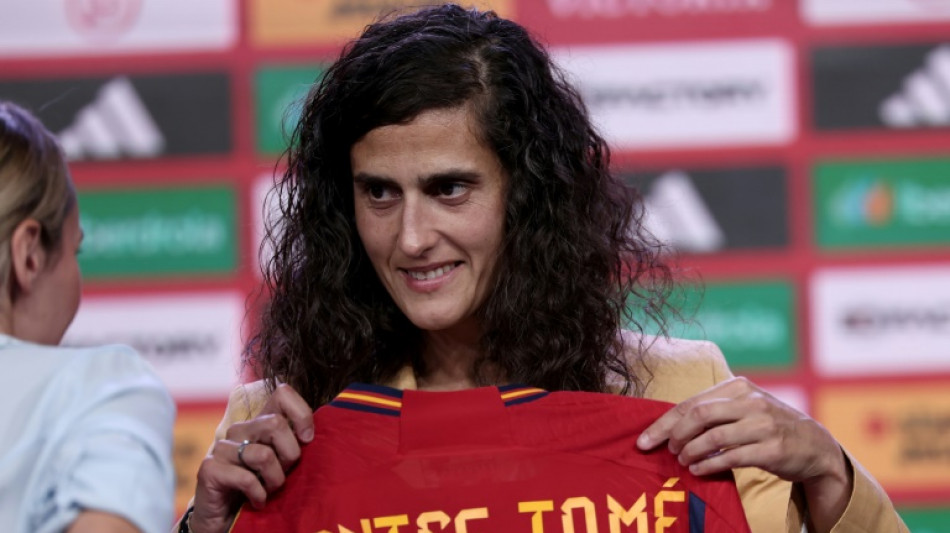
Several striking Spain players arrive for national team camp / Photo: Thomas COEX - AFP

 Malaysia Sues Google for $146m Over Harmful Content

 Black Wind Turbine Blades Reduce Bird Deaths by 74% in Spain Study

 Brazil’s Landless Movement Partners with China to Build Affordable Tractors for Family Farms

 Raheem Sterling Receives Suspended Sentence After Lamborghini Crash

 Luxembourg Pay Rise Delayed as Regional and World Headlines Develop

 Audience to Choose the Set List at Luxembourg's First FAMIL Jukebox Night

 Twickenham Grounds Team Prepares Pitch for Six Matches in Three Days

 Black Friday Discounts Cut Prices on Two Top-Rated Wiper Blades

 Arizona Gun Regulation Battle Intensifies Under New Democratic Legislative Majority
Six Spain players arrived at a Madrid hotel to join their women's national team camp on Tuesday, five of whom are currently striking over changes they want made in the Spanish football federation (RFEF).
Spain's women's World Cup final-winning goalscorer Olga Carmona and four others presented themselves, along with Athenea del Castillo, who is not on strike, while other players are expected to join up later for the camp in Oliva according to Spanish media reports.
Asked by a reporter if she was happy to be included in the squad, goalkeeper Misa Rodriguez replied "no" on her arrival to the hotel.
The striking players issued a statement Monday in which they reiterated their wish not to be called up, but acknowledged legal consequences which may force them to attend.
The Spanish government said early Tuesday players who do not attend would have to be punished under the country's sports law.
New Spain coach Montse Tome named a surprise 23-woman squad on Monday for upcoming Nations League qualifiers including 20 players who said they were striking until further changes were made in the RFEF after the kiss scandal which rocked Spanish football.
Disgraced former federation president Luis Rubiales forcibly kissed midfielder Jenni Hermoso on the lips after Spain won the World Cup in Sydney on August 20, provoking worldwide outrage.
Rubiales eventually resigned three weeks after the incident and controversial coach Jorge Vilda was sacked, but many players want more wide-ranging improvements and structural changes.
As many as 39 players are on strike against the RFEF but they were told by the government early Tuesday that those who did not attend the team's camps when called up would have to be punished.
Hermoso was not named in the squad by Tome in order to "protect" her, the new coach, Vilda's former assistant, said Monday.
"Protect me from what? And from whom?" Hermoso posted on X, formerly Twitter, early Tuesday.
She accused the Spanish federation of seeking to "intimidate and threaten" the World Cup champion players by calling them up against their will for the upcoming matches.
Victor Francos, the president of Spain's High Council for Sports (CSD), said early Tuesday he would have to apply the country's sports law against any player who snubbed the call.
"If they don't turn up, the government would have to apply the law, which is a pity for me, but the law is the law," Francos told radio station Cadena Ser.
Spain's sports law from 2022 states that athletes must attend the call-ups of the national teams when summoned, and not doing so would be a "very serious" infraction.
The potential fines range between 3,000 and 30,000 euros ($3,200 to $32,100), while they could also lose their licenses to play altogether, for up to five years.
The decision on a potential punishment would be made by Spain's top sports court at the request of the CSD.
Spain play Sweden on September 22 and Switzerland on September 26 in the Nations League.
The eventual finalists of the Nations League will qualify for the 2024 Olympic Games.
- 'We support them' -
Spanish players were offered support by their Swedish counterparts.
"They need to feel the support around them, that other countries support them in the decisions they make," said Sweden midfielder Filippa Angeldahl.
"If they feel they have to boycott to make something happen, it's clear that we support them."
Goalkeeper Hedvig Lindahl wrote on X: "I expect UEFA and FIFA to protect players of the game they oversee rather than adding pressure.
"I don't want to be part of encouraging people to chase a football dream if the game will not protect them while doing so."
"The RFEF does not have the right to deprive Spain of their women's national team, and more so after having won a World Cup," said the Spanish minister for culture and sport, Miquel Iceta.
"We call on the RFEF to correct all the deficiencies of this irregular call-up and to change the federation's structures so that the federation is a place of security, competitiveness and professionalism to which the players and the Spanish population as a whole have a right."
Tome, her staff, and the players who have arrived in Madrid travel to Oliva, in the east of Spain near Valencia, early Tuesday afternoon.
They will fly to Sweden on Thursday morning before playing in Gothenburg on Friday.
O.Gaspar--PC